
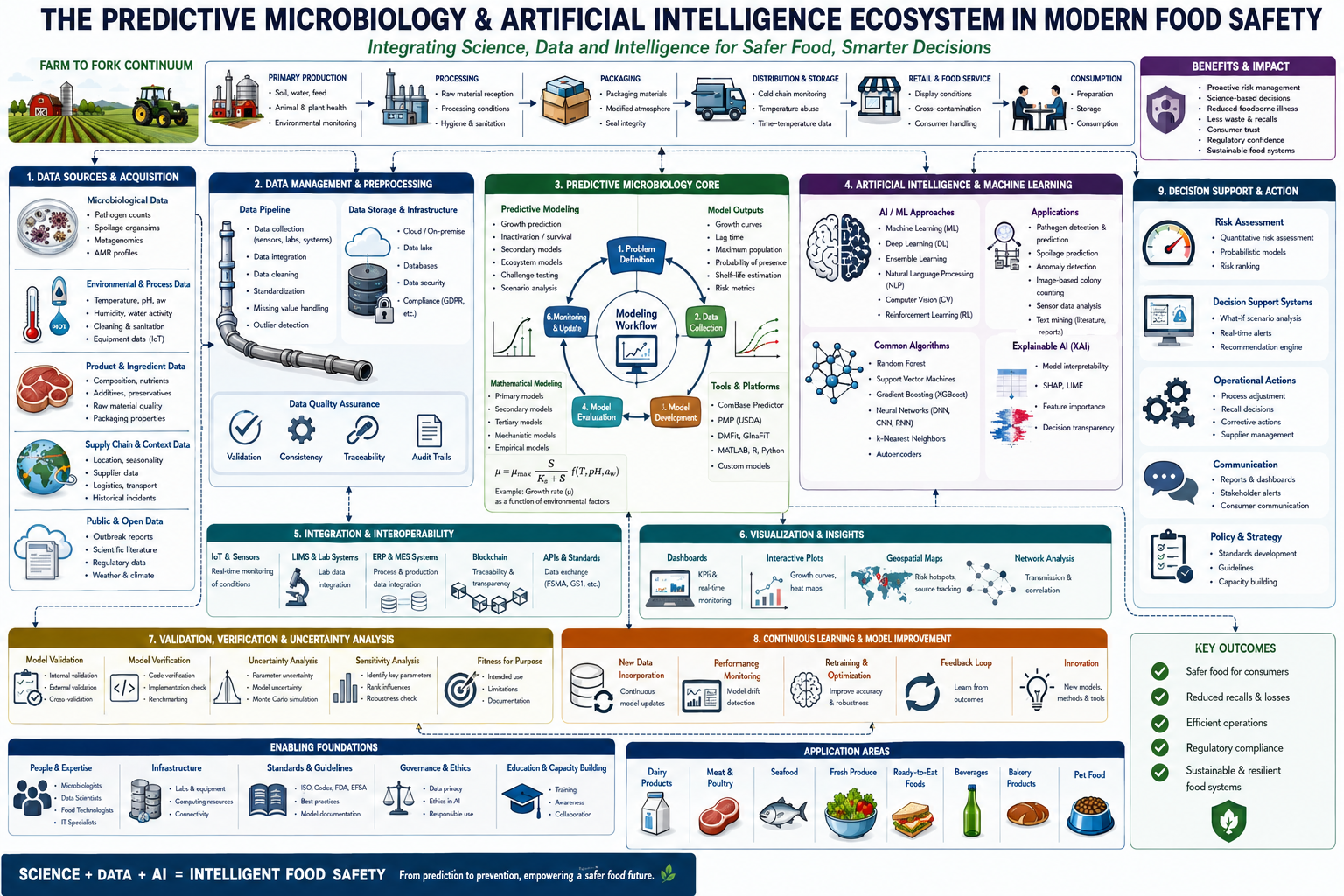
Summary
Food safety has traditionally relied on laboratory testing, routine inspections, and corrective actions after hazards have already occurred. While these approaches remain essential, the increasing complexity of global food systems demands more proactive strategies that anticipate risks before contaminated products reach consumers.
Predictive microbiology combines microbiology, mathematics, statistics, and computer science to forecast how microorganisms behave under different environmental conditions. When integrated with artificial intelligence (AI), predictive models become even more powerful by analyzing vast amounts of production data, environmental monitoring results, genomic information, and supply chain variables to identify emerging food safety risks.
Today, predictive microbiology supports shelf-life determination, hazard analysis, process validation, cold chain management, and outbreak prevention. AI further enhances these capabilities by identifying patterns that humans may overlook, enabling food manufacturers to make faster, data-driven decisions.
This article explores the principles of predictive microbiology, the role of AI in modern food safety, industrial applications, emerging technologies, challenges, and future opportunities.
Introduction
Foodborne illnesses remain a major global public health concern, affecting hundreds of millions of people every year. Microorganisms such as Salmonella, Listeria monocytogenes, pathogenic Escherichia coli, Campylobacter, and Bacillus cereus continue to challenge food producers despite significant advances in sanitation and quality management.
Traditional microbiological testing provides valuable information but often reflects conditions after contamination has already occurred. Predictive microbiology shifts this approach by estimating microbial behavior before problems develop.
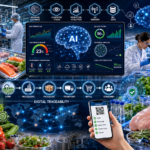
As digital food manufacturing expands, AI-powered predictive systems are enabling continuous risk assessment using real-time production and environmental data.
What Is Predictive Microbiology?
Predictive microbiology is the science of developing mathematical models that describe how microorganisms respond to environmental conditions.
Rather than simply identifying whether microorganisms are present, predictive models estimate how quickly they will:
- Grow
- Survive
- Become inactivated
- Produce toxins
- Respond to preservation treatments
These predictions support evidence-based food safety decisions throughout production and distribution.
Factors Influencing Microbial Growth
Microbial behavior depends on numerous interacting factors, including:
- Temperature
- pH
- Water activity (aw)
- Salt concentration
- Oxygen availability
- Nutrient availability
- Food composition
- Preservatives
- Packaging atmosphere
- Storage duration
Predictive models integrate these variables to estimate microbial responses under realistic conditions.
Types of Predictive Models
Primary Models
Primary models describe changes in microbial populations over time, including lag phase, exponential growth, stationary phase, and decline.
Secondary Models
Secondary models explain how environmental factors such as temperature or pH influence the parameters estimated by primary models.
Tertiary Models
These user-friendly software tools combine multiple mathematical models, allowing food scientists to simulate real-world processing and storage conditions.
The Role of Artificial Intelligence
Artificial intelligence extends predictive microbiology by learning from large, complex datasets.
AI systems can analyze:
- Environmental monitoring records
- Production temperatures
- Cleaning and sanitation data
- Whole genome sequencing results
- Supply chain information
- Consumer complaint data
- Historical outbreak investigations
Machine learning algorithms continuously improve predictions as new information becomes available.
Applications in the Food Industry
Shelf-Life Prediction
Predictive models estimate how microorganisms will behave throughout storage, helping manufacturers establish scientifically supported expiry dates.
Cold Chain Monitoring
AI can identify temperature deviations during transportation and estimate their impact on microbial growth and product safety.
Hazard Analysis and HACCP
Predictive microbiology strengthens Hazard Analysis and Critical Control Point (HACCP) systems by identifying situations where microbial hazards are most likely to occur.
Product Development
Manufacturers can evaluate formulation changes without performing every possible laboratory experiment, reducing development time and costs.
Environmental Monitoring
AI analyzes environmental swab data to detect recurring contamination patterns and prioritize sanitation interventions.
Outbreak Investigation
Combining predictive microbiology with whole genome sequencing and epidemiological data helps investigators identify contamination sources more rapidly.
Machine Learning Techniques
Common AI methods used in food safety include:
- Artificial Neural Networks (ANN)
- Random Forest algorithms
- Support Vector Machines (SVM)
- Decision Trees
- Gradient Boosting
- Deep Learning
- Bayesian Networks
These techniques are particularly valuable for analyzing large datasets with complex interactions.
Emerging Technologies
Several innovations are expanding predictive microbiology.
Digital Twins
Virtual models of food production systems simulate microbial behavior under different processing conditions before physical changes are implemented.
Internet of Things (IoT)
Wireless sensors continuously monitor temperature, humidity, and other environmental conditions, providing real-time data for predictive models.
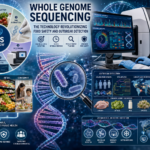
Whole Genome Sequencing
Genomic information improves understanding of pathogen persistence, virulence, and resistance, enhancing predictive accuracy.
Cloud Computing
Cloud-based platforms enable rapid analysis of large datasets and facilitate collaboration across multiple production sites.
Benefits of Predictive Microbiology and AI
Food manufacturers gain several advantages:
- Earlier identification of food safety risks
- Improved shelf-life estimation
- Reduced food waste
- Better resource allocation
- Faster decision-making
- Enhanced regulatory compliance
- More efficient process validation
- Improved outbreak prevention
These benefits contribute to safer foods and more sustainable production systems.
Challenges
Despite significant progress, several challenges remain.
Data Quality
Reliable predictions require accurate, standardized, and representative datasets.
Model Validation
Predictive models must be validated for specific foods, processing conditions, and microorganisms.
Interpretation
AI-generated predictions should complement—not replace—expert scientific judgment.
Cybersecurity
As food systems become increasingly digital, protecting sensitive production and safety data becomes more important.
Current Research
Researchers are investigating:
- AI-assisted pathogen surveillance
- Real-time predictive shelf-life models
- Climate change impacts on microbial behavior
- Integration of metagenomics into predictive systems
- Explainable AI for regulatory decision-making
- Autonomous food safety monitoring
These developments aim to improve both prediction accuracy and practical implementation.
Future Outlook
The future of predictive microbiology lies in intelligent, connected food systems where sensors, AI, robotics, and genomic technologies work together to provide continuous food safety assurance.
Future food factories may automatically adjust processing conditions in response to predicted microbial risks, reducing contamination before it occurs. Digital twins, autonomous monitoring, and advanced analytics will support more resilient and sustainable food supply chains.
Conclusion
Predictive microbiology has transformed food safety from a reactive discipline into a proactive science. By combining mathematical modeling with artificial intelligence, the food industry can anticipate microbial risks, optimize processing conditions, extend shelf life, and strengthen outbreak prevention.
As data quality, computational power, and analytical technologies continue to improve, predictive microbiology and AI will become indispensable tools for protecting public health and supporting the production of safe, high-quality foods in an increasingly complex global food system.
Key Takeaways
- Predictive microbiology estimates microbial behavior under different environmental conditions.
- Artificial intelligence enhances prediction accuracy by analyzing complex datasets.
- Applications include shelf-life prediction, HACCP, cold chain management, environmental monitoring, and outbreak investigations.
- Emerging technologies such as digital twins, IoT, and whole genome sequencing are expanding predictive capabilities.
- AI-supported predictive microbiology is helping build safer, smarter, and more sustainable food systems.
References
- McMeekin, T. A., Olley, J., Ratkowsky, D. A., & Ross, T. (2002). Predictive microbiology: Towards the interface and beyond. International Journal of Food Microbiology, 73(2–3), 395–407. https://doi.org/10.1016/S0168-1605(01)00692-8
- Ross, T., & McMeekin, T. A. (2003). Modeling microbial growth within food safety risk assessments. Risk Analysis, 23(1), 179–197.
- Buchanan, R. L., Whiting, R. C., & Damert, W. C. (1997). When is simple good enough? A comparison of the Gompertz, Baranyi, and three-phase linear models. Food Microbiology, 14(4), 313–326.
- Food and Agriculture Organization (FAO). Food Safety and Quality. https://www.fao.org/food-safety
- World Health Organization (WHO). Food Safety. https://www.who.int/health-topics/food-safety
- Membré, J. M., & Valdramidis, V. P. (2016). Modelling microbial responses in foods. Current Opinion in Food Science, 8, 80–85.