
Summary
Foodborne diseases affect an estimated 600 million people every year, making them one of the world’s leading public health challenges. Traditional laboratory methods often require days or even weeks to determine whether illnesses reported in different locations originate from the same contaminated food source.
Whole Genome Sequencing (WGS) has fundamentally changed this landscape. By decoding the complete DNA sequence of bacteria, viruses, and other microorganisms, WGS allows scientists to determine whether pathogens isolated from patients, foods, and processing environments are genetically related with unprecedented precision.
Today, WGS supports outbreak investigations, routine food surveillance, antimicrobial resistance monitoring, source attribution, and international collaboration among public health agencies. Countries increasingly integrate genomic surveillance into food safety systems to detect outbreaks earlier, identify contamination sources more accurately, and implement more effective control measures.
This article explains how Whole Genome Sequencing works, its applications in food safety, current challenges, recent innovations, and its future role in protecting global food systems.
Introduction
Food safety laboratories have traditionally relied on culture-based microbiology, biochemical testing, and molecular methods such as PCR to identify foodborne pathogens. While these techniques remain valuable, they often provide limited information about the genetic relationships among isolates.
Whole Genome Sequencing offers a much higher level of resolution by analysing the complete genetic blueprint of microorganisms. Instead of identifying only the species, WGS can distinguish between extremely closely related strains, allowing investigators to determine whether pathogens share a common origin.
This capability has transformed foodborne outbreak investigations involving pathogens such as:
- Salmonella
- Listeria monocytogenes
- Escherichia coli O157:H7
- Campylobacter
- Vibrio
- Cronobacter sakazakii
What Is Whole Genome Sequencing?
Whole Genome Sequencing determines the complete DNA sequence of an organism.
Unlike earlier molecular typing methods that examine only selected genes, WGS analyses the organism’s entire genome, providing comprehensive information about:
- Species identification
- Strain relationships
- Virulence genes
- Antimicrobial resistance genes
- Evolutionary relationships
Because every bacterial strain accumulates small genetic differences over time, comparing complete genomes enables investigators to determine whether isolates are closely related.
How WGS Works
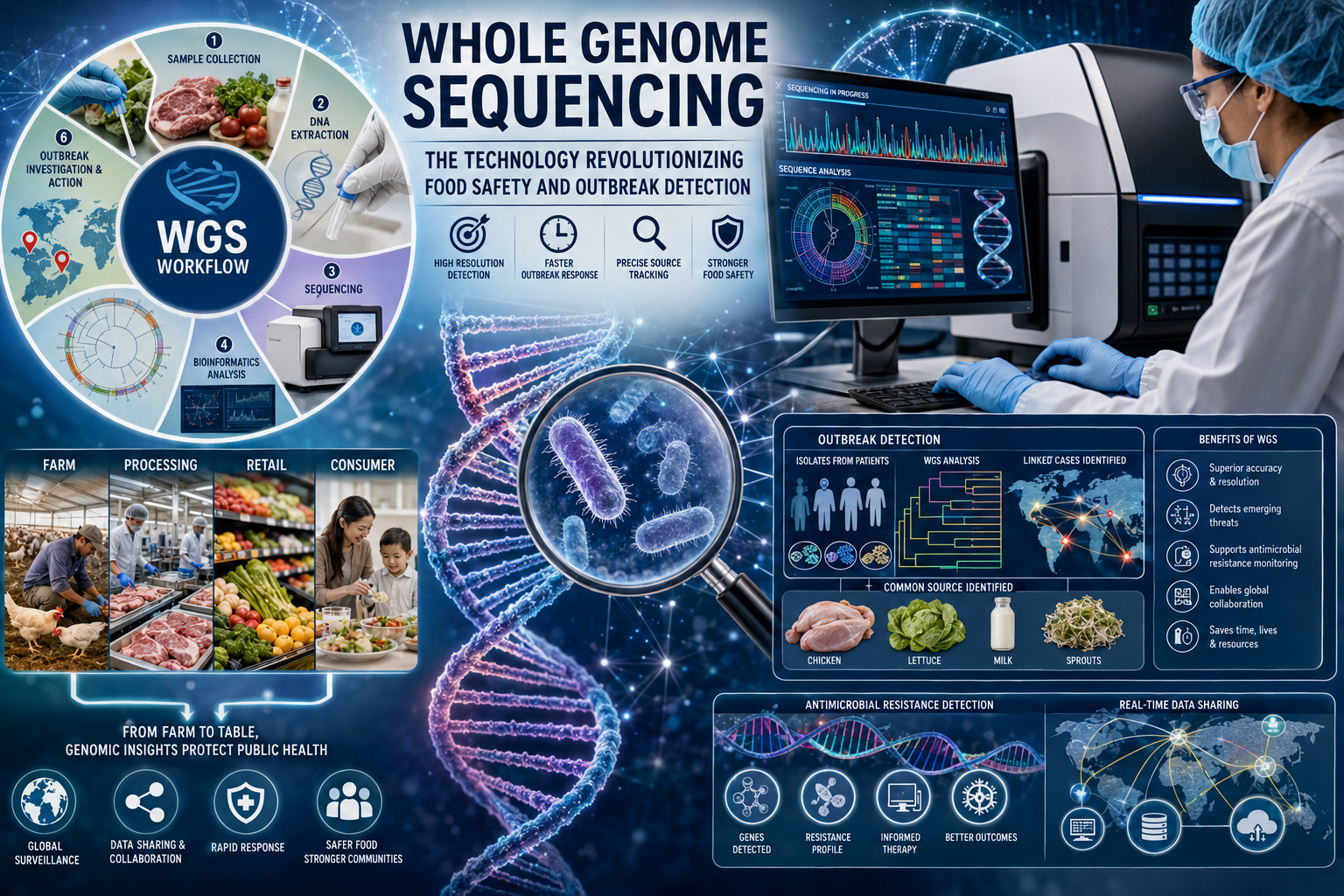
The workflow generally involves:
Sample Collection
Samples may originate from:
- Clinical patients
- Food products
- Food processing environments
- Water
- Animal production systems
DNA Extraction
High-quality microbial DNA is isolated from the sample.
DNA Sequencing
Modern sequencing instruments determine millions of DNA fragments simultaneously.
Bioinformatics Analysis
Powerful software reconstructs the genome and compares it with reference databases.
Interpretation
Scientists evaluate genetic similarity to determine whether isolates belong to the same outbreak.
Applications in Food Safety
Outbreak Investigation
WGS enables investigators to link cases occurring across different regions and identify contaminated food sources with remarkable precision.
Environmental Monitoring
Food manufacturers use environmental sampling programs to monitor processing facilities for persistent contamination.
Repeated isolation of genetically related strains may indicate harbourage sites requiring corrective action.
Antimicrobial Resistance Surveillance
Genome analysis identifies genes associated with resistance to antibiotics.
This information supports both food safety and public health surveillance.
Traceability
Genomic data can strengthen supply chain investigations by linking contaminated foods with production facilities or environmental sources.
Advantages Over Traditional Methods
Compared with conventional typing techniques, WGS offers:
- Higher discriminatory power
- Greater accuracy
- Better outbreak detection
- Improved traceability
- Simultaneous identification of virulence and resistance genes
- Standardized data sharing across laboratories
Challenges
Despite its benefits, WGS implementation requires:
- Specialized sequencing equipment
- Bioinformatics expertise
- High-performance computing infrastructure
- Standardized analytical pipelines
- Sustainable funding
Many lower-resource laboratories continue to build capacity through regional and international collaborations.
Future Directions
Emerging innovations include:
- Portable nanopore sequencing for field investigations
- Artificial intelligence-assisted genome interpretation
- Real-time genomic surveillance
- Integration with blockchain-enabled traceability
- Cloud-based international pathogen databases
- Predictive analytics for outbreak forecasting
These advances are expected to improve the speed and precision of food safety responses.
Conclusion
Whole Genome Sequencing has become one of the most important technological advances in modern food safety. By providing complete genetic information, WGS enables scientists to identify outbreaks faster, trace contamination more accurately, monitor antimicrobial resistance, and strengthen international disease surveillance.
As sequencing costs continue to decline and bioinformatics tools become more accessible, Whole Genome Sequencing is likely to become an integral component of food safety systems worldwide, supporting earlier interventions and safer food supply chains.
Key Takeaways
- WGS analyses the complete DNA of foodborne pathogens.
- It provides much higher resolution than traditional typing methods.
- Applications include outbreak investigations, environmental monitoring, antimicrobial resistance surveillance, and traceability.
- Continued advances in sequencing and bioinformatics will further strengthen food safety systems.
References
- World Health Organization (WHO). Food Safety. https://www.who.int/health-topics/food-safety
- Food and Agriculture Organization (FAO). Food Safety and Quality. https://www.fao.org/food-safety
- U.S. Food and Drug Administration. GenomeTrakr Network. https://www.fda.gov/food/whole-genome-sequencing-wgs-program/genometrakr-network
- Centers for Disease Control and Prevention. Whole Genome Sequencing. https://www.cdc.gov
- European Food Safety Authority (EFSA). Whole Genome Sequencing in Food Safety Risk Assessment. https://www.efsa.europa.eu
- Ashton, P.M. et al. (2016). Revolutionizing Public Health Reference Microbiology Using Whole Genome Sequencing. Genome Medicine. https://doi.org/10.1186/s13073-016-0324-5
- Allard, M.W. et al. (2016). Practical Value of Food Pathogen Traceability Through Whole Genome Sequencing. Genome Medicine. https://doi.org/10.1186/s13073-016-0327-2