
Summary
Food safety testing has advanced remarkably over the past century, progressing from culture-based microbiological methods to sophisticated molecular diagnostics, biosensors, mass spectrometry, and artificial intelligence (AI)-assisted analytical platforms. Yet many food safety challenges remain. Detecting contaminants at extremely low concentrations, identifying pathogens before they multiply to hazardous levels, and monitoring food quality continuously throughout the supply chain require technologies with unprecedented sensitivity and precision.
Quantum sensing is emerging as one of the most promising next-generation technologies capable of meeting these demands. By exploiting the principles of quantum mechanics, quantum sensors can measure physical, chemical, and biological signals with extraordinary accuracy—often exceeding the capabilities of conventional sensors.
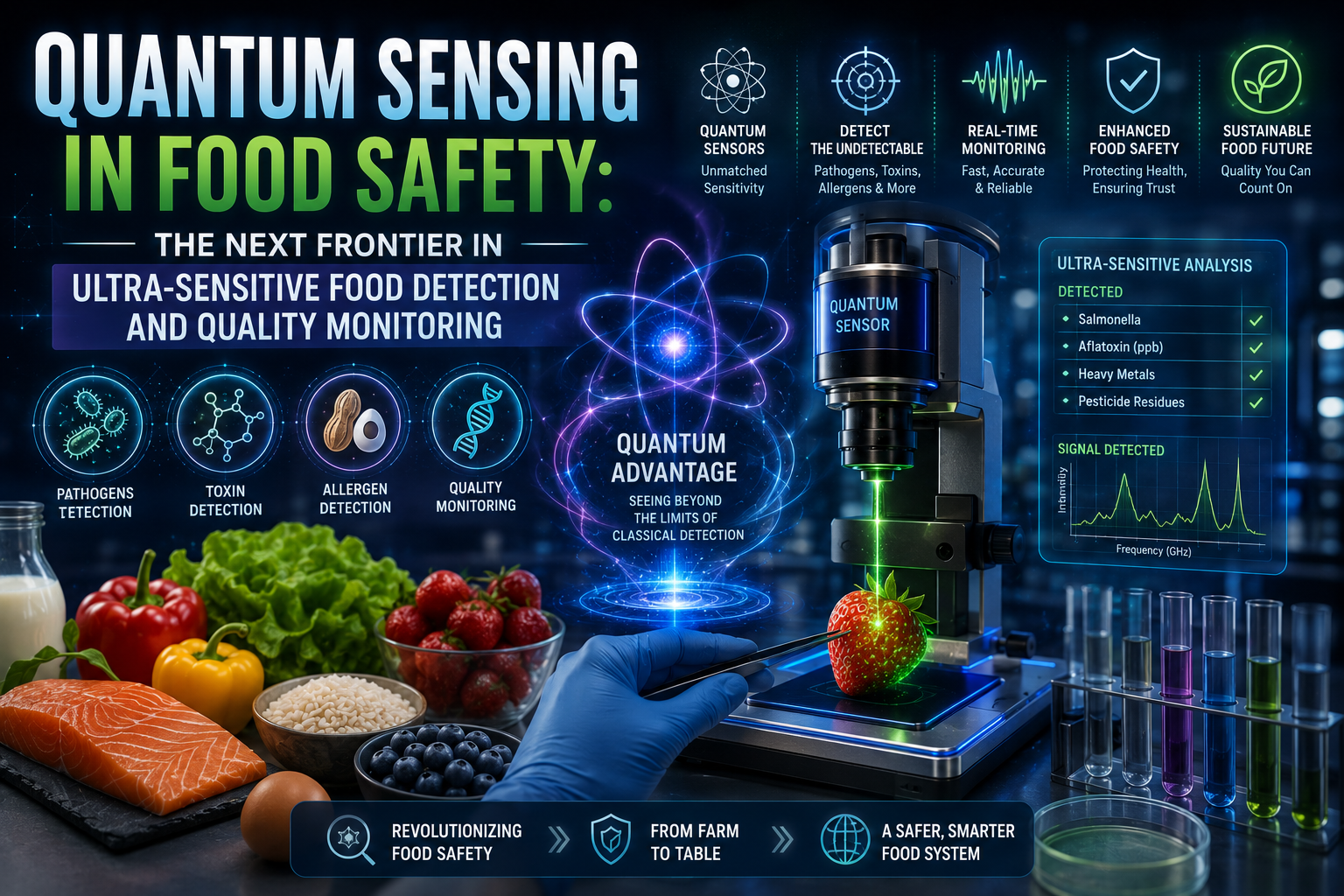
Although quantum sensing is still an emerging field within food science, researchers are exploring its applications in pathogen detection, pesticide residue analysis, heavy metal monitoring, food authentication, environmental surveillance, cold-chain monitoring, and smart packaging. Combined with artificial intelligence, nanotechnology, biosensors, microfluidics, and the Internet of Things (IoT), quantum sensing has the potential to transform food safety from periodic testing to continuous, real-time monitoring.
This article explores the scientific principles of quantum sensing, its applications across the food industry, current research, technical challenges, and its future role in building intelligent and resilient food systems.
Introduction
Modern food supply chains are longer, more complex, and more interconnected than ever before. Foods may travel thousands of kilometers before reaching consumers, increasing the need for rapid, sensitive, and reliable monitoring systems.
Conventional laboratory techniques such as polymerase chain reaction (PCR), enzyme-linked immunosorbent assays (ELISA), liquid chromatography–mass spectrometry (LC-MS), and whole genome sequencing remain indispensable. However, many of these methods require specialized laboratories, trained personnel, and hours—or even days—to produce results.
Quantum sensing offers a complementary approach. Instead of relying solely on conventional chemical reactions or optical measurements, quantum sensors exploit the behavior of atoms, photons, electrons, or quantum defects in materials to detect extremely small changes in magnetic fields, electric fields, temperature, pressure, or molecular interactions. These capabilities could enable earlier detection of food hazards and more responsive food safety systems.
What Is Quantum Sensing?
Quantum sensing is the use of quantum mechanical phenomena to make highly precise measurements of physical, chemical, or biological properties.
Unlike conventional sensors, quantum sensors utilize effects such as:
- Quantum superposition
- Quantum coherence
- Quantum entanglement
- Spin-state transitions
- Single-photon interactions
These quantum effects allow sensors to detect signals that would otherwise be too weak for traditional measurement systems.
Fundamental Principles
Several quantum phenomena underpin modern quantum sensors.
Quantum Superposition
Quantum particles can exist in multiple states simultaneously until measured. This property enables highly sensitive measurements of environmental changes.
Quantum Entanglement
Entangled particles remain correlated even when separated, allowing enhanced measurement precision in specialized sensing systems.
Spin-Based Detection
Certain materials, such as nitrogen-vacancy (NV) centers in diamond, exhibit electron spin properties that change in response to magnetic fields, temperature, or nearby molecules.
These characteristics make them attractive for biosensing applications.
Single-Photon Detection
Highly sensitive photonic systems can detect extremely small optical signals associated with molecular interactions.
Types of Quantum Sensors
Researchers are developing several categories of quantum sensors relevant to food science.
Diamond Quantum Sensors
Nitrogen-vacancy diamonds enable highly sensitive magnetic and temperature measurements at microscopic scales.
Potential applications include biosensing and microbial detection.
Atomic Sensors
These sensors exploit interactions between atoms and electromagnetic fields to achieve exceptional measurement precision.
Quantum Optical Sensors
Quantum optics enables detection of weak optical signals associated with food quality, contaminants, or molecular binding events.
Quantum Gravimeters
Although primarily used in geophysics, highly sensitive gravimetric technologies may eventually contribute to agricultural monitoring and precision farming.
Applications in Food Safety
Pathogen Detection
Rapid identification of pathogens remains a major priority.
Quantum biosensors are being investigated for detecting:
- Salmonella
- Listeria monocytogenes
- Pathogenic Escherichia coli
- Campylobacter
- Vibrio species
Future systems may reduce detection times while maintaining high sensitivity.
Mycotoxin Detection
Researchers are exploring quantum-enhanced biosensors capable of detecting extremely low concentrations of:
- Aflatoxins
- Ochratoxin A
- Fumonisins
- Zearalenone
These technologies may improve monitoring of cereals, nuts, spices, and animal feeds.
Heavy Metal Monitoring
Quantum sensors may support detection of:
- Lead
- Cadmium
- Mercury
- Arsenic
Rapid field-based analysis could strengthen environmental and food safety surveillance.
Pesticide Residues
Highly sensitive quantum sensing platforms may identify pesticide residues at trace concentrations without extensive laboratory preparation.
Food Authentication
Quantum spectroscopy combined with machine learning may improve identification of food adulteration and verification of geographical origin.
Applications include:
- Honey
- Olive oil
- Coffee
- Spices
- Milk
- Seafood
Applications Across the Food Chain
Precision Agriculture
Quantum sensors may enhance:
- Soil nutrient mapping
- Water monitoring
- Environmental surveillance
- Climate observation
- Precision irrigation
Food Manufacturing
Potential applications include:
- Real-time process monitoring
- Fermentation control
- Equipment diagnostics
- Environmental monitoring
- Packaging inspection
Cold Chain Management
Ultra-sensitive temperature monitoring could improve transportation and storage of highly perishable foods.
Smart Packaging
Future smart packaging may incorporate quantum-enabled sensing components capable of detecting spoilage biomarkers in real time.
Integration with Emerging Technologies
Quantum sensing is expected to complement several existing technologies.
Artificial Intelligence
AI interprets large sensor datasets, identifies anomalies, and predicts emerging food safety risks.
Internet of Things (IoT)
Quantum sensors integrated into IoT networks enable continuous monitoring across food supply chains.
Biosensors
Quantum technologies can significantly improve the sensitivity of biological sensing platforms.
Nanotechnology
Nanomaterials enhance signal amplification and improve sensor performance.
Digital Twins
Real-time quantum sensor data may feed digital twins used for predictive process optimization and food safety management.
Industrial Opportunities
Although commercial food applications remain limited, future opportunities include:
- Intelligent food processing facilities
- Automated quality control
- Continuous contamination monitoring
- Smart logistics
- Precision fermentation
- Environmental surveillance
- Digital food factories
As quantum hardware becomes more practical and affordable, adoption is expected to expand.
Challenges
Several scientific and technical challenges remain.
Cost
Quantum sensing technologies currently require specialized equipment that may be expensive for routine industrial use.
Scalability
Many laboratory demonstrations have not yet been translated into large-scale commercial systems.
Robustness
Food manufacturing environments require sensors capable of operating reliably under variable industrial conditions.
Standardization
Validated analytical protocols and regulatory standards are still developing.
Workforce Development
Implementing quantum technologies will require interdisciplinary expertise in food science, physics, engineering, data science, and analytical chemistry.
Current Research
Researchers worldwide are investigating:
- Quantum-enhanced biosensors
- Nitrogen-vacancy diamond sensing
- Quantum photonics
- Portable quantum detection platforms
- AI-assisted quantum signal interpretation
- Foodborne pathogen monitoring
- Ultra-sensitive contaminant detection
- Quantum spectroscopy
- Quantum imaging for food inspection
Many of these technologies remain in experimental or early translational stages but show considerable promise.
Future Outlook
Over the next two decades, quantum sensing may become an important component of intelligent food systems.
Potential developments include:
- Portable handheld quantum food safety scanners
- Continuous monitoring throughout supply chains
- Autonomous smart factories using quantum sensor networks
- AI-driven predictive contamination alerts
- Smart packaging with embedded quantum biosensors
- Integration with blockchain for trusted food traceability
- Personalized food quality monitoring in homes
While these applications will require continued technological development, they illustrate the transformative potential of quantum sensing.
Conclusion
Quantum sensing represents one of the most exciting emerging frontiers in food science. By harnessing the principles of quantum mechanics, these technologies promise levels of sensitivity and precision that could substantially improve food safety, quality assurance, environmental monitoring, and supply-chain management.
Although widespread commercial implementation is still in its early stages, ongoing advances in quantum physics, nanotechnology, biosensors, artificial intelligence, and materials science are steadily moving quantum sensing closer to practical food industry applications. As research progresses, quantum sensors may become valuable tools for detecting contaminants earlier, improving process control, and strengthening consumer confidence in global food systems.
Key Takeaways
- Quantum sensing uses quantum mechanical principles to achieve extremely sensitive measurements.
- Potential food applications include pathogen detection, contaminant monitoring, food authentication, and smart packaging.
- Quantum sensors may complement existing analytical methods rather than replace them.
- Artificial intelligence, IoT, nanotechnology, biosensors, and digital twins will likely accelerate future applications.
- Although still an emerging technology, quantum sensing has the potential to transform food safety and quality monitoring.
References
- Degen, C. L., Reinhard, F., & Cappellaro, P. (2017). Quantum sensing. Reviews of Modern Physics, 89(3), 035002. https://doi.org/10.1103/RevModPhys.89.035002
- Pirandola, S., et al. (2018). Advances in photonic quantum sensing. Nature Photonics, 12, 724–733.
- Awschalom, D. D., Hanson, R., Wrachtrup, J., & Zhou, B. B. (2018). Quantum technologies with optically interfaced solid-state spins. Nature Photonics, 12, 516–527.
- Food and Agriculture Organization (FAO). Food Safety and Quality. https://www.fao.org/food-safety
- World Health Organization (WHO). Food Safety. https://www.who.int/health-topics/food-safety
- European Food Safety Authority (EFSA). Scientific publications on emerging technologies for food safety assessment.
- National Institute of Standards and Technology (NIST). Quantum Information Science Program. https://www.nist.gov/quantum-information-science
- Giovannetti, V., Lloyd, S., & Maccone, L. (2011). Advances in quantum metrology. Nature Photonics, 5, 222–229.