
Summary
Modern food supply chains are increasingly complex. A single packaged food product may contain ingredients sourced from multiple countries, processed in different facilities, transported across continents, and sold through various retail channels before reaching consumers. While globalization has improved food availability and affordability, it has also made food traceability, authenticity, and recall management more challenging.
Traditional paper-based or fragmented digital record systems often struggle to provide rapid, accurate information during food safety incidents. Delays in tracing contaminated products can increase public health risks, amplify economic losses, and undermine consumer confidence.
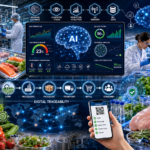
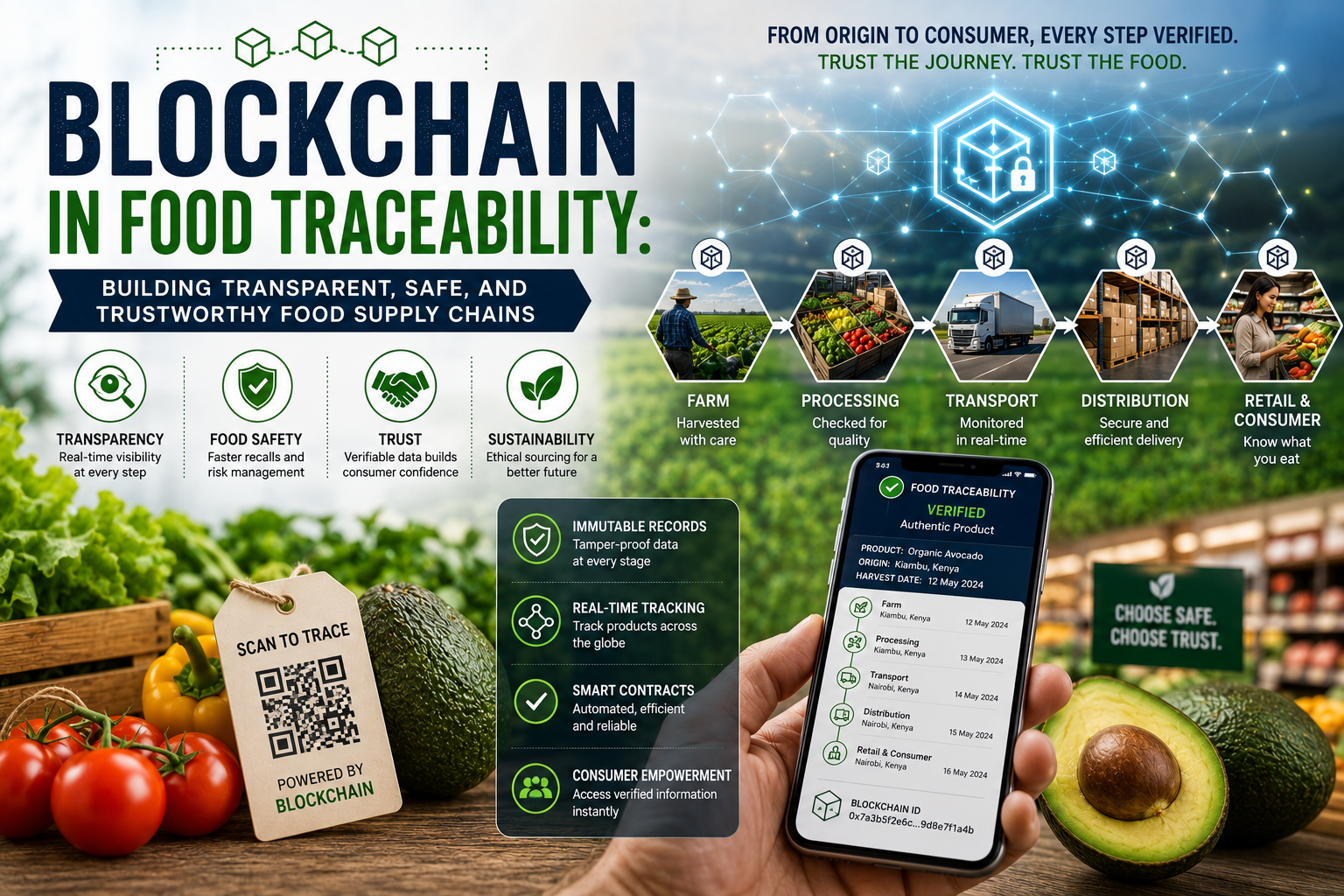
Blockchain technology offers a new approach to food traceability by creating secure, decentralized, and tamper-resistant digital records that document every stage of a food product’s journey—from farm to fork. When combined with the Internet of Things (IoT), artificial intelligence (AI), smart sensors, QR codes, and cloud computing, blockchain enables near real-time visibility into food supply chains, helping manufacturers, regulators, retailers, and consumers verify product origin, authenticity, and handling conditions.
This article explores the principles of blockchain technology, its applications in food systems, benefits, limitations, regulatory considerations, current research, and the future of digital food traceability.
Introduction
Food traceability has become a cornerstone of modern food safety management. Governments, food manufacturers, retailers, and consumers increasingly expect transparent supply chains capable of identifying where food originated, how it was produced, and where it has traveled.
Food safety incidents involving pathogens, allergens, chemical contaminants, and food fraud have highlighted the importance of rapid traceability. Traditional systems often depend on disconnected databases, handwritten records, or incompatible software platforms, making investigations slow and resource-intensive.
Blockchain introduces a shared digital ledger in which authorized participants record transactions that are chronologically linked and cryptographically protected. Because entries cannot easily be altered without consensus, blockchain enhances confidence in the integrity of supply chain records.
What Is Blockchain?
Blockchain is a type of distributed ledger technology (DLT) that stores information in a series of digitally linked blocks.
Each block contains:
- Transaction data
- A timestamp
- A cryptographic hash of the previous block
- A unique digital identifier
Together, these blocks create a chronological chain of records that is highly resistant to unauthorized modification.
Unlike conventional centralized databases controlled by a single organization, blockchain networks distribute identical copies of the ledger across multiple authorized participants.
Key Characteristics of Blockchain
Decentralization
Data are shared across multiple participants rather than stored in a single central database.
Immutability
Once validated and added to the blockchain, records are extremely difficult to alter without detection.
Transparency
Authorized participants can access relevant supply chain information, improving accountability and collaboration.
Traceability
Every transaction is permanently linked, enabling products to be traced throughout the supply chain.
Security
Cryptographic techniques help protect records against unauthorized modification.
Types of Blockchain Networks
Public Blockchains
Public blockchains allow broad participation and are typically used for open decentralized applications.
Private Blockchains
Private blockchains restrict participation to approved organizations and are commonly used in commercial food supply chains.
Consortium Blockchains
Several organizations jointly manage the blockchain network, balancing collaboration with controlled access.
Most food industry implementations currently favor private or consortium models because they better protect commercially sensitive information.
How Blockchain Works in Food Supply Chains
Consider a package of roasted coffee.
Information may be recorded at each stage:
- Coffee farm
- Harvest date
- Processing facility
- Export documentation
- Shipping conditions
- Roasting facility
- Packaging
- Distribution center
- Retail store
Each participant adds verified information to the blockchain, creating a continuous digital history.
Consumers may then scan a QR code to access selected traceability information.
Applications Across the Food Industry
Food Traceability
Blockchain enables rapid tracking of foods including:
- Fresh produce
- Meat
- Seafood
- Dairy products
- Coffee
- Cocoa
- Spices
- Honey
- Processed foods
Improved traceability supports both routine quality assurance and emergency investigations.
Food Safety
Blockchain strengthens food safety by:
- Accelerating traceback investigations
- Supporting recall management
- Improving documentation
- Enhancing regulatory compliance
- Recording critical control point information
When integrated with HACCP systems, blockchain can improve documentation of preventive controls.
Food Fraud Prevention
Food fraud remains a significant challenge for high-value products.
Blockchain can strengthen verification of:
- Geographic origin
- Organic certification
- Species identity
- Sustainability claims
- Fair-trade certification
However, blockchain secures recorded information—it does not independently verify that the original data entered are correct. Reliable verification still depends on audits, laboratory testing, sensors, and trusted data inputs.
Cold Chain Monitoring
IoT-enabled sensors continuously record:
- Temperature
- Humidity
- Shock
- Location
- Transit duration
These measurements can be securely linked to blockchain records, improving accountability during transportation and storage.
Sustainability Reporting
Blockchain can document sustainability indicators such as:
- Carbon footprint
- Water use
- Renewable energy utilization
- Deforestation-free sourcing
- Animal welfare certifications
Transparent reporting may support environmental, social, and governance (ESG) initiatives.
Integration with Emerging Technologies
Blockchain is most effective when integrated with complementary technologies.
Internet of Things (IoT)
Connected sensors automatically upload environmental data, reducing manual data entry.
Artificial Intelligence
AI analyzes blockchain-linked datasets to identify anomalies, predict supply chain disruptions, and improve demand forecasting.
Smart Contracts
Smart contracts automatically execute predefined actions when specified conditions are met.
Examples include:
- Releasing payments after verified delivery
- Flagging cold-chain deviations
- Triggering quality inspections
QR Codes
Consumers can scan packaging to access product history, certifications, and origin information.
Digital Twins
Blockchain can preserve trusted operational records used by digital twins to simulate supply chain performance.
Benefits
Faster Food Recalls
Rapid identification of affected lots reduces investigation time and limits unnecessary product withdrawals.
Greater Consumer Trust
Transparent product histories help consumers make informed purchasing decisions.
Improved Regulatory Compliance
Permanent digital records support inspections and auditing.
Enhanced Collaboration
Shared records improve communication among supply chain partners.
Reduced Administrative Burden
Automation decreases paperwork and minimizes transcription errors.
Challenges
Despite its promise, blockchain is not a universal solution.
Data Accuracy
Blockchain protects stored data but cannot guarantee that inaccurate information was not entered initially.
Reliable verification mechanisms remain essential.
Implementation Costs
Developing blockchain infrastructure requires investment in software, hardware, training, and integration.
Interoperability
Different blockchain platforms may not communicate seamlessly.
Scalability
Large food supply chains generate enormous transaction volumes requiring efficient system design.
Privacy
Commercially sensitive information must be protected while maintaining appropriate transparency.
Regulatory Considerations
Several organizations support improved digital traceability.
Relevant authorities include:
- Codex Alimentarius Commission
- Food and Agriculture Organization (FAO)
- World Health Organization (WHO)
- U.S. Food and Drug Administration (FDA)
- European Food Safety Authority (EFSA)
Although blockchain itself is generally technology-neutral from a regulatory perspective, systems must still comply with food safety, privacy, and record-keeping requirements established within each jurisdiction.
Current Research
Researchers are actively investigating:
- AI-enabled blockchain analytics
- Blockchain for antimicrobial resistance surveillance
- Digital certification systems
- Carbon footprint verification
- Seafood traceability
- Agricultural input traceability
- Smart packaging integration
- Decentralized food safety reporting
Studies increasingly evaluate blockchain alongside IoT, remote sensing, and advanced analytical technologies.
Future Outlook
Future food supply chains are expected to become increasingly digital, interconnected, and transparent.
Potential developments include:
- Fully automated blockchain-enabled traceability
- AI-guided recall prediction
- Continuous environmental monitoring through IoT sensors
- Consumer-accessible digital product passports
- Blockchain-integrated digital twins
- Cross-border traceability standards
- Circular economy monitoring for food packaging and waste reduction
As interoperability improves and implementation costs decline, blockchain may become an increasingly valuable component of integrated food safety and quality management systems.
Conclusion
Blockchain technology has the potential to strengthen food traceability by creating secure, transparent, and tamper-resistant records throughout the food supply chain. When combined with IoT sensors, artificial intelligence, QR codes, smart contracts, and robust verification systems, blockchain can improve recall management, enhance consumer confidence, support sustainability reporting, and reduce opportunities for food fraud.
Its greatest value lies not in replacing existing food safety systems but in complementing them. Laboratory testing, regulatory oversight, auditing, and preventive food safety programs remain essential. Together, these technologies are helping build more resilient, accountable, and trustworthy global food systems.
Key Takeaways
- Blockchain is a distributed ledger technology that creates secure and tamper-resistant digital records.
- Major food applications include traceability, recall management, food fraud prevention, cold-chain monitoring, and sustainability reporting.
- Blockchain secures recorded information but does not independently verify its accuracy.
- Integration with AI, IoT, QR codes, digital twins, and smart contracts enhances its value.
- Blockchain is becoming an important enabling technology for modern, transparent food supply chains.
References
- Galvez, J. F., Mejuto, J. C., & Simal-Gandara, J. (2018). Future challenges on the use of blockchain for food traceability analysis. Trends in Analytical Chemistry, 107, 222–232. https://doi.org/10.1016/j.trac.2018.08.011
- Tian, F. (2017). A supply chain traceability system for food safety based on blockchain technology. Proceedings of the International Conference on Service Systems and Service Management.
- Kamilaris, A., Fonts, A., & Prenafeta-Boldú, F. X. (2019). The rise of blockchain technology in agriculture and food supply chains. Trends in Food Science & Technology, 91, 640–652. https://doi.org/10.1016/j.tifs.2019.07.034
- Food and Agriculture Organization (FAO). Food Safety and Quality. https://www.fao.org/food-safety
- World Health Organization (WHO). Food Safety. https://www.who.int/health-topics/food-safety
- Codex Alimentarius Commission. General Principles of Food Hygiene. https://www.fao.org/fao-who-codexalimentarius/
- U.S. Food and Drug Administration (FDA). New Era of Smarter Food Safety Blueprint. https://www.fda.gov/food/new-era-smarter-food-safety
- European Food Safety Authority (EFSA). Scientific publications on food traceability and digital food systems.