
Summary
For millions of people worldwide, consuming even tiny amounts of certain foods can trigger severe allergic reactions. Unlike food intolerances, food allergies involve an immune response that may cause symptoms ranging from mild itching to life-threatening anaphylaxis. Because there is currently no universal cure for food allergies, prevention remains the most effective strategy.
Food manufacturers therefore have a critical responsibility to identify allergenic ingredients, prevent cross-contact during production, accurately label products, and implement rigorous allergen control systems throughout the supply chain.
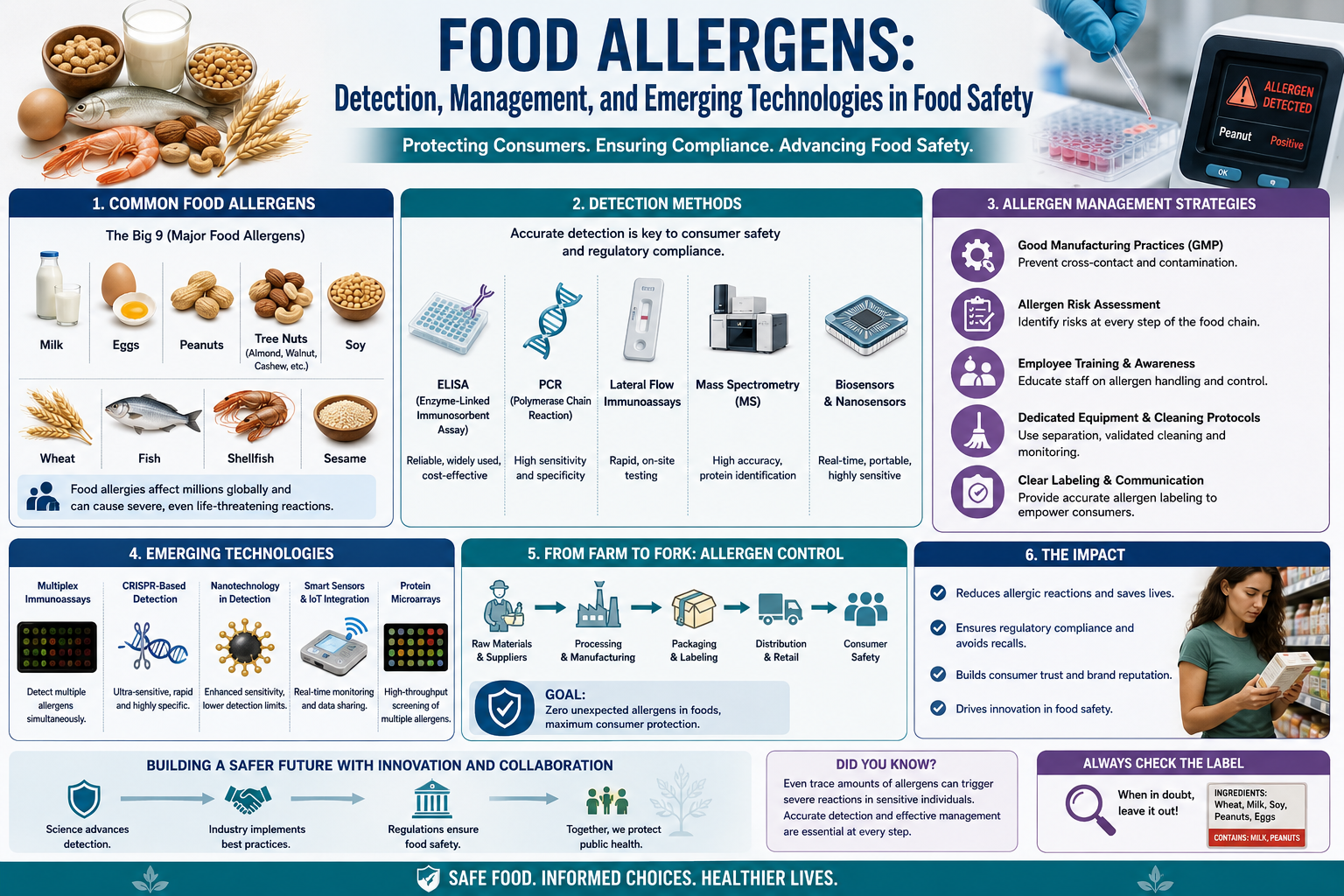
Advances in analytical science have transformed allergen detection. Modern laboratories now employ enzyme-linked immunosorbent assays (ELISA), polymerase chain reaction (PCR), liquid chromatography–mass spectrometry (LC-MS/MS), biosensors, and even artificial intelligence-assisted monitoring systems to improve allergen surveillance and reduce accidental exposure.
This article explores the science behind food allergies, the major food allergens, detection technologies, regulatory requirements, manufacturing controls, emerging innovations, and the future of allergen management in modern food systems.
Introduction
Food allergies have become an increasingly important global public health issue. Current estimates suggest that food allergies affect approximately 220–250 million people worldwide, with prevalence increasing in many regions, particularly among children.
The globalization of food trade, increasing consumption of processed foods, and complex food supply chains have made allergen management more challenging than ever before. A single undeclared allergen can trigger product recalls affecting multiple countries, causing substantial financial losses and posing serious health risks.
Food scientists, analytical chemists, manufacturers, regulators, and healthcare professionals are therefore working together to strengthen allergen detection, risk assessment, labeling, and consumer protection.
What Is a Food Allergy?
A food allergy is an adverse immune response that occurs when the body’s immune system mistakenly identifies a normally harmless food protein as a threat.
During exposure, the immune system produces Immunoglobulin E (IgE) antibodies or, less commonly, other immune responses that trigger the release of histamine and other inflammatory mediators.
Symptoms may include:
- Skin rashes and hives
- Swelling of the lips, tongue, or throat
- Difficulty breathing
- Vomiting and diarrhea
- Dizziness
- Loss of consciousness
- Anaphylaxis
Anaphylaxis is a medical emergency requiring immediate treatment.
Food Allergy vs Food Intolerance
Food allergies are often confused with food intolerances, but they differ significantly.
| Food Allergy | Food Intolerance |
|---|---|
| Immune-mediated | Usually not immune-mediated |
| Can occur after tiny exposures | Usually dose-dependent |
| May cause anaphylaxis | Rarely life-threatening |
| Often lifelong | May improve over time |
| Requires strict avoidance | Some individuals tolerate small amounts |
Understanding this distinction is important for both healthcare providers and consumers.
The Major Food Allergens
Although more than 170 foods have been reported to cause allergic reactions, a relatively small number account for most severe cases.
Many regulatory authorities recognize the following as major allergens:
- Milk
- Eggs
- Fish
- Crustacean shellfish
- Peanuts
- Tree nuts
- Wheat
- Soybeans
- Sesame (now recognized in several jurisdictions)
These allergens are responsible for the majority of food allergy incidents worldwide.
How Allergen Cross-Contact Occurs
Cross-contact occurs when allergenic proteins unintentionally contaminate foods that do not intentionally contain those allergens.
Common sources include:
Shared Equipment
Production lines processing multiple products may transfer allergenic residues if cleaning is inadequate.
Airborne Particles
Powdered ingredients such as milk powder or wheat flour may become airborne and contaminate nearby products.
Employee Practices
Improper handwashing, clothing, utensils, or movement between production areas can spread allergens.
Raw Material Mix-Ups
Incorrect ingredient handling or storage increases contamination risks.
Detecting Food Allergens
Modern food laboratories use multiple analytical techniques.
ELISA (Enzyme-Linked Immunosorbent Assay)
ELISA remains one of the most widely used methods for detecting allergenic proteins.
Advantages include:
- High sensitivity
- Relatively rapid analysis
- Suitable for routine testing
Limitations include reduced effectiveness for highly processed foods where proteins have been altered.
Polymerase Chain Reaction (PCR)
PCR detects allergen-associated DNA rather than proteins.
Applications include:
- Ingredient verification
- Species identification
- Process validation
PCR is particularly useful when protein detection becomes difficult after processing.
Liquid Chromatography–Mass Spectrometry (LC-MS/MS)
LC-MS/MS provides highly specific identification of allergenic peptides.
Advantages include:
- High specificity
- Multiplex detection
- Excellent confirmatory capability
Increasingly, LC-MS/MS is considered a reference technique for allergen analysis.
Biosensors
Emerging biosensor technologies enable rapid, portable allergen detection.
Researchers are developing sensors capable of identifying allergenic proteins within minutes using:
- Electrochemical detection
- Optical sensing
- Nanotechnology
- Microfluidics
Food Allergen Management in Manufacturing
Effective allergen management requires an integrated approach.
Supplier Control
Manufacturers should evaluate ingredient suppliers and verify allergen declarations.
Segregation
Allergenic ingredients should be stored and handled separately whenever possible.
Production Scheduling
Producing allergen-free products before allergen-containing products reduces contamination risks.
Cleaning Validation
Cleaning procedures must be scientifically validated to demonstrate effective allergen removal.
Environmental Monitoring
Routine sampling verifies sanitation effectiveness and identifies contamination risks.
Employee Training
Personnel should understand:
- Allergen risks
- Personal hygiene
- Cleaning procedures
- Product handling
- Label verification
Food Labeling Requirements
Food labeling is one of the most important consumer protection measures.
Many countries require clear declaration of major allergens within ingredient lists or through dedicated allergen statements.
Effective labeling should be:
- Accurate
- Easy to read
- Consistent
- Scientifically justified
Precautionary statements such as “may contain” should be based on documented risk assessments rather than used indiscriminately.
Emerging Technologies
Researchers are developing innovative approaches to improve allergen management.
Artificial Intelligence
AI systems analyze production data to identify contamination risks and optimize cleaning schedules.
Hyperspectral Imaging
This non-destructive technology may detect allergen contamination without direct contact.
DNA Sequencing
Next-generation sequencing supports ingredient authentication and traceability.
Digital Traceability
Blockchain and digital product passports improve transparency throughout food supply chains.
Portable Detection Devices
Smartphone-compatible biosensors may soon allow manufacturers and inspectors to perform rapid on-site allergen testing.
Current Research
Current scientific investigations focus on:
- Ultra-sensitive multiplex allergen detection
- Nanotechnology-based biosensors
- AI-assisted risk prediction
- Improved cleaning validation
- Novel food allergen biomarkers
- Standardized reference materials
- Machine learning for recall prevention
Researchers are also investigating how food processing influences allergenic protein structures and analytical detection.
Future Outlook
Food allergen management is expected to become increasingly data-driven.
Future innovations may include:
- Real-time production monitoring
- AI-guided sanitation systems
- Automated allergen mapping within factories
- Digital allergen passports
- Continuous biosensor monitoring
- Predictive contamination modeling
These technologies will improve both food safety and manufacturing efficiency.
Conclusion
Food allergens remain one of the most significant hazards in modern food production because even trace quantities can have life-threatening consequences for sensitive individuals. Advances in analytical chemistry, molecular biology, biosensor technology, and artificial intelligence are dramatically improving the ability of food manufacturers to detect allergens, prevent cross-contact, and ensure accurate labeling.
As global food supply chains continue to expand, effective allergen management will increasingly rely on integrated food safety systems, robust analytical technologies, transparent communication, and evidence-based regulatory oversight. Continued research and technological innovation promise safer foods and greater confidence for consumers living with food allergies.
Key Takeaways
- Food allergies are immune-mediated reactions that can cause severe or life-threatening responses.
- Most serious reactions involve a relatively small group of major food allergens.
- ELISA, PCR, LC-MS/MS, and biosensors are the primary analytical tools used for allergen detection.
- Comprehensive allergen management includes supplier control, segregation, validated cleaning, environmental monitoring, employee training, and accurate labeling.
- AI, biosensors, digital traceability, and hyperspectral imaging are shaping the future of allergen control.
References
- World Health Organization (WHO). Food Safety. https://www.who.int/health-topics/food-safety
- Food and Agriculture Organization (FAO). Food Safety and Quality. https://www.fao.org/food-safety
- Codex Alimentarius Commission. General Standard for the Labelling of Prepackaged Foods. https://www.fao.org/fao-who-codexalimentarius/
- Taylor, S. L., & Baumert, J. L. (2015). Cross-contact of food allergens. Journal of Allergy and Clinical Immunology, 136(5), 1208–1211. https://doi.org/10.1016/j.jaci.2015.09.004
- Poms, R. E., Klein, C. L., & Anklam, E. (2004). Methods for allergen analysis in food. Food Additives & Contaminants, 21(1), 1–31. https://doi.org/10.1080/02652030310001620442
- Monaci, L., & Visconti, A. (2009). Mass spectrometry-based proteomics methods for analysis of food allergens. TrAC Trends in Analytical Chemistry, 28(5), 581–591. https://doi.org/10.1016/j.trac.2009.02.006
- European Food Safety Authority (EFSA). Food Allergens. https://www.efsa.europa.eu
- U.S. Food and Drug Administration (FDA). Food Allergies. https://www.fda.gov/food/food-labeling-nutrition/food-allergies