
Summary
Every year, approximately one-third of all food produced globally is lost or wasted, representing not only a nutritional loss but also a significant waste of land, water, energy, and labor. While food waste has traditionally been viewed as an unavoidable consequence of food production and consumption, scientists are increasingly recognizing it as a valuable source of nutrients and functional ingredients.
Food waste upcycling is transforming the way the food industry views agricultural and food processing by-products. Instead of being discarded or used solely as low-value animal feed, materials such as fruit peels, cereal bran, brewer’s spent grain, whey, coffee grounds, and vegetable trimmings are being converted into high-value ingredients for foods, beverages, cosmetics, pharmaceuticals, and biodegradable packaging.
Driven by advances in food science, biotechnology, and sustainable processing technologies, upcycling supports the transition toward a circular food economy by reducing waste, lowering greenhouse gas emissions, and creating new economic opportunities.
This article explores the science behind food waste upcycling, current technologies, nutritional benefits, food safety considerations, commercial applications, and future innovations shaping sustainable food production.
Introduction
Global food systems face increasing pressure from population growth, climate change, resource scarcity, and rising consumer demand for sustainable products. At the same time, enormous quantities of edible materials are lost during harvesting, processing, transportation, retail, and household consumption.
Many of these discarded materials remain rich in valuable nutrients, including dietary fibre, proteins, healthy fats, vitamins, minerals, antioxidants, and bioactive compounds.
Modern food science is shifting from a linear “take–make–dispose” model to a circular economy approach, where food by-products are recovered, processed, and reintegrated into the food system as valuable resources rather than waste.
What Is Food Waste Upcycling?
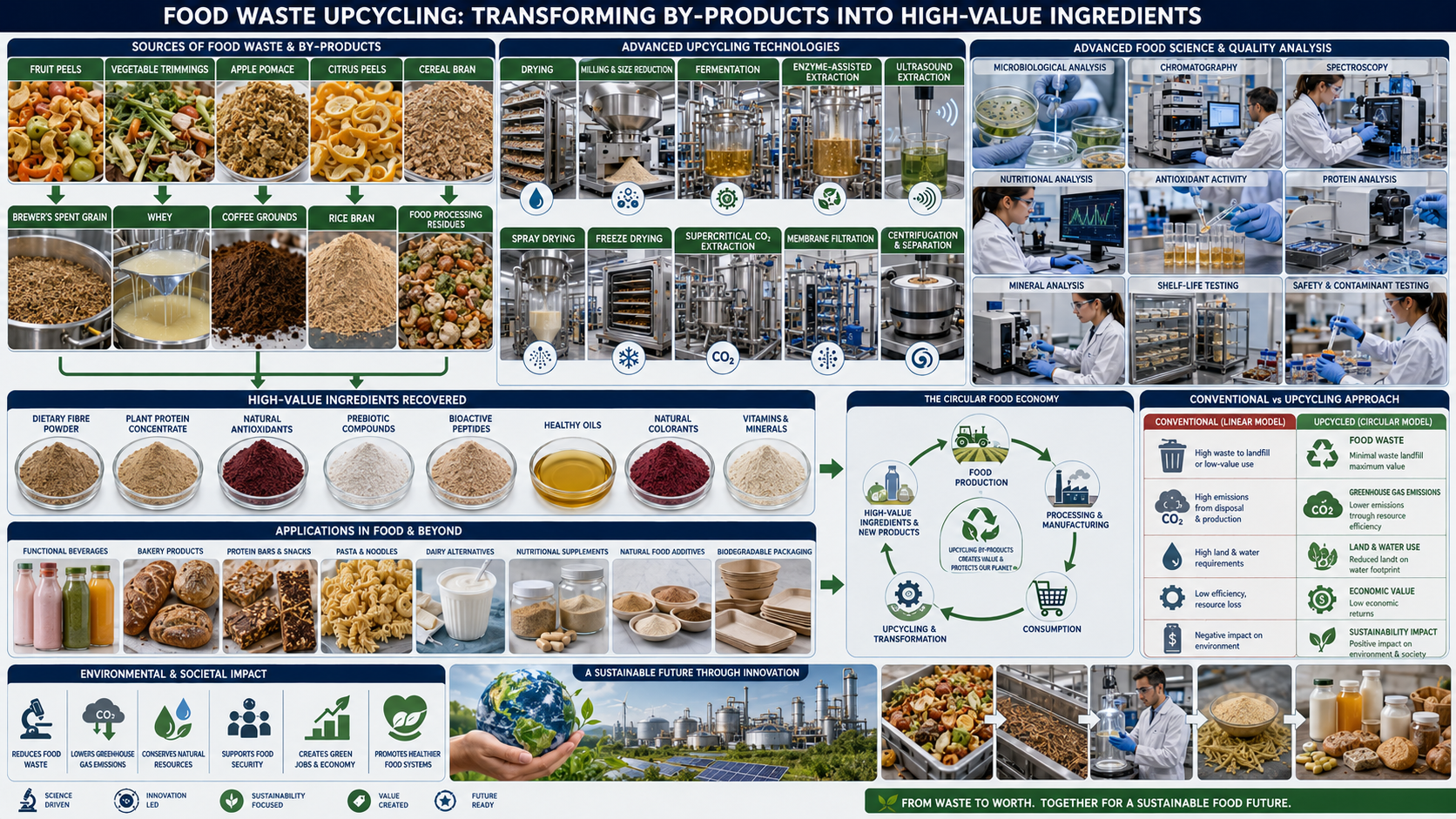
Food waste upcycling is the process of converting surplus food, agricultural residues, or food processing by-products into new products with higher economic, nutritional, or environmental value.
Unlike recycling, which often results in products of lower value, upcycling aims to create ingredients or products with equal or greater value than the original material.
Examples include:
- Apple pomace into dietary fibre powder
- Citrus peels into natural essential oils and pectin
- Brewer’s spent grain into protein-rich flour
- Whey into protein concentrates and beverages
- Coffee grounds into antioxidants and food ingredients
- Rice bran into functional oils
- Vegetable trimmings into powdered seasonings
Common Sources of Upcycled Food Ingredients
Fruit and Vegetable By-Products
Food processing generates large quantities of:
- Peels
- Seeds
- Pulp
- Pomace
- Stems
These materials often contain high concentrations of fibre, polyphenols, carotenoids, and natural pigments.
Cereal Processing By-Products
Major cereal by-products include:
- Wheat bran
- Rice bran
- Oat hulls
- Corn fibre
These ingredients are increasingly incorporated into high-fibre bakery products and breakfast cereals.
Dairy Industry By-Products
Cheese production generates large volumes of whey.
Rather than disposal, whey is now widely processed into:
- Whey protein concentrate (WPC)
- Whey protein isolate (WPI)
- Lactose
- Infant nutrition ingredients
- Sports nutrition products
Brewing Industry
Brewer’s spent grain is rich in:
- Protein
- Fibre
- Phenolic compounds
It is increasingly used in breads, snacks, pasta, and nutritional products.
Coffee Processing
Spent coffee grounds contain:
- Dietary fibre
- Antioxidants
- Oils
- Phenolic compounds
Researchers are exploring their use in baked goods, beverages, and biodegradable packaging materials.
Technologies Used in Food Upcycling
Modern food scientists employ a range of technologies to recover valuable compounds efficiently.
Drying Technologies
Methods include:
- Freeze drying
- Spray drying
- Vacuum drying
- Hot-air drying
Drying improves shelf life and facilitates ingredient production.
Milling and Fractionation
Mechanical processing converts dried by-products into fine powders suitable for food applications.
Enzyme-Assisted Extraction
Enzymes help release proteins, fibres, and bioactive compounds while improving extraction efficiency.
Fermentation
Beneficial microorganisms can enhance nutritional quality, improve digestibility, and create desirable flavors.
Fermentation may also reduce antinutritional factors.
Green Extraction Technologies
Emerging techniques include:
- Supercritical carbon dioxide extraction
- Ultrasound-assisted extraction
- Microwave-assisted extraction
- Pulsed electric field processing
These methods improve extraction efficiency while reducing solvent use.
Nutritional Benefits
Upcycled ingredients often retain valuable nutrients, including:
Dietary Fibre
Supports digestive health and may help reduce the risk of chronic diseases.
Plant Proteins
Many cereal and legume by-products provide valuable protein for food formulations.
Antioxidants
Polyphenols and flavonoids recovered from fruit and vegetable waste may contribute to oxidative stress reduction.
Vitamins and Minerals
Many by-products remain rich in essential micronutrients after primary processing.
Food Safety Considerations
Upcycled ingredients must meet the same food safety standards as conventional food ingredients.
Manufacturers implement:
- Good Manufacturing Practices (GMP)
- Hazard Analysis and Critical Control Point (HACCP)
- Microbiological testing
- Heavy metal analysis
- Pesticide residue monitoring
- Allergen management
- Traceability systems
Proper handling and processing are essential to ensure ingredient safety and quality.
Environmental Benefits
Food waste upcycling offers several sustainability advantages:
- Reduced landfill waste
- Lower greenhouse gas emissions
- Improved resource efficiency
- Reduced pressure on natural resources
- Greater circularity in food systems
By extracting additional value from existing resources, upcycling supports more sustainable production without increasing agricultural land use.
Commercial Applications
Upcycled ingredients are increasingly incorporated into:
- Bakery products
- Breakfast cereals
- Protein bars
- Dairy alternatives
- Functional beverages
- Pasta
- Snack foods
- Meat alternatives
- Nutritional supplements
- Natural food colorants
- Biodegradable food packaging
Consumer demand for sustainable products continues to drive innovation in this sector.
Research Spotlight
Researchers are investigating new ways to recover high-value compounds from food processing residues using biotechnology, artificial intelligence, and advanced extraction technologies.
Current research focuses on:
- Precision fermentation of food by-products
- Bioactive peptide production
- Novel dietary fibre ingredients
- Functional food formulations
- Sustainable packaging materials
- Biorefineries integrating multiple recovery processes
These innovations aim to maximize value while minimizing environmental impact.
Future Outlook
Food waste upcycling is expected to become a central component of sustainable food manufacturing.
Future developments may include:
- AI-driven ingredient optimization
- Smart biorefineries
- Precision extraction technologies
- Carbon-neutral processing systems
- Blockchain-enabled ingredient traceability
- Greater integration into mainstream food products
As governments and industries prioritize sustainability, upcycling will play an increasingly important role in achieving circular economy goals.
Conclusion
Food waste upcycling represents a major shift in how the food industry manages resources. By transforming agricultural residues and food processing by-products into valuable ingredients, scientists are helping reduce waste, improve resource efficiency, and create innovative food products that support both human health and environmental sustainability.
Although challenges related to logistics, standardization, and consumer awareness remain, advances in food science and processing technologies continue to expand the possibilities for upcycled ingredients. As the global food system moves toward a circular economy, food waste upcycling is poised to become an essential strategy for building resilient, efficient, and sustainable food systems.
Key Takeaways
- Food waste upcycling converts by-products into valuable food ingredients rather than discarding them.
- Common upcycled materials include fruit peels, cereal bran, whey, brewer’s spent grain, and coffee grounds.
- Technologies such as fermentation, enzyme-assisted extraction, drying, and green extraction improve ingredient recovery.
- Upcycling reduces food waste, lowers environmental impacts, and supports the circular economy.
- Food safety systems remain essential to ensure upcycled ingredients are safe, nutritious, and suitable for consumers.
References
- Food and Agriculture Organization (FAO). The State of Food and Agriculture: Moving Forward on Food Loss and Waste Reduction.
- United Nations Environment Programme (UNEP). Food Waste Index Report.
- Comprehensive Reviews in Food Science and Food Safety. Valorization of Food Processing By-Products.
- Trends in Food Science & Technology. Food Waste Upcycling and Circular Food Systems.
- Journal of Cleaner Production. Circular Economy Approaches in the Food Industry.
- Food Chemistry. Recovery of Bioactive Compounds from Food Processing By-Products.
- Annual Review of Food Science and Technology. Emerging Technologies for Sustainable Food Processing.
- Frontiers in Sustainable Food Systems. Innovations in Food By-Product Utilization.