
Summary
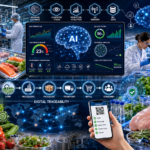
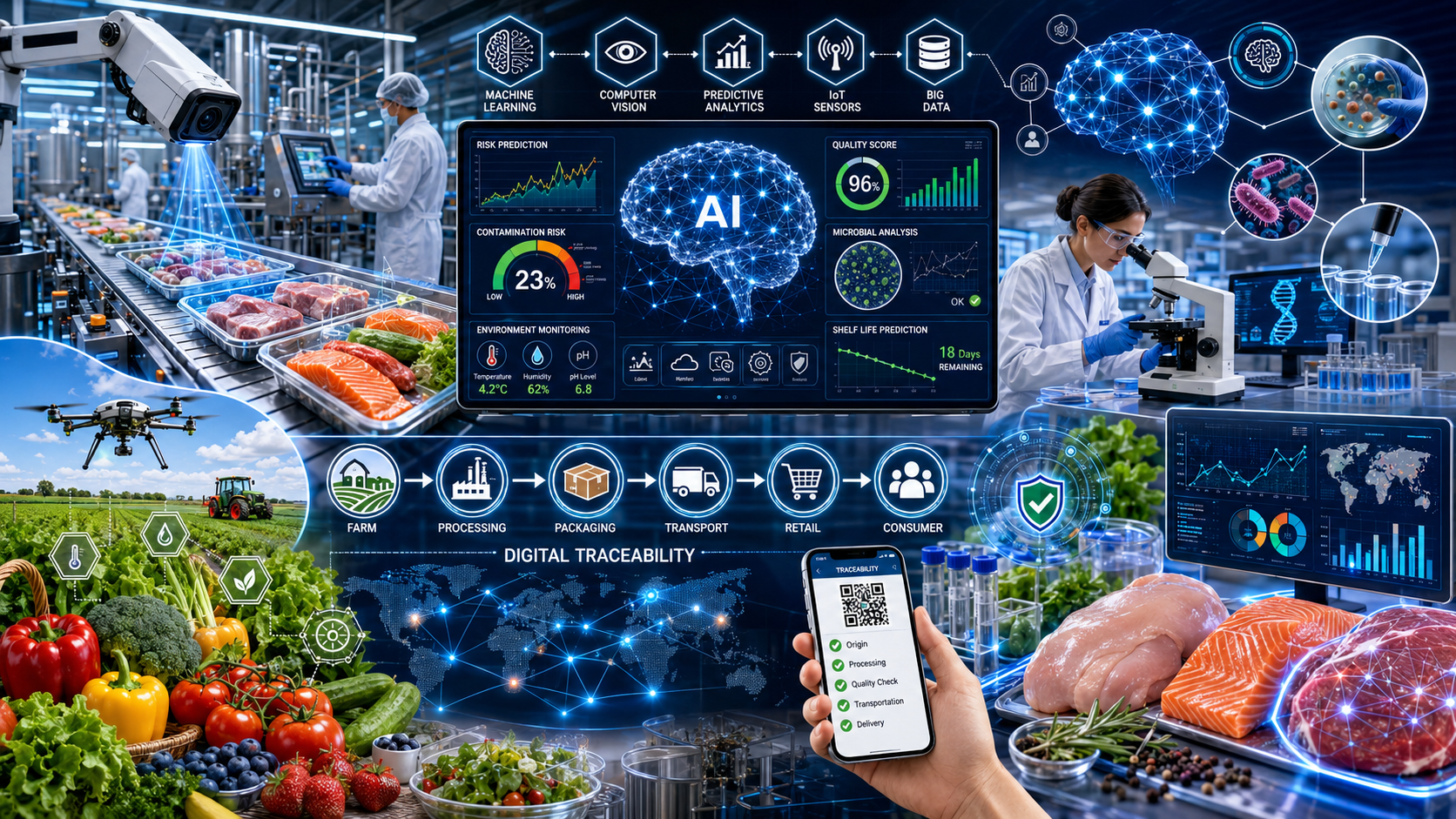
Artificial Intelligence (AI) is rapidly transforming food production, processing, safety monitoring, and quality assurance. Traditionally, food safety systems have relied heavily on manual inspections, laboratory analyses, and reactive interventions after contamination events occur. Today, AI-powered technologies are enabling predictive, data-driven approaches capable of identifying risks before they result in product recalls, outbreaks, or quality failures.
Machine learning algorithms, computer vision systems, predictive analytics, digital twins, and smart sensors are increasingly being deployed throughout food supply chains. These technologies can detect contaminants, identify defects, predict spoilage, monitor processing operations, and improve traceability with unprecedented speed and accuracy.
As food systems become more complex, AI offers opportunities to improve food safety outcomes, reduce waste, enhance efficiency, and strengthen consumer confidence. However, challenges related to data quality, algorithm transparency, cybersecurity, regulatory oversight, and workforce readiness remain important considerations.
This article explores the science behind AI applications in food safety, examines current industrial implementations, reviews recent research findings, and discusses future opportunities and challenges.
Introduction
The food industry is undergoing a digital transformation often referred to as Industry 4.0. This transformation involves integrating advanced technologies such as artificial intelligence, machine learning, robotics, cloud computing, and the Internet of Things (IoT) into food production systems.
Food safety remains one of the most important drivers behind this technological shift. Every year, foodborne diseases affect millions of people worldwide, resulting in significant health, social, and economic consequences. Traditional food safety systems have achieved considerable success in reducing many hazards, but growing supply chain complexity demands more sophisticated approaches.
Artificial intelligence offers the ability to analyze vast amounts of data, recognize patterns invisible to human observers, and support rapid decision-making. These capabilities are making AI an increasingly valuable tool for food manufacturers, regulators, retailers, and researchers.
Understanding Artificial Intelligence in Food Systems
What is Artificial Intelligence?
Artificial Intelligence refers to computer systems capable of performing tasks that traditionally require human intelligence.
These tasks include:
- Learning from data
- Pattern recognition
- Decision-making
- Prediction
- Image analysis
- Natural language processing
Machine learning, a subset of AI, enables systems to improve performance through experience without explicit programming.
Why Food Safety Generates Big Data
Modern food systems generate enormous volumes of data through:
- Temperature monitoring
- Environmental sensors
- Laboratory testing
- Production records
- Supply chain tracking
- Consumer feedback
- Regulatory inspections
AI systems can analyze these datasets to identify risks and opportunities for intervention.
Applications of AI in Food Safety
Computer Vision for Quality Inspection
One of the most successful applications of AI in food processing is computer vision.
Traditional visual inspection depends on human operators, who may experience fatigue and inconsistency.
AI-powered cameras can rapidly evaluate:
- Color
- Shape
- Size
- Surface defects
- Foreign materials
- Product uniformity
Applications include:
- Fruit grading
- Meat inspection
- Bakery quality control
- Packaging verification
Studies have demonstrated that computer vision systems can achieve accuracy levels exceeding conventional manual inspection methods.
Predictive Food Safety
Predictive analytics allows food manufacturers to identify hazards before they occur.
AI systems analyze:
- Historical contamination events
- Environmental conditions
- Production parameters
- Equipment performance
These data can be used to forecast:
- Microbial growth
- Product spoilage
- Process deviations
- Contamination risks
The transition from reactive to predictive food safety represents one of the most significant advances in modern food protection.
Environmental Monitoring
Food processing facilities routinely monitor:
- Air quality
- Surface hygiene
- Water quality
- Equipment cleanliness
AI can identify abnormal trends and generate alerts when contamination risks increase.
This capability supports proactive interventions before food products become compromised.
AI and Food Traceability
Smarter Supply Chains
Food recalls can cost companies millions of dollars while undermining consumer trust.
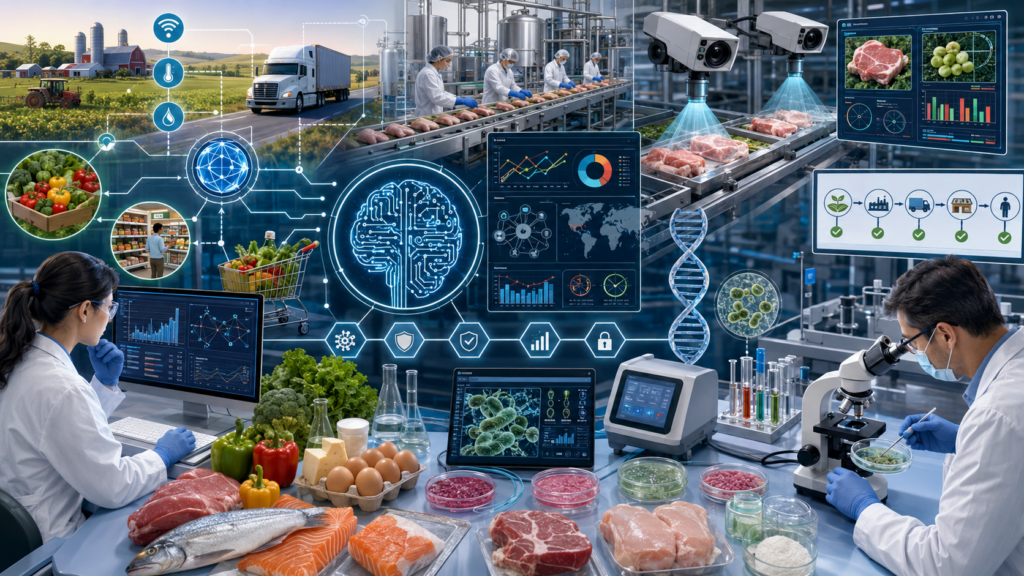
AI-powered traceability systems improve visibility throughout supply chains.
These systems integrate information from:
- Farms
- Processing facilities
- Warehouses
- Transportation systems
- Retail outlets
The result is faster identification of contamination sources and more targeted recalls.
Blockchain and AI
Increasingly, AI is being integrated with blockchain technology.
Benefits include:
- Improved transparency
- Reduced fraud
- Enhanced traceability
- Better regulatory compliance
Food companies are exploring these technologies to strengthen supply chain integrity.
Artificial Intelligence and Food Waste Reduction
Food waste remains a major global challenge.
According to the Food and Agriculture Organization (FAO), approximately one-third of food produced globally is lost or wasted.
AI contributes to waste reduction through:
- Demand forecasting
- Inventory optimization
- Shelf-life prediction
- Spoilage monitoring
Retailers can use predictive systems to optimize stock levels and reduce unnecessary disposal.
Research Spotlight
Artificial Intelligence in Food Safety Monitoring
Study
Bahrampour et al. (2024).
“Artificial Intelligence Applications in Food Safety and Quality Assessment.”
Journal: Foods.
Key Findings
The review identified significant opportunities for AI applications in:
- Hazard detection
- Pathogen prediction
- Quality monitoring
- Supply chain management
- Consumer protection
The authors concluded that AI technologies can substantially improve food safety outcomes while reducing operational costs.
Practical Implications
AI-driven systems may eventually become standard components of food safety management systems worldwide.
Industry Applications
Dairy Industry
AI supports:
- Mastitis detection
- Milk quality assessment
- Process control
- Shelf-life prediction
Meat Industry
Applications include:
- Carcass grading
- Defect detection
- Contamination monitoring
- Predictive maintenance
Fresh Produce Sector
Computer vision systems assist in:
- Fruit sorting
- Defect identification
- Ripeness assessment
- Quality grading
Food Retail
Retailers use AI for:
- Demand forecasting
- Inventory management
- Food waste reduction
- Customer preference analysis
Food Safety and Regulatory Considerations
Validation Requirements
AI systems used for food safety decision-making must undergo validation to ensure reliability.
Regulators increasingly require evidence that AI-based systems produce accurate and reproducible outcomes.
Data Integrity
AI performance depends heavily on data quality.
Poor-quality data can lead to:
- Incorrect predictions
- Missed hazards
- Operational inefficiencies
Robust data governance is therefore essential.
Cybersecurity
As food systems become increasingly digital, cybersecurity risks also increase.
Food manufacturers must protect:
- Production systems
- Traceability databases
- Quality records
- Consumer information
Challenges and Limitations
Despite its promise, AI faces several challenges:
High Initial Investment
Implementation costs may be prohibitive for some small and medium-sized enterprises.
Data Requirements
Effective AI systems require large, high-quality datasets.
Workforce Skills
Organizations need personnel capable of:
- Managing digital systems
- Interpreting AI outputs
- Maintaining data quality
Algorithm Transparency
Many AI models operate as “black boxes,” making decision-making difficult to explain.
This can create challenges for regulatory acceptance.
Future Directions
The future of AI in food safety may include:
- Real-time contamination prediction
- Autonomous inspection systems
- Digital twins of food factories
- Integrated farm-to-fork monitoring
- Advanced genomic surveillance
- AI-assisted regulatory inspections
The combination of AI, biosensors, robotics, and IoT technologies is expected to drive the next generation of food safety innovations.
Conclusion
Artificial intelligence is rapidly becoming a transformative force in food safety and quality control. By enabling predictive monitoring, automated inspection, enhanced traceability, and improved decision-making, AI offers unprecedented opportunities to strengthen food systems and protect public health.
Although challenges remain regarding implementation costs, data quality, cybersecurity, and regulatory oversight, continued technological advances are likely to accelerate adoption across the food industry. For food scientists, regulators, and industry professionals, understanding AI technologies will become increasingly important as food systems continue their digital transformation.
References and Further Reading
- Food and Agriculture Organization (FAO). Food Loss and Food Waste.
https://www.fao.org - World Health Organization (WHO). Food Safety.
https://www.who.int/health-topics/food-safety - Foods Journal (2024). Artificial Intelligence Applications in Food Safety and Quality Assessment.
https://www.mdpi.com/journal/foods - Journal of Food Engineering. Artificial Intelligence in Food Processing and Quality Control.
https://www.sciencedirect.com/journal/journal-of-food-engineering - Frontiers in Sustainable Food Systems. Artificial Intelligence for Sustainable Food Systems.
https://www.frontiersin.org/journals/sustainable-food-systems - FDA New Era of Smarter Food Safety.
https://www.fda.gov/food/new-era-smarter-food-safety - European Food Safety Authority (EFSA).
https://www.efsa.europa.eu - Nature Food. Digital Transformation of Food Systems.
https://www.nature.com/natfood/