

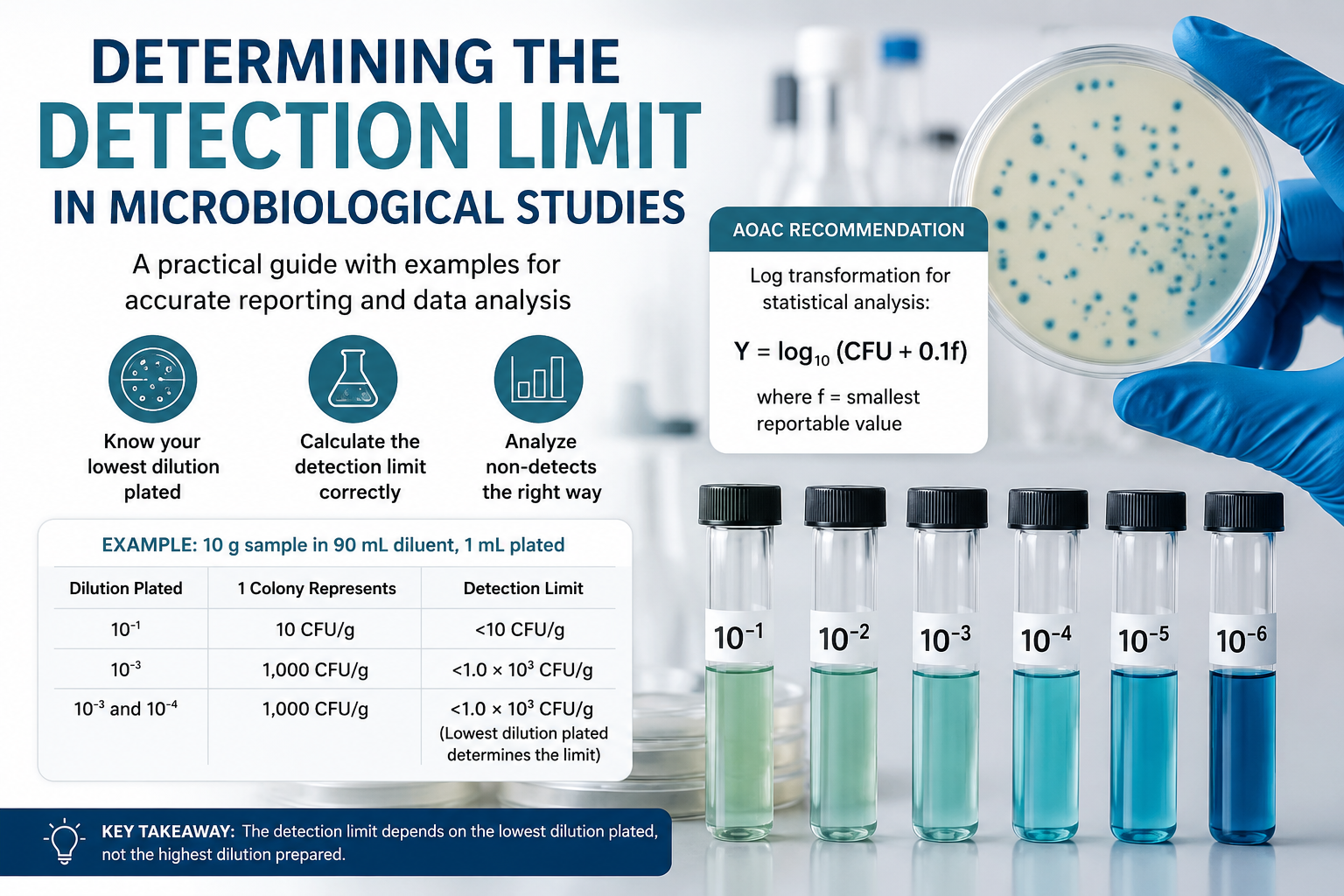
One of the most common misconceptions in food microbiology is that the highest dilution prepared determines the detection limit. It does not.
The detection limit depends on the lowest dilution that was actually plated, the volume plated, and the initial sample preparation.
What is the detection limit?
The detection limit is the lowest number of microorganisms that can be detected in the original sample using your analytical method.
For conventional plate count methods, it corresponds to one colony growing on the lowest dilution plate that was examined.
Example 1: Plating the 10⁻¹ dilution
Suppose you:
- Weigh 10 g of food into 90 mL diluent (10⁻¹ dilution)
- Plate 1 mL of the 10⁻¹ dilution
If one colony grows, it represents:
10 CFU/g
Therefore, the detection limit is:
10 CFU/g
If no colonies grow, you report:
<10 CFU/g
Example 2: Plating the 10⁻³ dilution
Suppose you prepare dilutions up to 10⁻⁶, but you only plate the 10⁻³ dilution.
One colony now represents:
1,000 CFU/g
Therefore, the detection limit becomes:
1,000 CFU/g
If no colonies are observed, the result is reported as:
<1.0 × 10³ CFU/g
Notice that the detection limit increased—not because you prepared more dilutions, but because you plated a more dilute sample.
Example 3: Plating both 10⁻³ and 10⁻⁴
If you plate both 10⁻³ and 10⁻⁴, the 10⁻³ plate determines the detection limit because it is the least diluted (more sensitive).
Therefore:
- Detection limit = 1,000 CFU/g
- Not 10,000 CFU/g
A common mistake
Many researchers believe that preparing dilutions up to 10⁻⁶ means the detection limit is determined by the 10⁻⁶ dilution.
This is incorrect.
The detection limit is determined by the lowest dilution that was plated and examined, not the highest dilution prepared.
Handling non-detects during statistical analysis
The AOAC INTERNATIONAL recommends transforming microbiological count data using:
where f is the smallest reportable value (detection/reporting limit).
For example:
- Detection limit = 10 CFU/g
- Then 0.1 × 10 = 1
The transformation becomes:
log₁₀(CFU + 1)
Thus, a sample reported as <10 CFU/g is transformed as:
log₁₀(0 + 1) = 0
This approach avoids the mathematical problem of taking the logarithm of zero while applying the same transformation rule to all samples.
Key take-home message
The detection limit in microbiological studies depends on:
- The initial sample dilution
- The lowest dilution plated
- The volume plated
It does not depend on the highest serial dilution prepared.
Understanding this principle helps ensure accurate reporting of microbiological results and appropriate statistical analysis of non-detects.
References
- Association of Official Analytical Collaboration (AOAC) INTERNATIONAL. (2019). Appendix X-H: Logarithmic Transformation of Data from Quantitative Method Single Laboratory and Collaborative Data. In Official Methods of Analysis of AOAC INTERNATIONAL. Available at: AOAC Appendix X-H: Logarithmic Transformation of Data from Quantitative Methods
- ISO 7218:2024. Microbiology of the food chain—General requirements and guidance for microbiological examinations. International Organization for Standardization.