
Summary
As the global population continues to grow and climate change places increasing pressure on agricultural systems, food producers face the challenge of producing more nutritious food while using fewer natural resources. Traditional plant breeding has delivered significant improvements over centuries, but developing new crop varieties often requires many years or even decades.
One technology rapidly changing this landscape is CRISPR (Clustered Regularly Interspaced Short Palindromic Repeats), a precise genome-editing tool that enables scientists to modify specific DNA sequences with remarkable accuracy. Unlike conventional breeding, CRISPR allows researchers to introduce targeted genetic changes without necessarily introducing DNA from unrelated species.
Researchers are using CRISPR to develop crops with improved disease resistance, drought tolerance, enhanced nutritional quality, reduced food waste, and better adaptation to changing climates. Scientists are also investigating applications in livestock, aquaculture, food fermentation, allergen reduction, and food safety.
Although regulatory approaches differ across countries, CRISPR is becoming one of the most influential technologies shaping the future of sustainable food systems.
Introduction
For thousands of years, humans have improved crops and livestock through selective breeding. Modern biotechnology accelerated this process through molecular breeding and genetic engineering.
Today, CRISPR represents the next major advancement in agricultural biotechnology by allowing highly targeted changes to an organism’s genome.
Because the technology can modify genes already present within an organism, it offers opportunities to improve agricultural productivity while addressing challenges such as climate change, emerging plant diseases, declining biodiversity, and food insecurity.
What Is CRISPR?
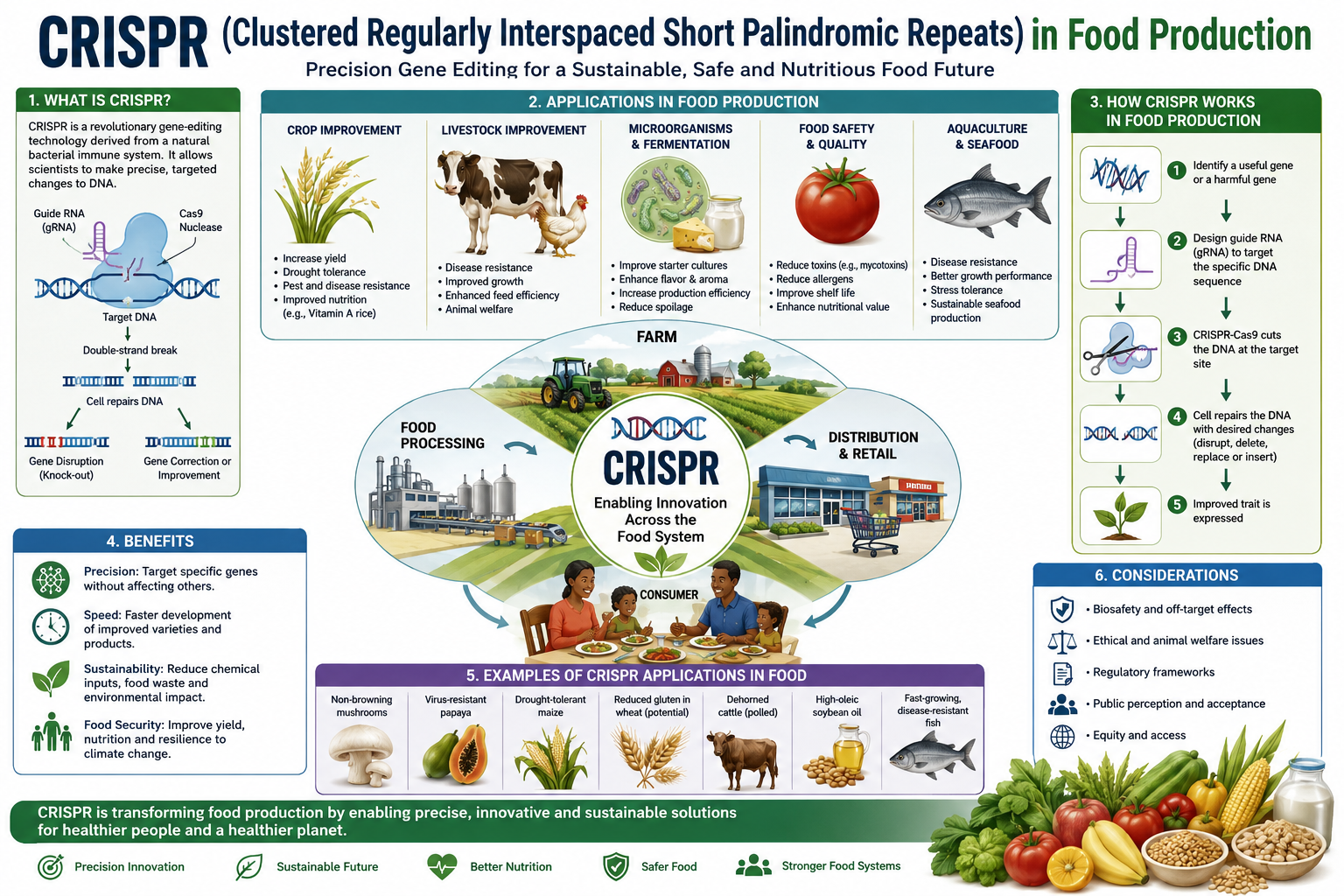
CRISPR is a gene-editing system originally discovered as part of the natural immune defense used by certain bacteria against viruses.
Scientists adapted this biological mechanism into a powerful laboratory tool capable of making precise modifications within DNA.
The CRISPR system typically consists of:
- A guide RNA (gRNA) that identifies the target DNA sequence.
- A CRISPR-associated (Cas) enzyme, most commonly Cas9, that cuts the DNA.
- The cell’s natural DNA repair mechanisms, which introduce or repair genetic changes.
Because edits occur at specific locations, CRISPR is generally more precise and efficient than many earlier genome-editing technologies.
How CRISPR Works
1. Identifying the Target Gene
Scientists first identify a gene associated with a desirable trait, such as drought tolerance or disease resistance.
2. Designing the Guide RNA
A guide RNA is created to direct the Cas enzyme to the exact DNA sequence that will be edited.
3. DNA Cutting
The Cas enzyme cuts the DNA at the selected location.
4. DNA Repair
The cell naturally repairs the break, allowing researchers to disable, modify, or replace specific genetic sequences depending on the intended outcome.
Applications in Food Production
Disease-Resistant Crops
CRISPR enables researchers to develop crops with improved resistance to bacterial, fungal, and viral diseases, reducing crop losses and potentially lowering pesticide use.
Examples under investigation include:
- Wheat
- Rice
- Tomatoes
- Potatoes
- Bananas
Climate-Resilient Agriculture
Scientists are editing genes associated with:
- Drought tolerance
- Heat resistance
- Salinity tolerance
- Flood resilience
These improvements may help farmers adapt to increasingly unpredictable weather patterns.
Enhanced Nutritional Quality
CRISPR is being explored to improve the nutritional composition of foods by increasing:
- Vitamins
- Essential amino acids
- Healthy oils
- Dietary fiber
- Antioxidants
Such advances could contribute to improved public health and help address micronutrient deficiencies.
Reduced Food Waste
Gene editing may extend shelf life by slowing ripening, reducing bruising, and improving resistance to post-harvest spoilage.
Longer-lasting fruits and vegetables can reduce losses throughout the supply chain.
Livestock Improvement
Research is investigating CRISPR applications for improving disease resistance, animal welfare, and production efficiency while supporting responsible livestock management.
Aquaculture
Gene editing is being studied to enhance disease resistance and productivity in fish and shellfish, with careful consideration of environmental and ethical implications.
CRISPR and Food Safety
CRISPR also supports food safety research by:
- Improving pathogen detection methods.
- Developing disease-resistant crops that require fewer chemical interventions.
- Enhancing traceability through molecular tools.
- Supporting research on foodborne pathogens and antimicrobial resistance.
In laboratory settings, CRISPR-based diagnostics are being developed to rapidly identify harmful microorganisms in food products.
Benefits of CRISPR Technology
Precision
Specific genes can be modified with much greater accuracy than conventional breeding methods.
Faster Crop Development
New crop varieties can often be developed more quickly than through traditional breeding.
Sustainability
Improved crop resilience may reduce losses and support more efficient use of water, fertilizers, and pesticides.
Improved Food Security
More resilient crops can contribute to stable food production under changing environmental conditions.
Challenges and Considerations
Despite its promise, CRISPR raises important scientific, regulatory, and societal questions.
Off-Target Effects
Although precision continues to improve, unintended genetic changes remain an area of ongoing research and careful evaluation.
Regulatory Differences
Countries regulate gene-edited foods differently. Some distinguish CRISPR-edited crops from genetically modified organisms (GMOs) when no foreign DNA is introduced, while others regulate them under broader biotechnology frameworks.
Public Acceptance
Consumer understanding and acceptance vary widely. Transparent communication, evidence-based risk assessment, and clear labeling policies where applicable are important for building trust.
Ethical Considerations
The use of gene-editing technologies should consider biodiversity, environmental impacts, equitable access, and responsible innovation.
Current Research
Scientists worldwide are exploring CRISPR applications in:
- Reducing natural toxins in crops.
- Developing disease-resistant bananas and cassava.
- Improving photosynthetic efficiency.
- Increasing nitrogen-use efficiency.
- Enhancing plant-based protein quality.
- Creating rapid CRISPR-based food pathogen detection systems.
Research continues to evaluate long-term safety, environmental performance, and socioeconomic impacts.
Future Outlook
CRISPR is expected to become an increasingly important tool within precision agriculture and sustainable food systems.
Future developments may include:
- AI-assisted genome editing.
- Climate-smart crop improvement.
- Enhanced microbial fermentation.
- Personalized nutrition ingredients.
- Improved traceability technologies.
- Faster development of resilient crop varieties.
Its greatest impact is likely to come when integrated with conventional breeding, digital agriculture, and responsible regulatory oversight.
Conclusion
CRISPR is transforming food biotechnology by enabling precise genetic improvements that address many of today’s most pressing agricultural challenges. From developing climate-resilient crops and enhancing nutritional quality to supporting food safety research and reducing food waste, the technology offers significant opportunities to strengthen global food systems.
While scientific, ethical, and regulatory considerations remain essential, evidence-based research and transparent governance will play a key role in determining how CRISPR contributes to sustainable agriculture in the decades ahead. Used responsibly, gene editing has the potential to improve food security while supporting environmental stewardship and agricultural innovation.
Key Takeaways
- CRISPR is a precise gene-editing technology that enables targeted DNA modifications.
- It has applications in crop improvement, livestock, aquaculture, food safety, and nutrition.
- Potential benefits include disease resistance, climate resilience, improved nutritional quality, and reduced food waste.
- Regulatory approaches differ globally, and ongoing research continues to evaluate safety and long-term impacts.
- CRISPR is expected to play a major role in the future of sustainable food production.
References
- Doudna, J. A., & Charpentier, E. (2014). The new frontier of genome engineering with CRISPR-Cas9. Science, 346(6213). https://doi.org/10.1126/science.1258096
- Jaganathan, D., Ramasamy, K., Sellamuthu, G., Jayabalan, S., & Venkataraman, G. (2018). CRISPR for crop improvement: An update review. Frontiers in Plant Science, 9, 985. https://doi.org/10.3389/fpls.2018.00985
- Chen, K., Wang, Y., Zhang, R., Zhang, H., & Gao, C. (2019). CRISPR/Cas genome editing and precision plant breeding. Annual Review of Plant Biology, 70, 667–697. https://doi.org/10.1146/annurev-arplant-050718-100049
- Food and Agriculture Organization (FAO). Genome Editing and Agrifood Systems.
- World Health Organization (WHO). Food Safety.
- National Academies of Sciences, Engineering, and Medicine. Genetically Engineered Crops: Experiences and Prospects.