
Summary
Food manufacturers invest heavily in cleaning and sanitation to ensure that foods reaching consumers are safe. Yet despite rigorous hygiene programs, certain microorganisms can survive routine cleaning by forming highly organized microbial communities known as biofilms. These microscopic structures can develop on stainless steel equipment, conveyor belts, drains, pipelines, storage tanks, cutting boards, and many other food-contact surfaces.
Biofilms present one of the most persistent challenges in food processing because the microorganisms embedded within them are protected by a self-produced matrix of extracellular polymeric substances (EPS). This protective layer makes biofilm-associated microorganisms significantly more resistant to cleaning agents, disinfectants, drying, and other environmental stresses than free-floating (planktonic) cells.
Persistent biofilms have been linked to contamination of dairy products, meat, seafood, fresh produce, beverages, and ready-to-eat foods. They can harbor important foodborne pathogens such as Listeria monocytogenes, Salmonella enterica, Escherichia coli, and Staphylococcus aureus, increasing the risk of product contamination and costly recalls.
This article explores how biofilms form, why they are so difficult to eliminate, their impact on food safety, and the innovative technologies helping the food industry detect, prevent, and control them.
Introduction
Food processing environments are designed to minimize microbial contamination through hygienic equipment design, cleaning and disinfection programs, environmental monitoring, and strict operational controls. However, microorganisms are remarkably adaptable.
Rather than existing as isolated cells, many bacteria naturally prefer to live in communities attached to surfaces. Once attached, they begin producing a sticky matrix that anchors them firmly and provides protection against environmental challenges.
This lifestyle, known as biofilm formation, enables microorganisms to survive in places where routine sanitation may be less effective, such as joints, welds, valves, drains, and damaged equipment surfaces.
For food manufacturers, understanding and controlling biofilms has become an essential component of modern food safety management systems.
What Is a Biofilm?
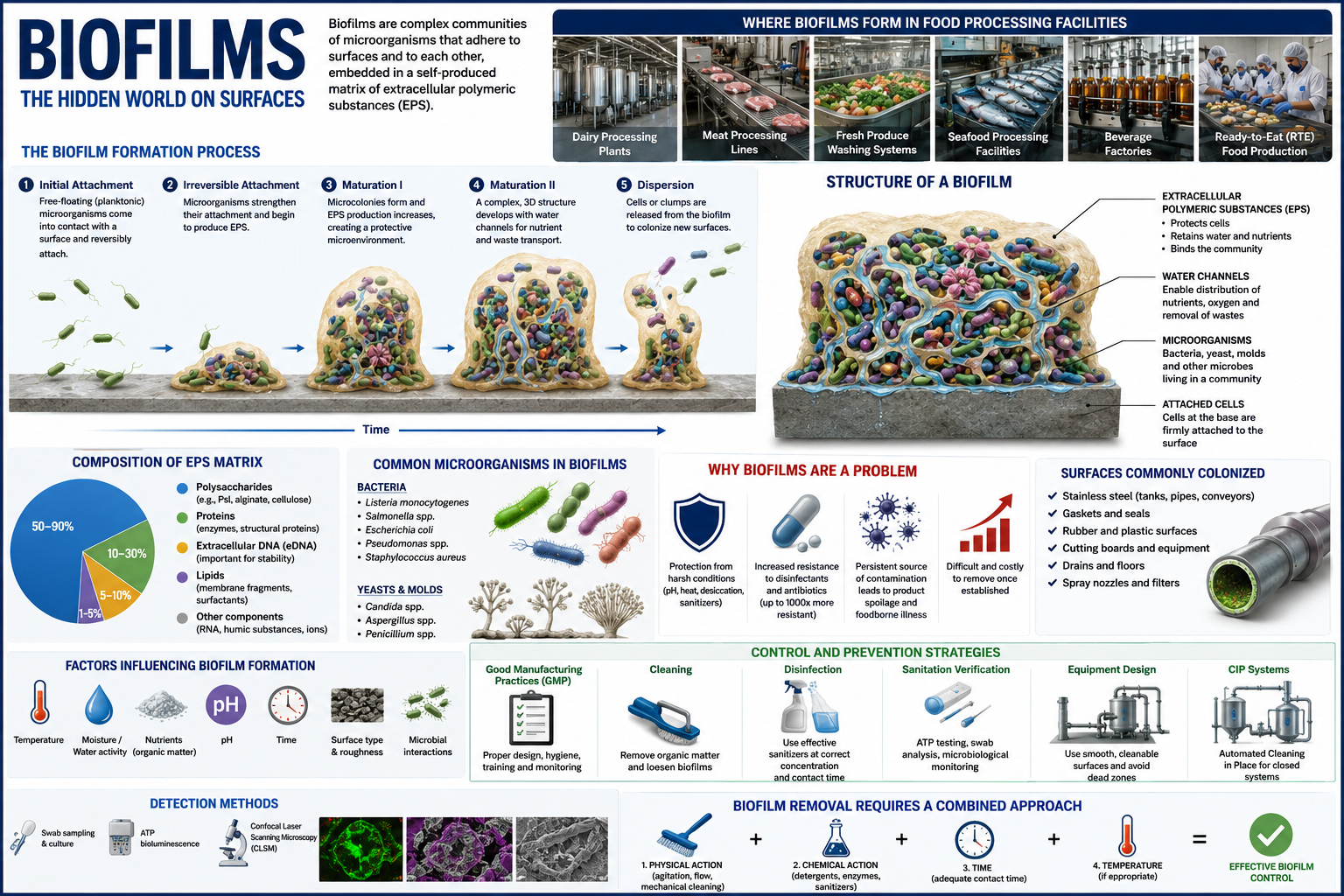
A biofilm is a structured community of microorganisms that adheres to a surface and is enclosed within a self-produced matrix called extracellular polymeric substances (EPS).
The EPS matrix consists primarily of:
- Polysaccharides
- Proteins
- Lipids
- Extracellular DNA
- Water
This matrix acts as a protective barrier that helps microorganisms:
- Attach firmly to surfaces
- Retain moisture
- Exchange nutrients
- Communicate chemically
- Resist cleaning and disinfectants
Biofilms may contain a single microbial species or complex communities of bacteria, yeasts, molds, and other microorganisms.
How Biofilms Form
Biofilm development is a dynamic process that generally occurs in five stages.
1. Surface Conditioning
Organic matter such as proteins, fats, sugars, and minerals rapidly coat food-contact surfaces, creating favorable conditions for microbial attachment.
2. Initial Attachment
Individual microbial cells temporarily attach to the conditioned surface using weak physical forces.
If conditions remain favorable, attachment becomes irreversible.
3. Biofilm Development
Attached microorganisms begin producing extracellular polymeric substances that form the protective biofilm matrix.
As cells multiply, the biofilm thickens and becomes increasingly resistant.
4. Maturation
The biofilm develops into a complex three-dimensional structure containing channels that transport nutrients, oxygen, and signaling molecules throughout the microbial community.
Different microorganisms may coexist and interact within the same biofilm.
5. Dispersion
Cells or clusters of microorganisms detach from the mature biofilm and spread to new locations, potentially contaminating equipment, food products, or other processing areas.
Common Foodborne Pathogens Associated with Biofilms
Several microorganisms of food safety concern readily form biofilms.
Listeria monocytogenes
A major concern in ready-to-eat food facilities because it can survive refrigeration and persist in processing environments for extended periods.
Salmonella enterica
Frequently associated with poultry, eggs, fresh produce, nuts, spices, and low-moisture foods.
Escherichia coli
Certain pathogenic strains can establish biofilms on food-contact surfaces and processing equipment.
Staphylococcus aureus
Can produce heat-stable toxins if allowed to grow under favorable conditions.
Spoilage Microorganisms
Biofilms also harbor spoilage bacteria, yeasts, and molds that reduce product shelf life and quality.
Where Biofilms Form in Food Processing Facilities
Biofilms develop wherever moisture, nutrients, and suitable surfaces are available.
High-risk locations include:
- Conveyor belts
- Stainless steel equipment
- Drains
- Pipes and valves
- Storage tanks
- Heat exchangers
- Cutting equipment
- Filling machines
- Gaskets and seals
- Cooling systems
Poorly accessible areas are particularly vulnerable because they may receive inadequate cleaning.
Why Biofilms Are Difficult to Remove
Biofilms are considerably more resistant than free-floating microorganisms for several reasons.
Protective EPS Matrix
The matrix slows the penetration of sanitizers and disinfectants.
Altered Microbial Physiology
Microorganisms inside biofilms often grow more slowly, making them less susceptible to antimicrobial agents that target actively dividing cells.
Mixed-Species Communities
Different microorganisms may protect one another by sharing nutrients and creating favorable microenvironments.
Surface Irregularities
Scratches, crevices, and damaged equipment surfaces provide ideal attachment sites.
Food Safety Implications
Persistent biofilms present several risks:
- Continuous contamination of finished products
- Increased likelihood of foodborne illness
- Reduced shelf life
- Product spoilage
- Costly recalls
- Production downtime
- Regulatory non-compliance
- Damage to consumer confidence
For ready-to-eat foods that receive no further cooking before consumption, effective biofilm control is especially important.
Detecting Biofilms
Routine microbiological testing may not always identify established biofilms.
Food manufacturers increasingly use advanced techniques such as:
- ATP bioluminescence
- Fluorescence microscopy
- Confocal laser scanning microscopy
- Scanning electron microscopy
- Polymerase Chain Reaction (PCR)
- Whole Genome Sequencing (WGS)
- Metagenomic analysis
- Environmental swabbing programs
These methods help identify persistent contamination and evaluate sanitation effectiveness.
Strategies for Prevention and Control
Effective biofilm management requires multiple complementary approaches.
Hygienic Equipment Design
Equipment should minimize crevices, dead ends, and difficult-to-clean surfaces.
Cleaning Before Sanitizing
Organic residues should be removed before applying disinfectants because soils can reduce sanitizer effectiveness.
Environmental Monitoring
Routine sampling helps identify contamination before it affects food products.
Staff Training
Employees should understand proper cleaning procedures, sanitation verification, and hygienic practices.
Process Validation
Cleaning protocols should be validated to ensure they consistently remove biofilms.
Emerging Technologies
Researchers are developing innovative approaches to improve biofilm control.
These include:
- Enzyme-based cleaners
- Cold plasma technology
- Ozone treatment
- Ultraviolet-C (UV-C) irradiation
- Pulsed Electric Field-assisted sanitation
- Antimicrobial surface coatings
- Nanotechnology-based disinfectants
- Bacteriophage applications
- AI-assisted environmental monitoring
- Robotic cleaning systems
Many of these technologies are designed to complement—not replace—conventional cleaning and sanitation programs.
Current Research
Current research focuses on:
- Understanding microbial communication (quorum sensing)
- Developing biofilm-resistant materials
- Real-time biosensors for early detection
- Smart sanitation systems
- Sustainable cleaning agents
- Predictive models for biofilm formation
Advances in microbiology and genomics are providing new insights into how biofilms persist and how they can be disrupted more effectively.
Future Outlook
Biofilm management will become increasingly important as food processing facilities adopt greater automation and digital monitoring.
Future innovations may include:
- AI-driven sanitation optimization
- Continuous biofilm sensing technologies
- Self-cleaning food-contact surfaces
- Intelligent cleaning-in-place (CIP) systems
- Predictive maintenance using environmental data
- Integration of genomic surveillance with sanitation programs
These technologies will strengthen food safety while improving operational efficiency and sustainability.
Conclusion
Biofilms represent one of the most persistent and underestimated microbial hazards in modern food processing. Their ability to protect microorganisms from cleaning and disinfection makes them a significant challenge for food manufacturers striving to produce safe, high-quality foods.
By combining hygienic facility design, validated sanitation programs, environmental monitoring, advanced detection methods, and emerging technologies, the food industry can substantially reduce the risks associated with biofilms. Continued research into microbial ecology, genomics, and innovative sanitation technologies promises even more effective solutions in the years ahead, helping to ensure safer food for consumers worldwide.
Key Takeaways
- Biofilms are structured microbial communities protected by an extracellular polymeric matrix.
- They commonly develop on food-contact surfaces in processing facilities.
- Biofilms increase resistance to cleaning and disinfectants.
- Persistent biofilms can contaminate foods and contribute to foodborne illness.
- Modern detection technologies and integrated sanitation programs are essential for effective biofilm control.
References
- Bridier, A., Briandet, R., Thomas, V., & Dubois-Brissonnet, F. (2011). Resistance of bacterial biofilms to disinfectants: A review. Biofouling, 27(9), 1017–1032. https://doi.org/10.1080/08927014.2011.626899
- Simões, M., Simões, L. C., & Vieira, M. J. (2010). A review of current and emergent biofilm control strategies. LWT – Food Science and Technology, 43(4), 573–583. https://doi.org/10.1016/j.lwt.2009.12.008
- Shi, X., & Zhu, X. (2009). Biofilm formation and food safety in food industries. Trends in Food Science & Technology, 20(9), 407–413. https://doi.org/10.1016/j.tifs.2009.01.054
- Galié, S., García-Gutiérrez, C., Miguélez, E. M., Villar, C. J., & Lombó, F. (2018). Biofilms in the food industry: Health aspects and control methods. Frontiers in Microbiology, 9, 898. https://doi.org/10.3389/fmicb.2018.00898
- Food and Agriculture Organization (FAO). Food Safety and Quality. https://www.fao.org/food-safety
- World Health Organization (WHO). Food Safety. https://www.who.int/health-topics/food-safety