
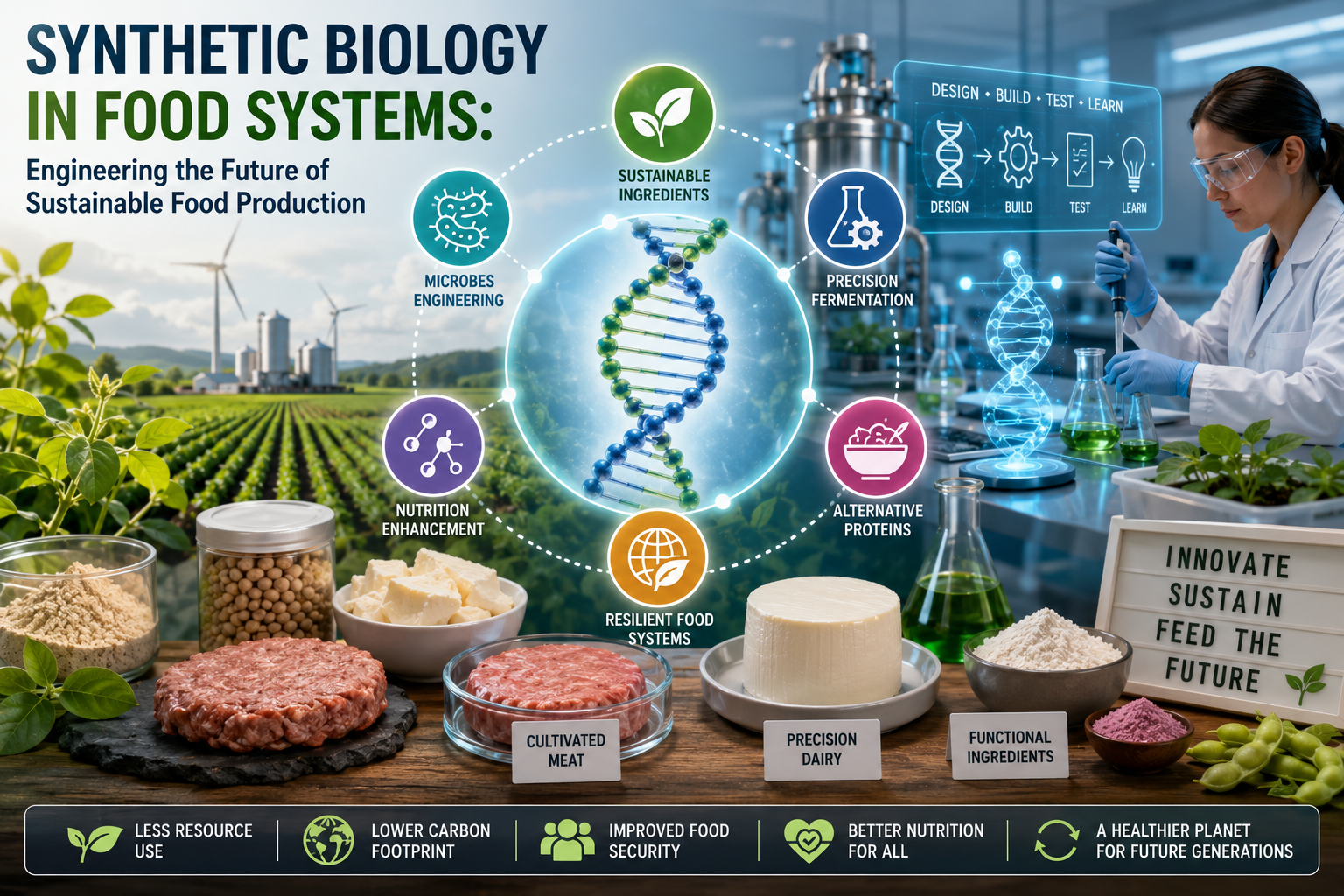
Summary
Global food systems face unprecedented challenges, including climate change, population growth, biodiversity loss, resource scarcity, antimicrobial resistance, and increasing demand for nutritious and sustainable foods. Traditional agricultural systems alone may struggle to meet future food requirements without significant environmental impacts. As a result, scientists are increasingly exploring transformative technologies capable of producing food more efficiently while reducing pressure on natural resources.
Synthetic biology has emerged as one of the most promising frontiers in modern biotechnology. By combining molecular biology, genetic engineering, computational biology, systems biology, and engineering principles, synthetic biology enables researchers to design, redesign, or construct biological systems with predictable functions. Unlike conventional genetic modification, which often focuses on introducing one or a few genes, synthetic biology adopts a systems-engineering approach to programming living organisms for specific applications.
In the food industry, synthetic biology is driving innovations in precision fermentation, alternative proteins, cultivated foods, food enzymes, flavor production, vitamins, probiotics, sustainable packaging, biosensors, and food safety monitoring. Advances in artificial intelligence (AI), machine learning, genome editing, automation, and bioinformatics are accelerating the design of biological systems capable of producing high-value food ingredients with remarkable precision.
This article explores the scientific foundations of synthetic biology, its applications across the food value chain, current research, regulatory considerations, ethical discussions, and the future of engineered biological systems in creating resilient and sustainable food systems.
Introduction
Food production has evolved through several technological revolutions, from domestication and mechanization to modern biotechnology and digital agriculture. Today, synthetic biology represents the next major leap in this evolution.
Rather than relying solely on conventional breeding or naturally occurring microorganisms, synthetic biology allows scientists to design biological systems that perform specific tasks. These may include producing dairy proteins without cows, synthesizing natural flavors without harvesting rare plants, creating microorganisms that manufacture vitamins or enzymes, or engineering microbes capable of degrading food contaminants.
The convergence of biotechnology with AI, robotics, automation, and high-throughput DNA sequencing has dramatically reduced the time and cost required to engineer biological systems, making synthetic biology increasingly relevant to the global food industry.
What Is Synthetic Biology?
Synthetic biology is an interdisciplinary field that applies engineering principles to biology by designing, constructing, and optimizing biological systems with predictable functions.
Key characteristics include:
- Rational biological design
- Standardized genetic components
- Modular biological engineering
- Computational modeling
- Automated design-build-test-learn cycles
- Systems-level optimization
Rather than modifying organisms through trial and error, synthetic biology emphasizes predictable, repeatable engineering.
Synthetic Biology vs Genetic Engineering
Although closely related, synthetic biology and conventional genetic engineering differ in scope.
| Feature | Genetic Engineering | Synthetic Biology |
|---|---|---|
| Primary goal | Modify existing traits | Design new biological functions |
| Scale | Individual genes | Entire biological systems |
| Design approach | Gene-focused | Engineering-based |
| Computational integration | Limited | Extensive |
| Automation | Moderate | High |
| AI integration | Increasing | Fundamental |
Synthetic biology builds upon genetic engineering while incorporating computational design, systems biology, and engineering methodologies.
The Design-Build-Test-Learn Cycle
Most synthetic biology projects follow an iterative engineering framework.
Design
Scientists identify biological objectives and use computational tools to design genetic pathways or metabolic networks.
Build
DNA constructs are synthesized and introduced into host organisms such as yeast, bacteria, fungi, or algae.
Test
Engineered organisms are evaluated for productivity, stability, safety, and desired biological functions.
Learn
Experimental results inform subsequent rounds of optimization, often assisted by machine learning and bioinformatics.
Applications Across the Food Industry
Precision Fermentation
One of the most successful applications of synthetic biology is precision fermentation.
Engineered microorganisms produce:
- Dairy proteins
- Egg proteins
- Enzymes
- Vitamins
- Flavor compounds
- Functional ingredients
These products can provide functional properties similar to conventionally produced ingredients while reducing reliance on livestock.
Alternative Proteins
Synthetic biology contributes to the development of sustainable protein sources by engineering microorganisms to produce high-quality proteins with desirable nutritional and functional characteristics.
Applications include:
- Microbial proteins
- Fungal proteins
- Algal proteins
- Recombinant food proteins
Cultivated Foods
Synthetic biology supports cultivated meat and seafood through:
- Growth factor production
- Cell culture optimization
- Scaffold development
- Media formulation improvements
These innovations aim to improve scalability and reduce production costs.
Food Enzymes
Many commercial food enzymes are produced using engineered microorganisms.
Applications include:
- Baking
- Brewing
- Dairy processing
- Juice clarification
- Starch processing
- Cheese production
Engineered production systems often improve efficiency and consistency.
Natural Flavors and Colors
Synthetic biology enables sustainable production of compounds such as:
- Vanillin
- Steviol glycosides
- Carotenoids
- Anthocyanins
- Terpenes
These ingredients can be produced through fermentation rather than extraction from limited natural sources.
Vitamins and Nutraceuticals
Engineered microbes manufacture numerous nutritional compounds, including:
- Vitamin B12
- Riboflavin
- Vitamin K
- Coenzyme Q10
- Amino acids
- Omega-3 fatty acids
Microbial production often offers improved sustainability compared with conventional manufacturing.
Food Safety Applications
Synthetic biology is increasingly contributing to safer food systems.
Biosensors
Engineered microorganisms and cell-free systems can detect:
- Foodborne pathogens
- Mycotoxins
- Heavy metals
- Pesticide residues
- Antibiotic residues
These biosensors may provide rapid, portable detection for food safety monitoring.
Biocontrol
Researchers are engineering beneficial microorganisms capable of suppressing foodborne pathogens or spoilage organisms during food production and storage.
Mycotoxin Detoxification
Synthetic biology is being investigated to enhance enzymes capable of degrading mycotoxins while preserving food quality.
Environmental Monitoring
Engineered biosensors may support continuous monitoring of food processing environments.
Agriculture and Primary Production
Applications extend beyond food manufacturing.
Crop Improvement
Synthetic biology contributes to developing crops with improved:
- Drought tolerance
- Disease resistance
- Nutrient use efficiency
- Climate resilience
Biological Nitrogen Fixation
Researchers are exploring engineered microbial systems that improve nitrogen availability, potentially reducing fertilizer requirements.
Livestock Health
Engineered probiotics and vaccines are being investigated to improve animal health while reducing antimicrobial use.
Integration with Artificial Intelligence
Artificial intelligence plays a central role in synthetic biology by:
- Predicting protein structures
- Optimizing metabolic pathways
- Designing DNA sequences
- Modeling biological networks
- Accelerating strain optimization
- Supporting laboratory automation
Machine learning significantly reduces experimental cycles and improves engineering efficiency.
Sustainability Benefits
Synthetic biology offers several potential sustainability advantages.
Reduced Land Use
Microbial fermentation generally requires less agricultural land than conventional livestock production.
Lower Greenhouse Gas Emissions
Certain fermentation-based production systems may generate fewer emissions than traditional agricultural systems.
Improved Resource Efficiency
Engineered biological systems can convert renewable feedstocks into valuable food ingredients with high efficiency.
Circular Bioeconomy
Agricultural by-products may serve as feedstocks for microbial production, supporting waste valorization and circular economy initiatives.
Challenges
Despite rapid progress, several challenges remain.
Regulatory Approval
Products must undergo rigorous safety assessments before commercialization.
Consumer Acceptance
Transparent communication is essential to build public trust in biotechnology-derived foods.
Technical Complexity
Engineering stable biological systems remains scientifically demanding.
Intellectual Property
Synthetic biology often involves patented technologies, raising questions about accessibility and innovation.
Biosafety
Appropriate containment and risk assessment are necessary throughout research and production.
Ethical and Regulatory Considerations
Regulators evaluate synthetic biology products using risk assessment frameworks that consider:
- Food safety
- Environmental impacts
- Allergenicity
- Toxicity
- Nutritional equivalence
- Manufacturing quality
International organizations, including the FAO, WHO, Codex Alimentarius Commission, EFSA, and FDA, continue to develop guidance relevant to biotechnology-derived foods.
Ethical discussions also address transparency, equitable access, biodiversity conservation, and public engagement.
Current Research
Active research areas include:
- Cell-free synthetic biology
- Engineered probiotics
- AI-guided protein design
- Carbon dioxide-utilizing microorganisms
- Novel food enzymes
- Sustainable flavor biosynthesis
- Living biosensors
- Programmable microbial communities
- Biodegradable biomaterials
- Climate-resilient food production
These innovations continue to expand the potential applications of synthetic biology in food systems.
Future Outlook
Over the coming decades, synthetic biology is expected to become increasingly integrated with digital food manufacturing.
Future developments may include:
- Autonomous biofoundries
- AI-designed food ingredients
- Carbon-negative food production
- Personalized nutrition manufactured through precision fermentation
- Programmable probiotics
- Smart fermentation systems linked to digital twins
- On-demand ingredient production
- Closed-loop circular biomanufacturing
As biological engineering becomes more predictable and scalable, synthetic biology may fundamentally reshape how food ingredients are produced.
Conclusion
Synthetic biology represents one of the most transformative technologies emerging in modern food science. By combining engineering principles with molecular biology, computational modeling, artificial intelligence, and industrial biotechnology, it enables the design of biological systems capable of producing food ingredients more efficiently and sustainably.
From precision fermentation and alternative proteins to biosensors, food enzymes, and sustainable manufacturing, synthetic biology is expanding the possibilities for resilient food production while supporting food safety and environmental sustainability. Continued research, transparent regulation, and responsible innovation will be essential to realizing its full potential while maintaining public confidence and protecting human and environmental health.
Key Takeaways
- Synthetic biology applies engineering principles to design biological systems with predictable functions.
- Major food applications include precision fermentation, alternative proteins, food enzymes, vitamins, flavors, biosensors, and cultivated foods.
- Artificial intelligence accelerates biological design through computational modeling and machine learning.
- Synthetic biology supports sustainability by reducing resource use, improving production efficiency, and enabling circular bioeconomy approaches.
- Responsible regulation, biosafety, and public engagement remain essential for the successful adoption of synthetic biology in food systems.
References
- Cameron, D. E., Bashor, C. J., & Collins, J. J. (2014). A brief history of synthetic biology. Nature Reviews Microbiology, 12(5), 381–390. https://doi.org/10.1038/nrmicro3239
- Nielsen, J., & Keasling, J. D. (2016). Engineering cellular metabolism. Cell, 164(6), 1185–1197. https://doi.org/10.1016/j.cell.2016.02.004
- Keasling, J. D. (2021). Synthetic biology and the development of tools for metabolic engineering. Metabolic Engineering, 63, 2–9.
- Lee, S. Y., Kim, H. U., Chae, T. U., et al. (2019). A comprehensive metabolic map for systems metabolic engineering. Nature Catalysis, 2, 18–33.
- Food and Agriculture Organization (FAO). Food Safety and Quality. https://www.fao.org/food-safety
- World Health Organization (WHO). Food Safety. https://www.who.int/health-topics/food-safety
- Codex Alimentarius Commission. Foods Derived from Modern Biotechnology. https://www.fao.org/fao-who-codexalimentarius/
- European Food Safety Authority (EFSA). Guidance on the risk assessment of genetically modified microorganisms and biotechnology-derived food products.