
Summary
Every day, billions of people consume foods that have been stored, transported, processed, or served using packaging and equipment made from plastics, paper, metals, glass, ceramics, coatings, inks, adhesives, and other food contact materials (FCMs). These materials play a vital role in protecting foods from contamination and spoilage. However, under certain conditions, small quantities of chemicals may migrate from these materials into food.
Chemical migration has become one of the most important topics in modern food safety because consumers, regulators, and manufacturers increasingly seek packaging that is both effective and safe. Advances in analytical chemistry now allow scientists to detect chemicals at extremely low concentrations, prompting greater attention to intentionally added substances, non-intentionally added substances (NIAS), microplastics, per- and polyfluoroalkyl substances (PFAS), bisphenols, phthalates, mineral oil hydrocarbons, and other emerging contaminants.
This article explains the science of food contact materials, how migration occurs, factors influencing migration, international regulations, analytical methods, current research, and emerging technologies that are shaping the future of safer and more sustainable food packaging.
Introduction
Packaging is often viewed simply as a protective container, yet it is an integral part of modern food systems. Without food packaging, spoilage rates would increase dramatically, foodborne contamination would become more common, and global food distribution would be significantly more difficult.
Modern food packaging must satisfy numerous requirements simultaneously. It should:
- Protect against microbial contamination
- Preserve nutritional quality
- Extend shelf life
- Prevent moisture and oxygen transfer
- Withstand transportation
- Provide consumer information
- Minimize environmental impact
At the same time, packaging materials should not transfer chemicals to foods at levels that could pose a health concern.
Balancing these objectives requires careful selection, testing, and regulation of food contact materials.
What Are Food Contact Materials?
Food contact materials are any materials or articles intended to come into direct or indirect contact with food during manufacturing, processing, packaging, storage, transportation, preparation, or serving.
Examples include:
- Plastic packaging
- Glass bottles
- Metal cans
- Paper and cardboard packaging
- Food processing equipment
- Conveyor belts
- Cutting boards
- Kitchen utensils
- Food storage containers
- Bottle caps and seals
Although these materials differ greatly, they all share one critical requirement: they must be safe for their intended use.
What Is Chemical Migration?
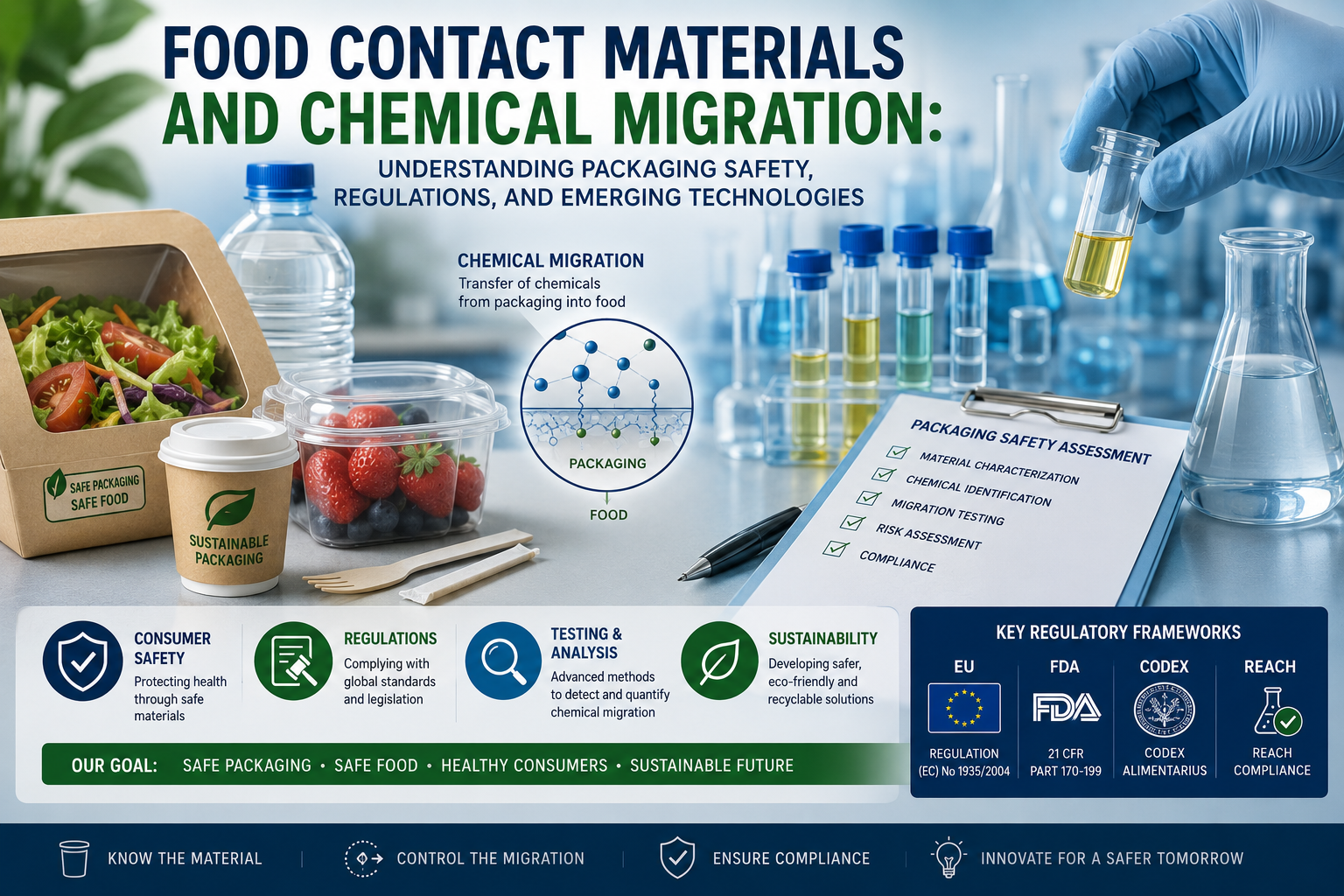
Chemical migration refers to the movement of chemical substances from food contact materials into food.
Migration does not necessarily indicate a safety problem. Small amounts of migration may occur naturally and remain well below regulatory safety limits.
However, migration becomes a concern when:
- Unsafe chemicals are present
- Migration exceeds legal limits
- Long-term exposure raises toxicological concerns
- Vulnerable populations such as infants are exposed
Understanding migration mechanisms is therefore essential for food safety.
Types of Migrating Substances
Intentionally Added Substances (IAS)
These substances are deliberately used during manufacturing.
Examples include:
- Plasticizers
- Stabilizers
- Antioxidants
- Colorants
- Lubricants
- UV absorbers
Non-Intentionally Added Substances (NIAS)
NIAS are formed unintentionally during manufacturing or degradation.
Sources include:
- Reaction by-products
- Degradation products
- Impurities
- Contaminants
- Recycling residues
Because NIAS are often chemically complex, they have become a major focus of current food packaging research.
Factors Affecting Chemical Migration
Several variables influence migration rates.
Temperature
Higher temperatures generally increase migration.
Examples include:
- Microwave heating
- Hot filling
- Sterilization
- Pasteurization
Contact Time
Longer storage periods increase opportunities for migration.
Food Composition
Fatty foods often absorb lipophilic chemicals more readily than aqueous foods.
Foods commonly associated with higher migration include:
- Cheese
- Butter
- Meat
- Chocolate
- Cooking oils
Packaging Material
Different polymers, coatings, and composite materials exhibit different migration behaviors.
Surface Area
Greater contact between packaging and food generally increases migration potential.
Major Chemicals of Interest
Bisphenols
Bisphenols, including BPA and some replacement compounds, have received considerable scientific attention because of potential endocrine activity.
Many jurisdictions have introduced restrictions or specific migration limits for certain applications.
Phthalates
Phthalates are commonly used as plasticizers in some materials but are subject to strict regulatory controls in food contact applications.
PFAS
Per- and polyfluoroalkyl substances have been used for grease-resistant packaging.
Due to concerns regarding persistence in the environment and potential health effects, many regulatory authorities are reviewing or restricting certain PFAS uses.
Mineral Oil Hydrocarbons
These compounds may migrate from recycled paperboard or printing inks under some conditions.
Printing Ink Components
Packaging inks are generally applied to the exterior of packaging, but migration through packaging layers or set-off during storage may occur if materials are poorly designed.
Migration Testing
Before food contact materials reach the market, manufacturers conduct migration testing under standardized conditions.
Overall Migration
Overall migration measures the total quantity of non-volatile substances transferred from packaging into food simulants.
Specific Migration
Specific migration evaluates individual chemicals with established regulatory limits.
Food Simulants
Because testing every food is impractical, laboratories use standardized food simulants representing:
- Aqueous foods
- Acidic foods
- Alcoholic foods
- Fatty foods
- Dry foods
These standardized methods improve comparability between laboratories.
Analytical Techniques
Modern laboratories use highly sensitive analytical technologies.
Gas Chromatography–Mass Spectrometry (GC-MS)
Used for volatile and semi-volatile compounds.
Applications include:
- Mineral oils
- Solvents
- Plastic additives
Liquid Chromatography–Mass Spectrometry (LC-MS/MS)
Suitable for less volatile compounds such as bisphenols, PFAS, and many NIAS.
Inductively Coupled Plasma Mass Spectrometry (ICP-MS)
Used to determine trace metals migrating from packaging.
High-Resolution Mass Spectrometry
Supports non-target screening to identify previously unknown migrating substances.
Regulatory Framework
Food contact materials are regulated internationally to ensure consumer safety.
Key organizations include:
- Codex Alimentarius Commission
- European Food Safety Authority (EFSA)
- U.S. Food and Drug Administration (FDA)
- Food and Agriculture Organization (FAO)
- World Health Organization (WHO)
Although regulatory approaches differ between jurisdictions, they generally require that food contact materials:
- Do not endanger human health
- Do not alter food composition unacceptably
- Do not negatively affect taste or odor
- Are manufactured according to good manufacturing practices
Sustainability and Circular Economy
The transition toward sustainable packaging introduces new opportunities and challenges.
Researchers are developing:
- Bioplastics
- Compostable packaging
- Fiber-based packaging
- Bio-based coatings
- Recyclable multilayer materials
At the same time, recycling may introduce contaminants if processes are not carefully controlled, emphasizing the importance of rigorous safety assessments.
Emerging Technologies
Several innovations are improving packaging safety.
Artificial Intelligence
AI assists manufacturers by predicting migration behavior, optimizing formulations, and identifying high-risk packaging combinations.
Digital Twins
Virtual simulations reduce the need for extensive physical migration testing during product development.
Smart Packaging
Sensors monitor storage conditions and help identify situations where packaging performance may be compromised.
Nanotechnology
Nano-engineered materials improve barrier properties while researchers continue evaluating their migration characteristics and long-term safety.
Current Research
Active research areas include:
- Non-target analysis of NIAS
- PFAS alternatives
- Safe recycled food-grade plastics
- Bio-based packaging materials
- AI-assisted migration prediction
- High-resolution screening methods
- Sustainable coatings
- Packaging for plant-based foods
Researchers are also evaluating cumulative dietary exposure from multiple food contact materials.
Future Outlook
The future of food contact materials will focus on safety by design.
Emerging developments include:
- AI-guided material selection
- Safer polymer chemistries
- Improved recycling technologies
- Intelligent migration prediction
- Fully recyclable high-performance packaging
- Digital traceability for packaging materials
Greater collaboration between material scientists, toxicologists, food chemists, packaging engineers, regulators, and manufacturers will continue improving consumer protection.
Conclusion
Food contact materials are indispensable components of modern food systems, preserving quality, extending shelf life, and facilitating global food distribution. At the same time, understanding chemical migration is essential for ensuring that packaging performs its protective function without compromising consumer health.
Advances in analytical chemistry, toxicology, materials science, and computational modeling are enabling more comprehensive assessments of both intentionally added substances and emerging contaminants. As sustainable packaging technologies evolve, integrating safety assessment with innovation will remain central to protecting public health while reducing environmental impacts.
Key Takeaways
- Food contact materials include all materials that come into contact with food during processing, packaging, storage, or use.
- Chemical migration depends on temperature, storage time, food composition, packaging material, and contact conditions.
- Scientists monitor both intentionally added substances and non-intentionally added substances (NIAS).
- Modern analytical techniques such as LC-MS/MS, GC-MS, ICP-MS, and high-resolution mass spectrometry enable highly sensitive migration testing.
- Future packaging will increasingly combine sustainable materials, smart technologies, AI-assisted design, and rigorous safety evaluation.
References
- Bradley, E. L., Castle, L., & Chaudhry, Q. (2013). Applications of nanomaterials in food packaging with a consideration of opportunities for developing countries. TrAC Trends in Analytical Chemistry, 45, 141–152.
- European Food Safety Authority (EFSA). Guidance on food contact materials and migration assessment.
- U.S. Food and Drug Administration (FDA). Food Contact Substances Program.
- Food and Agriculture Organization (FAO). Food Safety and Quality.
- World Health Organization (WHO). Food Safety.
- Muncke, J. (2021). Exposure to food contact chemicals and public health. Environmental Health, 20, 22.
- Groh, K. J., et al. (2019). Overview of intentionally used food contact chemicals and their hazards. Critical Reviews in Food Science and Nutrition.