
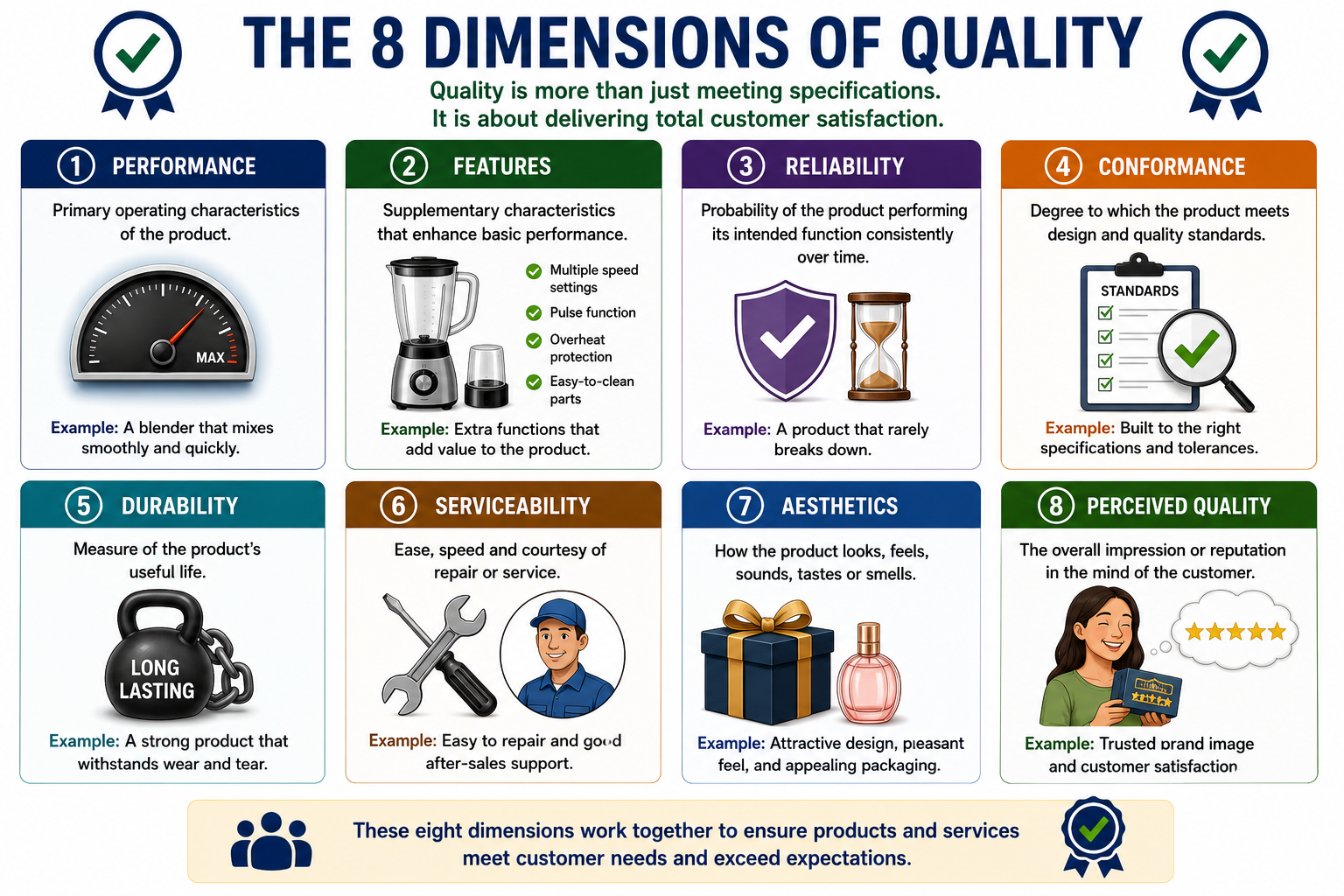
Quality is diverse, and many aspects relate to a product or service quality. Thus, quality is not defined by just one aspect but by a combination of many aspects. The trade-offs between these aspects may be the difference between acceptable brands and failing products in the market. The 8 dimensions of quality highlighted by Garvin [2] that link customer requirements to the engineering design of products include:
- Performance - these are the basic operating characteristics of the food product or service, and they can be measured. e.g., product attributes. A product's performance can determine its survival in the market. It is also one of the bases for consumer choice.
- Features - Additional characteristics that enhance the product’s or service’s appeal to the user, e.g., gluten-free bread, low-cholesterol product, etc. What has the manufacturer done beyond the obvious product characteristics? Some consumers buy food products just because of the additional features.
- Reliability - The likelihood that a product will not fail within a specific time period, e.g., if a certain product should have a shelf life of at least 3 years, then it yields exactly that. Most consumers rarely return to a product that once failed. Thus, manufacturers have to design reliable products that can adequately perform their design function.
- Conformance - The precision with which the product or service meets the specified standards. E.g., Conformance to legal standards. How well does the product conform to established guidelines as well as consumer requirements?
- Durability - Measures the length of a product’s life, e.g., the shelf life of food products. A longer shelf life is always desirable, as products don't go to waste if they cannot be consumed sooner. Manufacturers are always striving to provide more durable products
- Serviceability - The speed with which the product can be put into service when it breaks down, as well as the competence and behavior of the service person. How fast can a machine be put back to service if it breaks down? Some manufacturers of machines will have service men accompany the machine for installation, or be available on call
- Aesthetics - The subjective dimension indicating the kind of response a user has to a product. It represents the individual’s preference to feel, smell, taste, and smell food products. How does the consumer like the colour, flavour, or taste of a food product? These are subjective characteristics, and different people offer different views. Manufacturers have to make a decision on these attributes based on consumer needs.
- Perceived quality - Also a subjective dimension; it is the quality attributed to goods or services based on indirect measures. E.g., A well-maintained food plant may indicate a good workman. Although a product may have minimal nutritional quality, the perception that the product is natural or organic may draw many consumers to it, as they believe that the product is of better quality.
The manufacturer must keenly study all the above aspects and how they relate to their product. The ultimate goal is to obtain a good quality product. The quality attained for any food product is defined by the trade-offs in these well-defined aspects.