
Summary
Fermentation has been used for thousands of years to produce foods such as bread, yogurt, cheese, beer, wine, and fermented vegetables. Today, scientists are taking fermentation to an entirely new level through precision fermentation—a biotechnology that enables carefully selected microorganisms to produce specific food ingredients with remarkable accuracy.
Unlike traditional fermentation, which relies on naturally occurring microbial activities, precision fermentation uses microorganisms programmed to manufacture targeted proteins, enzymes, vitamins, fats, and other functional ingredients. These ingredients can be identical to those found in milk, eggs, or other animal-derived foods, but are produced without raising livestock.
This technology is rapidly transforming the food industry by supporting sustainable protein production, reducing environmental impacts, improving food safety, and expanding opportunities for innovative food products. While challenges remain—including production costs, regulatory approval, and consumer understanding—precision fermentation is increasingly viewed as one of the most significant advances in modern food science.
Introduction
Global food systems are under increasing pressure from population growth, climate change, limited agricultural resources, and rising demand for high-quality protein. Conventional livestock production provides valuable nutrition but also requires significant amounts of land, water, and feed, while contributing to greenhouse gas emissions.
Food scientists are therefore exploring innovative production systems that can provide essential nutrients more efficiently and sustainably. Precision fermentation has emerged as one of the leading technologies capable of producing high-value food ingredients with reduced environmental footprints.
From animal-free dairy proteins to specialty enzymes and nutritional ingredients, precision fermentation is opening new possibilities for food manufacturers and consumers alike.
What Is Precision Fermentation?
Precision fermentation is a biotechnology process in which microorganisms such as yeast, fungi, or bacteria are used to produce specific food ingredients under carefully controlled conditions.
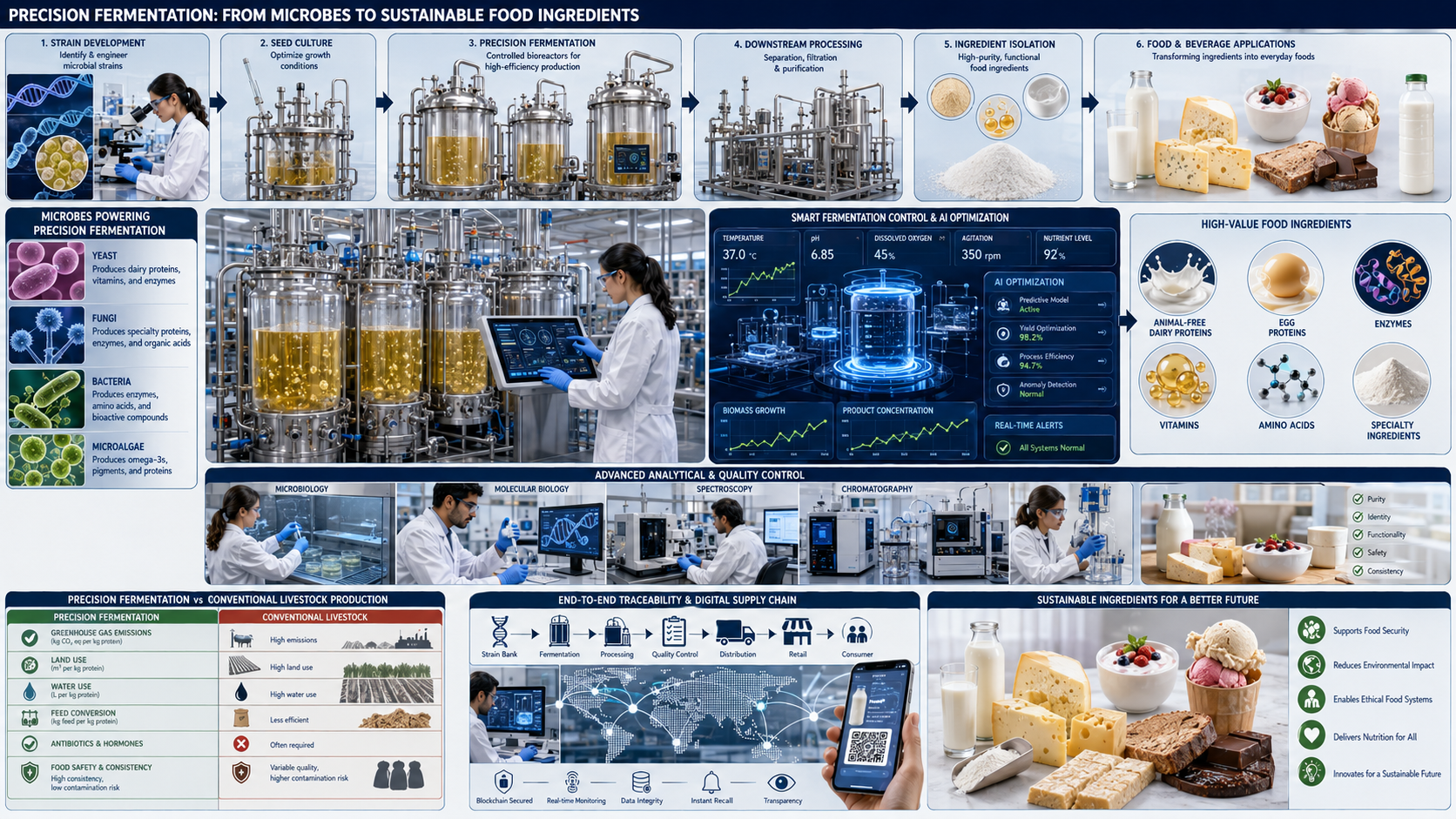
Scientists identify the genetic instructions responsible for producing a desired protein or molecule and introduce them into suitable microorganisms. During fermentation, these microorganisms use nutrients—typically sugars, minerals, nitrogen sources, and vitamins—to grow and produce the target ingredient.
After fermentation, the desired ingredient is purified and incorporated into food products.
Importantly, the final purified ingredient does not contain living production microorganisms.
How Precision Fermentation Works
Step 1: Selecting the Target Ingredient
Researchers identify a protein or functional ingredient to produce, such as:
- Whey protein
- Casein
- Egg white proteins
- Enzymes
- Vitamins
- Natural flavors
Step 2: Developing the Production Microorganism
A suitable microbial production strain is selected based on its ability to efficiently produce the target ingredient during fermentation.
Step 3: Controlled Fermentation
The microorganisms are cultivated in stainless-steel bioreactors where conditions such as:
- Temperature
- pH
- Oxygen
- Agitation
- Nutrient supply
are precisely controlled to maximize production efficiency.
Step 4: Purification
Following fermentation, the desired ingredient is separated from the fermentation broth using advanced purification techniques.
Quality testing ensures the ingredient meets food safety and purity standards.
Step 5: Food Manufacturing
The purified ingredient is incorporated into a wide range of foods, including dairy alternatives, beverages, baked goods, confectionery products, nutritional supplements, and specialty foods.
Current Applications
Precision fermentation is already being used to produce numerous food ingredients.
Animal-Free Dairy Proteins
Microorganisms can produce proteins that are structurally and functionally similar to those naturally found in milk.
These proteins can be used to manufacture cheeses, yogurts, ice creams, and beverages with dairy-like functionality.
Egg Proteins
Egg proteins produced through fermentation may be used in:
- Baking
- Confectionery
- Sauces
- Processed foods
They provide emulsification, foaming, and binding properties.
Food Enzymes
Many commercial food enzymes used in:
- Cheese making
- Baking
- Brewing
- Fruit juice processing
are already produced through microbial fermentation.
Vitamins and Nutritional Ingredients
Precision fermentation is widely used to manufacture:
- Vitamin B12
- Riboflavin
- Amino acids
- Organic acids
- Natural colorants
Advantages
Sustainability
Compared with conventional livestock production, precision fermentation has the potential to reduce:
- Land use
- Water consumption
- Greenhouse gas emissions
- Feed requirements
Environmental benefits depend on production efficiency and energy sources.
Food Safety
Production occurs in highly controlled manufacturing environments with strict quality assurance systems.
This reduces exposure to many environmental contaminants and improves process consistency.
Product Consistency
Controlled fermentation allows manufacturers to produce ingredients with highly consistent quality throughout the year.
Innovation
Precision fermentation enables development of novel food ingredients that may be difficult or inefficient to obtain through traditional agriculture.
Challenges
Despite its promise, several challenges remain.
Production Costs
Large-scale fermentation infrastructure and downstream purification remain expensive.
Continued technological improvements are reducing costs.
Consumer Understanding
Some consumers are unfamiliar with precision fermentation and may confuse it with conventional genetic modification or laboratory-grown foods.
Transparent communication and science-based education are essential.
Regulatory Oversight
Food ingredients produced using precision fermentation undergo rigorous safety evaluations before commercialization.
Regulatory agencies assess:
- Manufacturing processes
- Ingredient purity
- Toxicological safety
- Allergenicity
- Nutritional characteristics
Food Safety Considerations
Manufacturers employ comprehensive food safety systems including:
- Good Manufacturing Practices (GMP)
- Hazard Analysis and Critical Control Point (HACCP)
- Microbiological monitoring
- Ingredient traceability
- Quality assurance testing
Routine analytical testing verifies purity, composition, and product consistency.
Research Spotlight
Researchers continue improving precision fermentation through advances in:
- Synthetic biology
- Metabolic engineering
- High-efficiency microbial strains
- Continuous fermentation
- Bioreactor optimization
- Sustainable feedstocks
Artificial intelligence is increasingly being used to optimize fermentation conditions and improve production efficiency.
Future Outlook
The next generation of precision fermentation technologies may enable production of:
- Specialized dairy proteins
- Functional lipids
- Bioactive peptides
- Personalized nutrition ingredients
- Sustainable food additives
- Specialty fats for plant-based foods
As manufacturing costs decline and production capacity expands, precision fermentation is expected to play an increasingly important role in global food systems.
Conclusion
Precision fermentation represents one of the most exciting innovations in modern food biotechnology. By harnessing the capabilities of carefully selected microorganisms, scientists can produce high-quality food ingredients with remarkable precision, supporting more sustainable, resilient, and efficient food production.
Although challenges related to cost, consumer awareness, and regulation remain, advances in biotechnology, fermentation engineering, and food science continue to accelerate the adoption of this technology. In the coming decades, precision fermentation is likely to become a cornerstone of next-generation food manufacturing, helping meet global nutritional needs while reducing the environmental footprint of food production.
Key Takeaways
- Precision fermentation uses microorganisms to produce specific food ingredients with high precision.
- Applications include animal-free dairy proteins, egg proteins, enzymes, vitamins, and specialty ingredients.
- The technology can improve sustainability, consistency, and food safety.
- Controlled bioreactor systems ensure reliable production and quality.
- Continued innovation is expected to expand precision fermentation’s role in future food systems.
References
- Food and Agriculture Organization (FAO). The Future of Food and Agriculture.
- World Health Organization (WHO). Food Safety.
- Nature Food. Advances in Precision Fermentation for Food Production.
- Trends in Food Science & Technology. Precision Fermentation and Alternative Protein Technologies.
- Annual Review of Food Science and Technology. Microbial Biotechnology in Modern Food Manufacturing.
- Comprehensive Reviews in Food Science and Food Safety. Precision Fermentation Applications in Food Systems.
- Journal of Food Engineering. Bioprocess Design for Precision Fermentation.
- Frontiers in Bioengineering and Biotechnology. Microbial Cell Factories for Sustainable Food Production.