
Summary
Microplastics—tiny plastic particles smaller than five millimeters—have emerged as one of the most widely discussed environmental contaminants of the modern era. Once considered an ocean pollution problem primarily, researchers have now identified microplastics in drinking water, seafood, table salt, fruits, vegetables, honey, dairy products, and even the air we breathe.
Although scientists continue to investigate the long-term health effects of dietary exposure, growing evidence suggests that microplastics are entering food systems through multiple pathways. Environmental contamination, food processing, packaging materials, and agricultural practices may all contribute to human exposure.
This article examines where microplastics come from, how they enter the food chain, what current research says about potential health impacts, and the technologies being developed to monitor and reduce contamination.
Introduction
Plastic has transformed modern life. Lightweight, durable, and inexpensive, it is used in everything from food packaging and storage containers to transportation and medical devices. However, the widespread use of plastics has created an unintended consequence: the accumulation of plastic particles throughout the environment.
Over time, larger plastic materials break down into smaller fragments through sunlight, weathering, mechanical abrasion, and biological processes. These fragments eventually become microplastics and, in some cases, even smaller particles known as nanoplastics.
Scientists are increasingly concerned about the presence of these particles in food systems because they may carry chemicals, pollutants, and microorganisms capable of affecting environmental and human health.
What Are Microplastics?
Microplastics are generally defined as plastic particles smaller than 5 millimeters.
They are typically classified into two categories:
Primary Microplastics
These are intentionally manufactured at microscopic sizes.
Examples include:
- Industrial plastic pellets
- Cosmetic microbeads
- Certain synthetic fibers
Secondary Microplastics
These result from the breakdown of larger plastic products.
Examples include:
- Plastic bottles
- Food packaging
- Fishing gear
- Plastic bags
- Agricultural films
Secondary microplastics represent the largest source of environmental contamination.
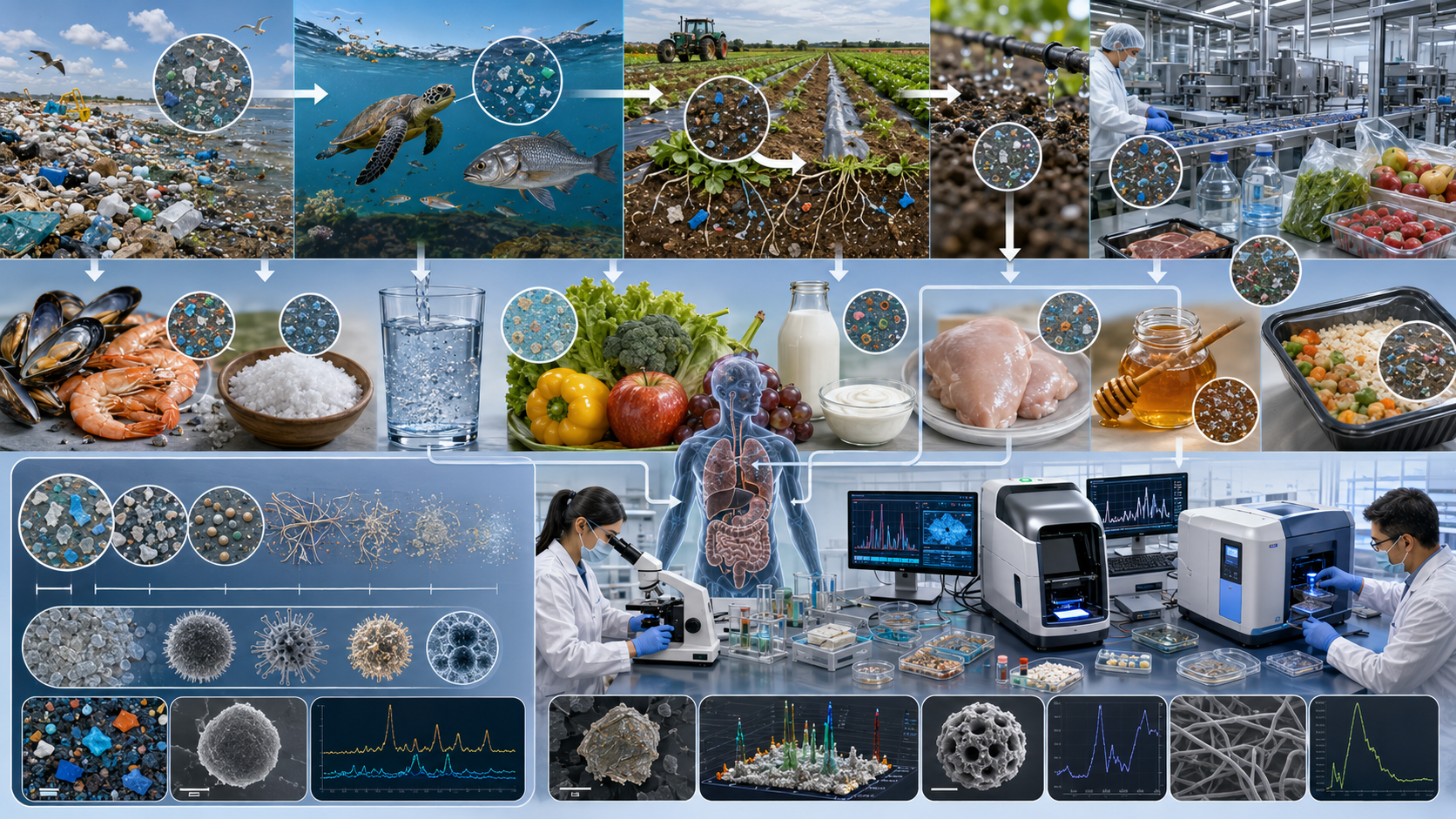
How Microplastics Enter the Food Chain
Marine Environments
Oceans are major reservoirs for plastic waste.
Fish, shellfish, and other marine organisms may ingest plastic particles directly or indirectly through contaminated prey.
As a result, microplastics have been detected in:
- Fish
- Mussels
- Oysters
- Shrimp
- Sea salt
Agricultural Systems
Microplastics are increasingly being found in agricultural soils.
Sources include:
- Plastic mulch films
- Irrigation water
- Sewage sludge fertilizers
- Atmospheric deposition
Researchers have reported evidence that some crops may absorb microscopic plastic particles from soil and water.
Food Processing and Packaging
Food can become contaminated during manufacturing, processing, transportation, and storage.
Potential sources include:
- Plastic conveyor belts
- Processing equipment
- Packaging materials
- Synthetic clothing fibers shed by workers
Food packaging remains an active area of scientific investigation.
Foods Commonly Reported to Contain Microplastics
Studies have identified microplastics in a variety of foods, including:
Seafood
Seafood is among the most frequently studied categories because marine organisms are directly exposed to contaminated environments.
Drinking Water
Both bottled and tap water have been found to contain microplastic particles in numerous studies.
Salt
Sea salt can accumulate microplastics originating from marine pollution.
Fruits and Vegetables
Emerging research suggests that plants may take up microscopic particles from soil and irrigation water.
Honey and Sugar
Trace amounts of microplastics have been reported in some honey and sugar samples, likely due to environmental contamination.
Potential Health Concerns
Scientists are still working to understand the health implications of chronic microplastic exposure.
Several concerns are being investigated.
Physical Effects
Particles may interact with tissues in the digestive system.
Researchers are examining:
- Inflammation
- Cellular stress
- Tissue responses
Chemical Exposure
Plastics can contain additives such as:
- Plasticizers
- Stabilizers
- Flame retardants
- Pigments
Some plastics may also absorb environmental contaminants.
Microbial Transport
Microplastics can serve as surfaces for microorganisms, creating what researchers call the “plastisphere.”
Scientists are studying whether these particles contribute to the transport of pathogens through environmental systems.
Nanoplastics
Nanoplastics are even smaller than microplastics and may pose unique concerns because of their ability to interact with cells and biological tissues.
Research in this area remains ongoing.
What Does Current Science Say?
One of the biggest challenges in microplastic research is the lack of standardized testing methods.
Different studies often use:
- Different sampling methods
- Different particle size thresholds
- Different analytical techniques
As a result, estimates of human exposure vary considerably.
Current scientific consensus suggests:
- Human exposure to microplastics is widespread.
- Microplastics are present in numerous foods and beverages.
- Long-term health impacts remain under investigation.
- More research is needed before definitive conclusions can be reached.
How Scientists Detect Microplastics
Detecting plastic particles in food requires sophisticated analytical techniques.
Fourier Transform Infrared Spectroscopy (FTIR)
FTIR identifies plastics by analyzing their molecular signatures.
Raman Spectroscopy
This method helps determine the chemical composition of particles.
Electron Microscopy
Microscopy enables researchers to visualize very small particles and evaluate their structure.
Thermal Analysis
Scientists can quantify plastic content by measuring characteristic thermal properties.
Reducing Microplastic Contamination
While eliminating environmental plastic contamination will require global action, several strategies may help reduce future exposure.
Improved Waste Management
Reducing plastic leakage into the environment remains one of the most effective interventions.
Sustainable Packaging
Food companies are increasingly exploring:
- Recyclable materials
- Compostable packaging
- Bio-based alternatives
Better Water Treatment
Advanced filtration technologies may help remove microplastics from drinking water supplies.
Agricultural Best Practices
Reducing unnecessary plastic use in agriculture can help limit soil contamination.
Research Spotlight
Microplastics and Human Food Systems
Recent scientific reviews emphasize that microplastics have become a global food safety and environmental health issue.
Researchers have highlighted three key priorities:
- Standardized detection methods.
- Better exposure assessment.
- Long-term human health studies.
The next decade is expected to provide substantially more information regarding the biological significance of dietary microplastic exposure.
Future Directions
Emerging technologies may improve monitoring and risk assessment through:
- Artificial intelligence-assisted particle identification
- Automated laboratory analysis
- Advanced spectroscopy systems
- Real-time environmental monitoring
- Improved food packaging design
Scientists are also investigating biodegradable materials that may reduce future contamination.
Conclusion
Microplastics have become an unavoidable component of modern environments and food systems. Evidence increasingly shows that these particles can enter foods through environmental contamination, agricultural practices, processing operations, and packaging materials.
Although significant questions remain regarding long-term health impacts, researchers agree that reducing plastic pollution should remain a global priority. Continued scientific research, improved monitoring technologies, and sustainable production practices will play critical roles in protecting both environmental and public health.
References and Further Reading
- World Health Organization (WHO). Microplastics in Drinking Water.
- Food and Agriculture Organization (FAO). Plastic Pollution and Food Systems.
- United Nations Environment Programme (UNEP). Turning Off the Tap on Plastic Pollution.
- Nature Reviews Earth & Environment. Microplastics in Terrestrial and Aquatic Food Systems.
- Environmental Science & Technology. Microplastics and Human Exposure Research.
- Journal of Hazardous Materials. Detection and Characterization of Microplastics in Food.
- Science of the Total Environment. Agricultural Sources of Microplastic Contamination.
- Frontiers in Environmental Science. Microplastics in Food and Human Health.