
Summary
As the global population continues to grow, the demand for sustainable, nutritious, and environmentally friendly protein sources is increasing. Traditional livestock production requires large amounts of land, water, and feed while contributing significantly to greenhouse gas emissions. These challenges have prompted scientists to explore alternative protein sources capable of meeting future food demands.
Edible insects have emerged as one of the most promising solutions. More than 2,000 insect species are consumed by humans worldwide, providing high-quality protein, healthy fats, vitamins, minerals, and bioactive compounds. In many parts of Africa, Asia, and Latin America, insects have been part of traditional diets for centuries.
Despite their long history of consumption, edible insects remain relatively unfamiliar in many Western countries. Growing interest in sustainable diets, food innovation, and environmental conservation is now driving research into insect farming, food safety, nutritional quality, and consumer acceptance.
This article explores the science behind edible insects, their nutritional benefits, environmental advantages, food safety considerations, commercial opportunities, and their potential role in future global food systems.
Introduction
Global food systems face unprecedented challenges. Climate change, population growth, declining biodiversity, and limited natural resources are increasing pressure on agriculture.
Livestock production currently accounts for a substantial proportion of agricultural land use while requiring considerable quantities of water and feed. Scientists are therefore investigating protein sources that can be produced more efficiently with a lower environmental footprint.
Edible insects offer one such opportunity. They convert feed into body mass efficiently, reproduce rapidly, and can often be reared using fewer natural resources than conventional livestock.
For many communities around the world, insect consumption—or entomophagy—is not a new concept but a long-standing cultural tradition.
What Are Edible Insects?
Edible insects are insect species considered safe and suitable for human consumption.
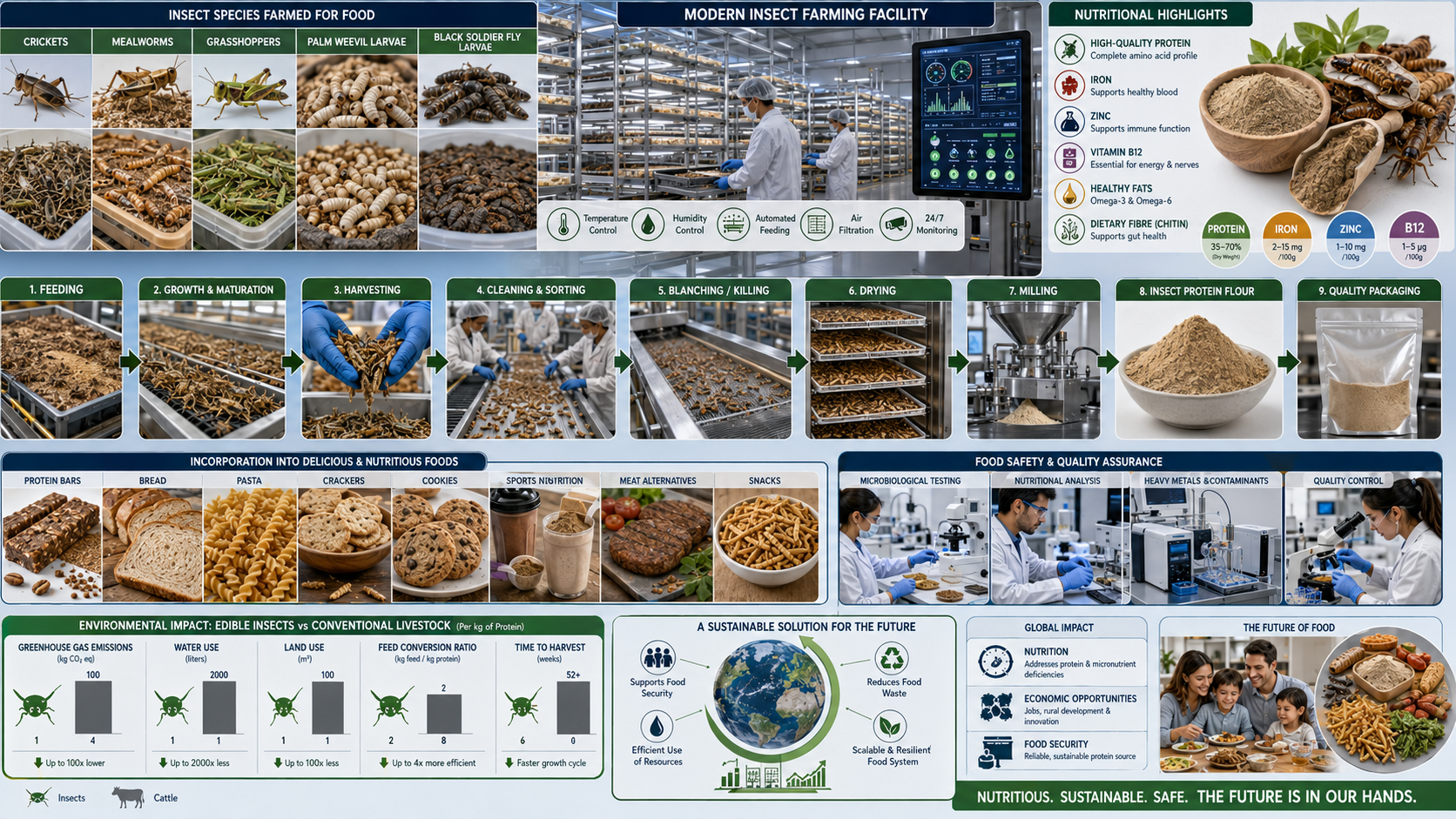
Commonly consumed species include:
- Crickets
- Mealworms
- Grasshoppers
- Locusts
- Black soldier fly larvae (primarily for animal feed, with emerging food applications)
- Palm weevil larvae
- Termites
- Silkworm pupae
These insects may be consumed whole, roasted, dried, fried, or processed into powders and protein ingredients.
Nutritional Value
Many edible insects provide exceptional nutritional quality.
High-Quality Protein
Depending on the species and processing method, insects may contain between 35% and 70% protein on a dry-weight basis.
They supply many essential amino acids required for growth and tissue repair.
Healthy Fats
Many species contain beneficial unsaturated fatty acids, including omega-3 and omega-6 fatty acids.
Fat composition varies depending on the insect species and diet.
Vitamins
Edible insects may provide:
- Vitamin B12
- Riboflavin
- Niacin
- Folate
Some species also contain vitamin A precursors.
Minerals
Insects can be rich sources of:
- Iron
- Zinc
- Calcium
- Magnesium
- Potassium
- Phosphorus
Iron from certain insect species has shown promising bioavailability in research studies.
Dietary Fibre
Unlike meat, insects contain chitin, a structural polysaccharide that functions as dietary fibre.
Scientists continue to investigate its potential effects on gut health and immunity.
Environmental Benefits
One of the greatest advantages of insect farming is resource efficiency.
Lower Greenhouse Gas Emissions
Many insect species produce substantially fewer greenhouse gases than cattle and other ruminants.
Reduced Land Requirements
Vertical farming systems allow insect production in relatively small spaces.
Efficient Feed Conversion
Insects convert feed into edible biomass more efficiently than many traditional livestock species.
Lower Water Use
Water requirements for insect farming are generally much lower than for beef production.
Circular Economy Opportunities
Certain insect species can convert agricultural by-products and food processing residues into valuable protein, supporting more sustainable food systems.
Food Safety Considerations
Like all foods, edible insects must be produced under appropriate food safety standards.
Potential considerations include:
Microbiological Hazards
Poor handling or inadequate processing can allow the growth of harmful microorganisms.
Good hygiene and proper heat treatment are essential.
Allergic Reactions
People allergic to crustaceans, shrimp, crab, or dust mites may also react to insect proteins due to similarities in certain allergens.
Appropriate labeling is important.
Chemical Contaminants
The safety of insects depends largely on the quality of their feed.
Contaminated feed may introduce:
- Heavy metals
- Pesticides
- Environmental contaminants
Regulated farming systems help minimize these risks.
How Are Edible Insects Processed?
Commercial production typically involves several stages:
Farming
Insects are reared in controlled environments with carefully managed temperature, humidity, and feed.
Harvesting
Insects are harvested at the optimal stage for nutritional quality and product consistency.
Processing
Depending on the intended product, insects may be:
- Blanched
- Dried
- Roasted
- Freeze-dried
- Milled into flour
- Incorporated into food formulations
Applications in the Food Industry
Edible insects are increasingly being incorporated into:
- Protein bars
- Pasta
- Crackers
- Cookies
- Bread
- Breakfast cereals
- Meat alternatives
- Sports nutrition products
Insect protein powders allow manufacturers to develop familiar foods while reducing the visibility of whole insects, which may improve consumer acceptance.
Consumer Acceptance
Consumer perception remains one of the greatest barriers to widespread adoption.
Factors influencing acceptance include:
- Cultural traditions
- Food neophobia
- Product appearance
- Taste
- Knowledge of nutritional benefits
- Environmental awareness
Research suggests consumers are generally more willing to try products containing insect flour than whole insects.
Research Spotlight
Scientists continue investigating:
- Improved insect breeding programs
- Automated insect farming technologies
- Nutritional optimization
- Functional food applications
- Protein extraction methods
- Shelf-life improvement
- Food safety monitoring
Researchers are also studying insect-derived ingredients for use in specialized nutrition products and sustainable food systems.
Future Outlook
The edible insect industry is expected to expand significantly over the coming decades.
Future developments may include:
- Large-scale automated insect farms
- New insect-based protein ingredients
- Improved food processing technologies
- Enhanced food safety standards
- Greater consumer education
- Wider regulatory harmonization
As sustainability becomes increasingly important, edible insects could become a valuable complement—not necessarily a replacement—to conventional animal proteins.
Conclusion
Edible insects represent one of the most promising alternative protein sources for the future. They combine impressive nutritional value with efficient resource use, lower environmental impacts, and diverse culinary possibilities.
Although challenges such as consumer acceptance, allergen management, and regulatory frameworks remain, advances in food science and insect farming technologies continue to improve their commercial potential.
With continued research, innovation, and education, edible insects may play an increasingly important role in building resilient, nutritious, and sustainable global food systems.
Key Takeaways
- More than 2,000 insect species are consumed worldwide.
- Edible insects provide high-quality protein, healthy fats, vitamins, and minerals.
- Insect farming requires less land, water, and feed than many conventional livestock systems.
- Proper farming, processing, and labeling are essential to ensure food safety.
- Insect-based ingredients are increasingly being incorporated into mainstream food products.
References
- Food and Agriculture Organization (FAO). Edible Insects: Future Prospects for Food and Feed Security.
- World Health Organization (WHO). Food Safety.
- European Food Safety Authority (EFSA). Risk Profile Related to the Production and Consumption of Insects as Food and Feed.
- Trends in Food Science & Technology. Edible Insects as Sustainable Protein Sources.
- Comprehensive Reviews in Food Science and Food Safety. Nutritional Composition of Edible Insects.
- Journal of Insects as Food and Feed. Advances in Insect Farming Technologies.
- Annual Review of Food Science and Technology. Alternative Proteins for Sustainable Food Systems.
- Frontiers in Nutrition. Consumer Acceptance of Insect-Based Foods.