
Summary
Food manufacturing is entering a new era where physical production systems are continuously connected to intelligent virtual models capable of monitoring, analyzing, and predicting operational performance in real time. This technology, known as the digital twin, is transforming how food manufacturers manage production, improve food safety, reduce waste, and optimize efficiency.
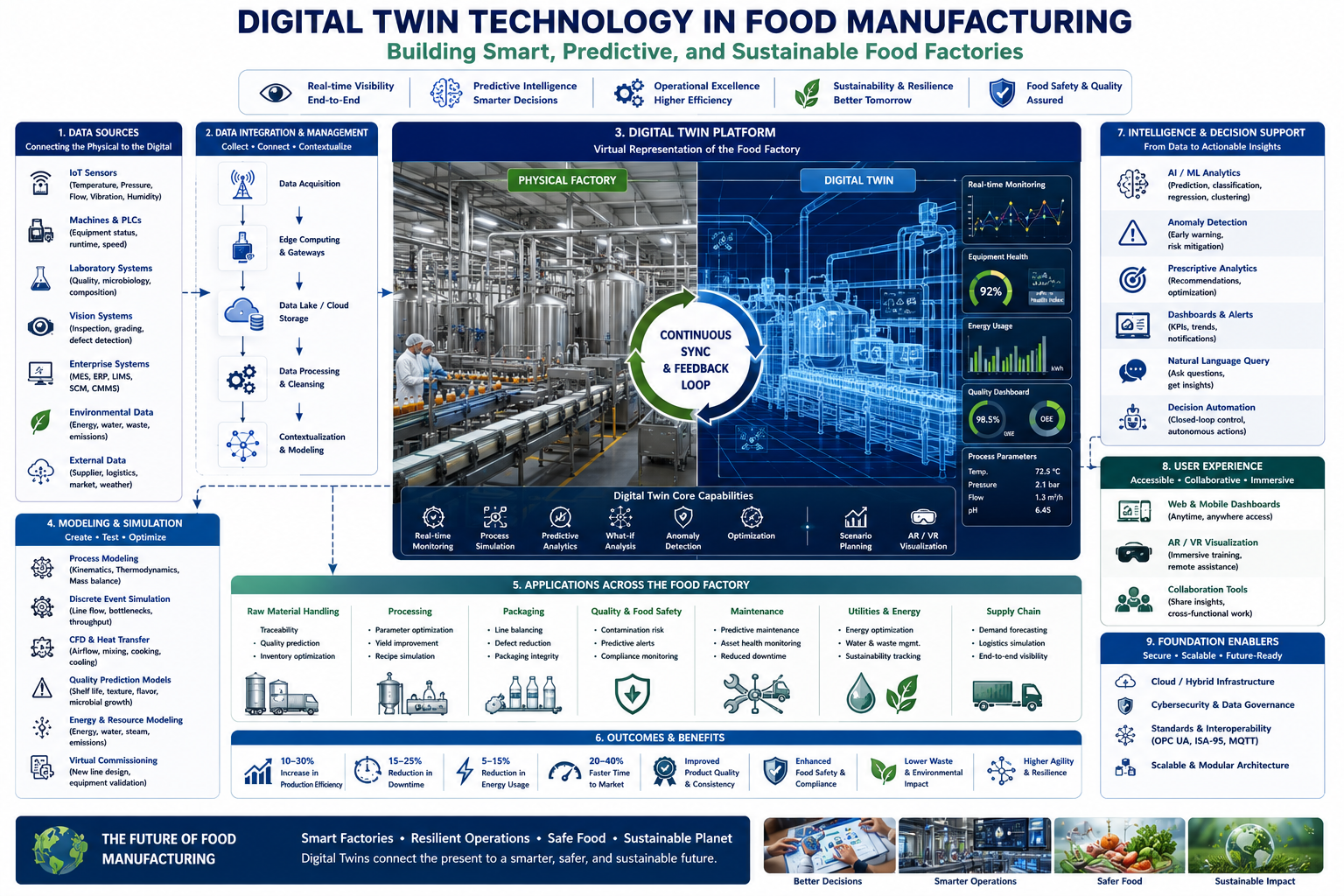
A digital twin is a dynamic virtual representation of a physical asset, production line, process, or entire factory. By integrating data from sensors, industrial equipment, laboratory analyses, environmental monitoring systems, and artificial intelligence (AI), digital twins allow manufacturers to simulate production scenarios, detect emerging problems before they occur, and make evidence-based decisions with unprecedented speed.
From dairy processing and beverage production to meat plants, grain milling, seafood processing, and ready-to-eat food manufacturing, digital twin technology is becoming an essential component of Industry 4.0. This article explores how digital twins work, their applications in food manufacturing, benefits, challenges, emerging innovations, and their role in creating safer and more sustainable food systems.
Introduction
Food manufacturers operate increasingly complex production systems where quality, efficiency, sustainability, and food safety must be managed simultaneously. Traditional process monitoring often relies on periodic measurements and operator experience, making it difficult to identify developing problems before they affect production.
Digital twin technology changes this approach by continuously collecting operational data and comparing real-world performance with an intelligent virtual model. The result is a system capable of predicting failures, optimizing processing conditions, validating process changes, and improving product consistency.
As artificial intelligence, cloud computing, and the Industrial Internet of Things (IIoT) continue to mature, digital twins are becoming central to modern food manufacturing.
What Is a Digital Twin?
A digital twin is a continuously updated virtual model of a physical object, machine, production process, or manufacturing facility.
Unlike a static computer simulation, a digital twin receives live operational data from the real system through connected sensors and control systems.
A complete digital twin typically integrates:
- Industrial sensors
- Programmable logic controllers (PLCs)
- SCADA systems
- Manufacturing execution systems (MES)
- Enterprise resource planning (ERP) software
- Laboratory information management systems (LIMS)
- Artificial intelligence and machine learning algorithms
- Cloud computing infrastructure
Together, these technologies create a real-time digital representation of manufacturing operations.
How Digital Twins Work
Step 1: Data Collection
Sensors installed throughout the production facility continuously monitor key parameters, including:
- Temperature
- Pressure
- Humidity
- Flow rate
- pH
- Equipment vibration
- Energy consumption
- Product quality attributes
Step 2: Data Transmission
Operational data are securely transmitted to cloud or on-premises computing systems.
Step 3: Virtual Modeling
The digital twin updates continuously to reflect the current state of equipment and production processes.
Step 4: AI Analysis
Artificial intelligence analyzes incoming data, detects anomalies, predicts future performance, and recommends operational adjustments.
Step 5: Decision Support
Production managers receive dashboards, alerts, simulations, and optimization recommendations that support informed decision-making.
Applications in Food Manufacturing
Predictive Maintenance
Digital twins identify early signs of equipment wear before mechanical failures occur.
Benefits include:
- Reduced downtime
- Lower maintenance costs
- Longer equipment lifespan
- Improved production reliability
Food Safety Monitoring
Digital twins integrate environmental monitoring, sanitation verification, microbiological testing, and production data to identify emerging food safety risks.
Examples include:
- Cold chain deviations
- Sanitation failures
- Cross-contamination risks
- Temperature excursions
Process Optimization
Manufacturers can simulate production changes before implementing them, reducing trial-and-error experimentation.
Applications include:
- Pasteurization optimization
- Fermentation control
- Drying efficiency
- Packaging performance
Quality Assurance
Digital twins monitor production consistency by continuously comparing actual product characteristics with target specifications.
Quality indicators may include:
- Moisture content
- Viscosity
- Texture
- Color
- Particle size
- Nutritional composition
Sustainability Management
Manufacturers can optimize:
- Water use
- Energy consumption
- Raw material utilization
- Carbon emissions
- Waste generation
These improvements support environmental sustainability and cost reduction.
Industry Applications
Digital twins are being adopted across multiple food sectors.
Dairy Industry
- Milk pasteurization optimization
- Cheese ripening monitoring
- Cold storage management
Beverage Manufacturing
- Filling line optimization
- Carbonation control
- Bottle inspection
- Packaging efficiency
Meat and Poultry Processing
- Chilling performance
- Equipment sanitation
- Production scheduling
- Cold chain monitoring
Grain and Milling
- Moisture management
- Storage optimization
- Drying efficiency
- Mycotoxin risk prediction
Seafood Processing
- Temperature monitoring
- Shelf-life prediction
- Traceability
- Logistics optimization
Integration with Artificial Intelligence
Artificial intelligence enhances digital twins through:
- Predictive analytics
- Pattern recognition
- Anomaly detection
- Automated decision support
- Production scheduling optimization
- Energy optimization
Machine learning continuously improves prediction accuracy as additional production data become available.
Benefits
Digital twins provide numerous advantages.
Improved Food Safety
Continuous monitoring allows earlier detection of process deviations.
Increased Productivity
Optimized operations improve throughput while minimizing production interruptions.
Better Product Quality
Real-time quality control reduces variability between production batches.
Lower Operating Costs
Predictive maintenance and optimized resource utilization reduce operational expenses.
Faster Innovation
Virtual simulations reduce development time for new products and processing technologies.
Challenges
Despite their advantages, digital twins present several implementation challenges.
High Initial Investment
Establishing digital twin systems requires investment in sensors, software, connectivity, and computational infrastructure.
Data Integration
Combining information from multiple equipment manufacturers and software platforms can be technically complex.
Cybersecurity
Protecting operational technology and production data from cyber threats is essential.
Workforce Skills
Successful implementation requires personnel with expertise in food engineering, automation, data science, and AI.
Emerging Technologies
Several innovations are expanding digital twin capabilities.
Internet of Things (IoT)
Smart sensors continuously provide high-quality operational data.
Edge Computing
Processing data closer to production equipment reduces latency and enables faster decision-making.
Robotics
Digital twins coordinate robotic systems performing inspection, packaging, and material handling.
Computer Vision
AI-powered imaging systems automatically detect product defects and quality deviations.
Blockchain
Integration with blockchain strengthens traceability and transparency throughout food supply chains.
Current Research
Researchers are investigating:
- AI-driven autonomous food factories
- Digital twins for fermentation optimization
- Real-time pathogen risk prediction
- Energy-efficient manufacturing
- Climate-resilient production systems
- Precision sanitation optimization
- Circular food manufacturing models
These developments are expected to improve operational resilience and sustainability.
Future Outlook
Digital twins will play an increasingly important role as food manufacturing becomes more connected and data-driven.
Future developments may include:
- Fully autonomous production optimization
- Self-adjusting processing equipment
- AI-guided quality assurance
- Integrated genomic and microbiological monitoring
- Personalized food manufacturing
- Carbon-neutral production management
Combined with robotics, artificial intelligence, and advanced analytics, digital twins will help create intelligent food factories capable of continuously improving their own performance.
Conclusion
Digital twin technology represents one of the most significant advances in modern food manufacturing. By creating intelligent virtual models that continuously mirror physical production systems, digital twins enable food manufacturers to improve safety, optimize operations, reduce waste, and make faster, evidence-based decisions.
As Industry 4.0 technologies continue to mature, digital twins are expected to become standard tools for food production facilities worldwide. Their ability to integrate artificial intelligence, sensor networks, predictive analytics, and sustainability metrics positions them as a cornerstone of the next generation of safe, efficient, and resilient food systems.
Key Takeaways
- Digital twins are real-time virtual models of physical food manufacturing systems.
- They combine IoT sensors, AI, cloud computing, and production data to optimize operations.
- Applications include predictive maintenance, food safety monitoring, process optimization, and sustainability management.
- Digital twins support faster innovation, improved quality, reduced downtime, and lower operational costs.
- They are expected to become a core technology in the future of smart food manufacturing.
References
- Tao, F., Zhang, H., Liu, A., & Nee, A. Y. C. (2019). Digital Twin in Industry: State-of-the-Art. IEEE Transactions on Industrial Informatics, 15(4), 2405–2415. https://doi.org/10.1109/TII.2018.2873186
- Fuller, A., Fan, Z., Day, C., & Barlow, C. (2020). Digital Twin: Enabling Technologies, Challenges and Open Research. IEEE Access, 8, 108952–108971. https://doi.org/10.1109/ACCESS.2020.2998358
- Verdouw, C. N., Tekinerdogan, B., Beulens, A. J. M., & Wolfert, S. (2021). Digital Twins in Smart Farming and Food Systems. Biosystems Engineering, 213, 208–226.
- Food and Agriculture Organization (FAO). Food Safety and Quality. https://www.fao.org/food-safety
- World Health Organization (WHO). Food Safety. https://www.who.int/health-topics/food-safety
- Kritzinger, W., Karner, M., Traar, G., Henjes, J., & Sihn, W. (2018). Digital Twin in Manufacturing: A Categorical Literature Review. IFAC-PapersOnLine, 51(11), 1016–1022.