
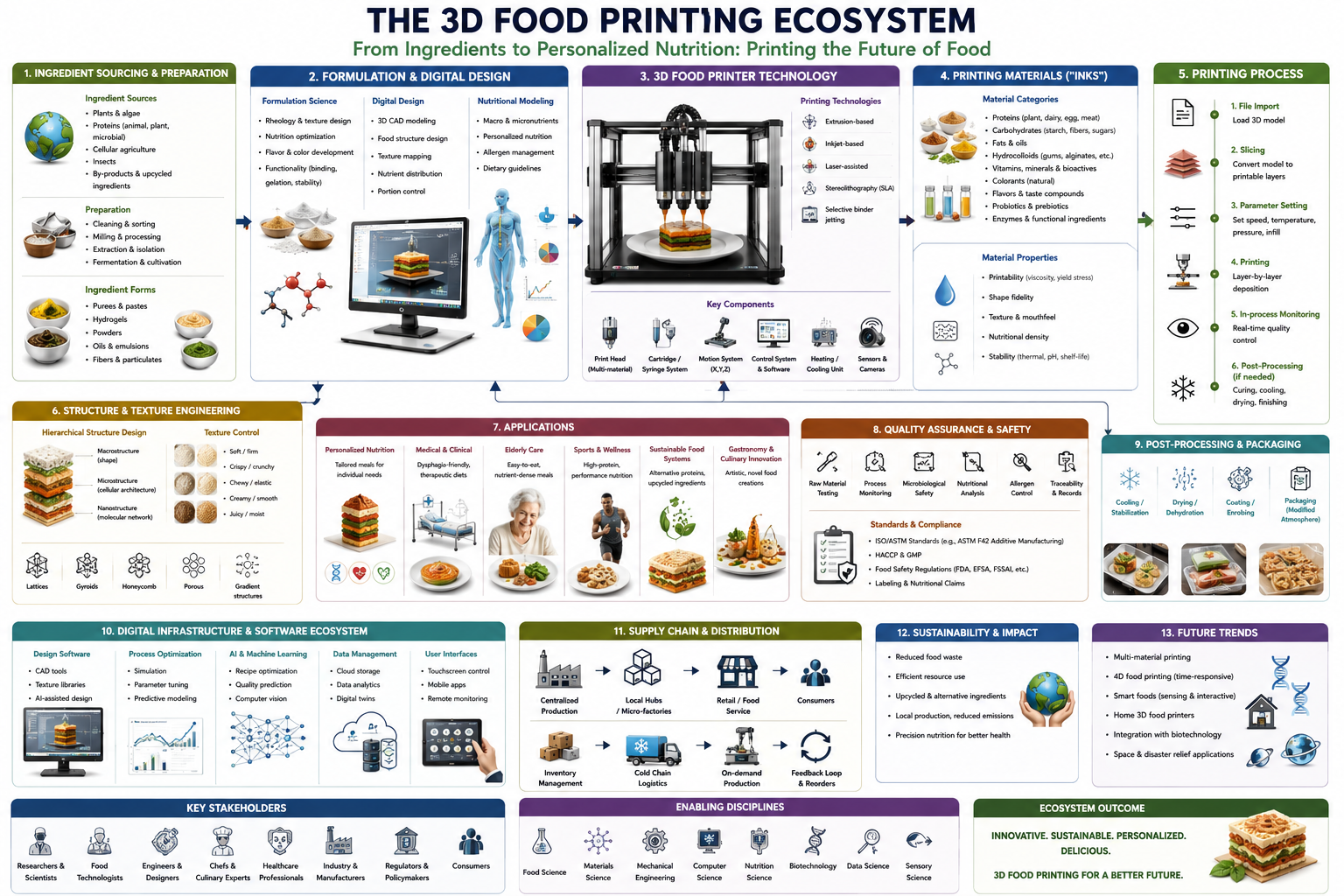
Summary
Imagine ordering a meal that is customized to your exact nutritional requirements, printed into an attractive shape within minutes, and produced with minimal food waste. This vision is rapidly becoming reality through 3D food printing, one of the most exciting emerging technologies in food science.
3D food printing applies additive manufacturing principles to edible materials by depositing food layer upon layer according to a digital design. Unlike conventional food processing, which often relies on cutting, molding, or shaping, 3D printing enables precise control over portion size, texture, nutrient composition, and appearance.
Researchers are exploring applications ranging from personalized nutrition and hospital meals to plant-based meat alternatives, confectionery, cultured foods, and even long-duration space missions. Although widespread commercial adoption is still developing, advances in food materials, robotics, artificial intelligence (AI), and digital manufacturing are accelerating the technology’s growth.
This article examines how 3D food printing works, its current applications, benefits, challenges, and the innovations that may reshape the future of food production.
Introduction
Food manufacturing has evolved from manual preparation to highly automated production lines. Today, digital technologies are driving another transformation through additive manufacturing, commonly known as 3D printing.
Originally developed for engineering and industrial design, 3D printing has expanded into medicine, construction, aerospace, and increasingly, food production. Instead of plastics or metals, food printers use edible materials such as chocolate, dough, vegetable purees, cheese, protein pastes, and other printable formulations.
The ability to digitally design foods offers unprecedented flexibility in nutrition, aesthetics, and production efficiency.
What Is 3D Food Printing?
3D food printing is an additive manufacturing process in which edible ingredients are deposited layer by layer to create three-dimensional food products from digital computer models.
The technology combines:
- Computer-aided design (CAD)
- Food formulation science
- Precision robotics
- Digital manufacturing
- Automated process control
Different foods require different printing techniques depending on their physical properties.
How 3D Food Printing Works
Step 1: Digital Design
A digital model of the food product is created using specialized software. The design specifies dimensions, internal structure, and printing sequence.
Step 2: Ingredient Preparation
Food ingredients are formulated into printable materials with suitable viscosity and flow characteristics.
Common printable materials include:
- Chocolate
- Cookie dough
- Mashed potatoes
- Vegetable purees
- Cheese pastes
- Plant-based proteins
- Fruit gels
- Sugar-based materials
Step 3: Layer-by-Layer Printing
The printer deposits thin layers of edible material according to the digital design until the product is complete.
Step 4: Post-Processing
Depending on the product, printed foods may be baked, cooked, cooled, dried, or otherwise finished before consumption.
Types of Food Printing Technologies
Several printing methods are used in food manufacturing.
Extrusion Printing
The most common technique, where edible pastes are forced through a nozzle.
Applications include:
- Chocolate
- Dough
- Purees
- Cheese
- Meat analogues
Inkjet Printing
Small droplets of edible liquids are deposited with high precision, often used for decorating cakes, pastries, and confectionery.
Binder Jetting
A liquid binder selectively joins layers of powdered food ingredients.
This approach is being explored for customized snacks and confectionery.
Laser-Based Processing
Experimental systems use lasers for localized cooking or browning immediately after deposition.
Applications of 3D Food Printing
Personalized Nutrition
One of the most promising applications is customizing foods according to individual nutritional requirements.
Meals can potentially be tailored based on:
- Age
- Health status
- Allergies
- Athletic performance
- Energy requirements
- Medical conditions
Healthcare and Clinical Nutrition
Hospitals and long-term care facilities are investigating 3D printing to improve meals for individuals with swallowing disorders (dysphagia).
Modified-texture foods can be shaped to resemble their original appearance while maintaining safe swallowing characteristics.
Plant-Based Foods
3D printing enables precise structuring of plant proteins to improve the appearance and texture of meat alternatives.
Fine Dining
Chefs use food printing to create intricate designs that would be difficult or impossible to produce manually.
Space Exploration
Space agencies are investigating food printing technologies for future long-duration missions, where efficient use of ingredients and personalized nutrition will be essential.
Food Safety Considerations
Like all food manufacturing systems, 3D food printing must operate under robust food safety controls.
Key considerations include:
- Hygienic equipment design
- Ingredient quality
- Temperature control
- Cleaning and sanitation
- Cross-contact prevention
- Process validation
- Traceability
Food safety management systems such as Hazard Analysis and Critical Control Point (HACCP) remain essential.
Advantages
Personalized Nutrition
Nutrient composition can be adjusted for individual dietary needs.
Reduced Food Waste
Precise ingredient deposition minimizes unnecessary waste during production.
Creative Food Design
Complex shapes and internal structures enhance product appeal.
Efficient Ingredient Utilization
Alternative proteins and upcycled ingredients can be incorporated into printable formulations.
Automation
Digital production reduces manual handling and improves consistency.
Challenges
Despite significant progress, several obstacles remain.
Printable Ingredients
Not all foods possess suitable rheological properties for printing.
Printing Speed
Current systems are generally slower than conventional mass-production methods.
Consumer Acceptance
Some consumers remain unfamiliar with digitally manufactured foods.
Equipment Costs
Industrial-scale food printers require significant investment.
Regulatory Development
As the technology evolves, regulatory guidance continues to develop in many jurisdictions.
Emerging Technologies
Researchers are combining 3D food printing with several advanced technologies.
Artificial Intelligence
AI optimizes printing parameters, predicts product quality, and supports personalized meal formulation.
Robotics
Automated production systems improve speed and precision.
Digital Twins
Virtual production models simulate printing performance before manufacturing begins.
Smart Sensors
Real-time monitoring improves quality control throughout printing.
Alternative Proteins
3D printing is enabling innovative products based on plant proteins, fungi, algae, insect-derived ingredients, and cultivated cells.
Current Research
Scientists are investigating:
- Multi-material food printing
- High-protein personalized meals
- Functional foods with targeted nutrient delivery
- Printable probiotics
- Sustainable food formulations
- Bioprinting of cultured meat structures
- AI-driven nutritional optimization
These innovations aim to improve both nutrition and manufacturing efficiency.
Future Outlook
The future of 3D food printing extends far beyond novelty products.
Potential developments include:
- Home food printers
- Hospital nutrition printing systems
- School meal customization
- Automated restaurant kitchens
- Space habitat food production
- Precision nutrition linked to wearable health devices
- On-demand manufacturing using sustainable ingredients
As technology matures, food printing may become an integral component of digital food manufacturing and personalized healthcare.
Conclusion
3D food printing represents a convergence of food science, engineering, robotics, and digital technology. By enabling precise control over ingredients, nutrition, texture, and design, it offers exciting opportunities for personalized nutrition, healthcare, sustainable manufacturing, and innovative food experiences.
Although technical, economic, and regulatory challenges remain, continued advances in materials science, automation, and artificial intelligence are steadily expanding the technology’s commercial potential. As these innovations progress, 3D food printing is poised to become an important tool in creating safer, more nutritious, and more sustainable food systems.
Key Takeaways
- 3D food printing uses additive manufacturing to produce foods layer by layer from digital designs.
- The technology supports personalized nutrition, healthcare, plant-based foods, and sustainable manufacturing.
- Common printable ingredients include chocolate, dough, vegetable purees, cheese, and protein-based formulations.
- AI, robotics, digital twins, and smart sensors are accelerating the evolution of food printing.
- With continued innovation, 3D food printing could reshape the future of food production and consumption.
References
- Godoi, F. C., Prakash, S., & Bhandari, B. R. (2016). 3D printing technologies applied for food design: Status and prospects. Journal of Food Engineering, 179, 44–54. https://doi.org/10.1016/j.jfoodeng.2016.01.025
- Liu, Z., Zhang, M., Bhandari, B., & Yang, C. (2017). Impact of rheological properties of food materials on 3D food printing. Comprehensive Reviews in Food Science and Food Safety, 17(2), 229–245.
- Sun, J., Zhou, W., Huang, D., Fuh, J. Y. H., & Hong, G. S. (2015). An overview of 3D printing technologies for food fabrication. Food and Bioprocess Technology, 8, 1605–1615. https://doi.org/10.1007/s11947-015-1528-6
- Food and Agriculture Organization (FAO). Food Safety and Quality. https://www.fao.org/food-safety
- World Health Organization (WHO). Food Safety. https://www.who.int/health-topics/food-safety
- Derossi, A., Caporizzi, R., Azzollini, D., & Severini, C. (2018). Application of 3D printing for customized food. A review. International Journal of Food Science & Technology, 53(11), 2485–2498.