
Summary
Consumers increasingly demand foods that are fresh, minimally processed, and free from excessive preservatives, while food manufacturers face growing pressure to improve safety, reduce food waste, and maintain nutritional quality. These expectations have accelerated the development of innovative non-thermal food preservation technologies.
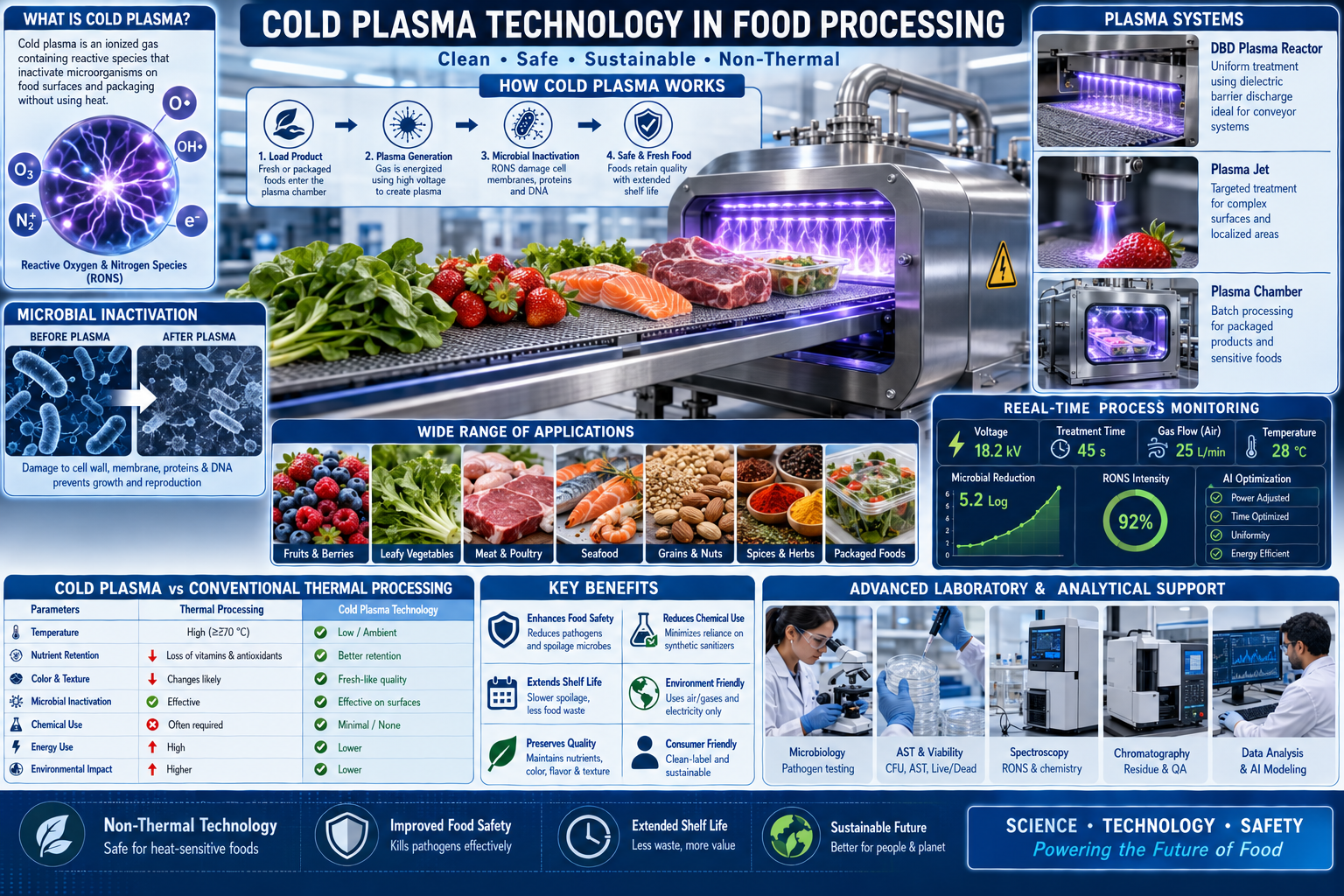
One of the most promising innovations is Cold Plasma Technology (CPT). Unlike thermal pasteurization or sterilization, cold plasma uses energized gases containing reactive oxygen and nitrogen species to inactivate microorganisms on food surfaces, packaging materials, and food-processing equipment without exposing products to damaging temperatures.
Cold plasma has demonstrated effectiveness against bacteria, yeasts, molds, viruses, and bacterial spores under specific processing conditions. It also shows potential for degrading certain pesticide residues, reducing biofilms, and extending the shelf life of fresh produce and ready-to-eat foods.
Although commercial adoption is still expanding, cold plasma is widely recognized as one of the most promising next-generation food preservation technologies.
Introduction
Food preservation has evolved dramatically over the past century. Traditional techniques such as drying, salting, fermentation, pasteurization, refrigeration, and freezing remain essential, but modern consumers increasingly expect foods that retain their fresh appearance, texture, flavor, and nutritional value.
Emerging non-thermal technologies seek to achieve microbial safety while minimizing quality losses. Among these technologies, cold plasma has gained significant attention because it can rapidly inactivate microorganisms at or near room temperature.
Its applications now extend beyond food preservation to packaging sterilization, equipment sanitation, seed treatment, and environmental decontamination.
What Is Cold Plasma?
Plasma is often called the fourth state of matter, alongside solids, liquids, and gases.
When energy is supplied to a gas, some molecules become ionized, producing a mixture of:
- Electrons
- Positive ions
- Neutral molecules
- Reactive oxygen species (ROS)
- Reactive nitrogen species (RNS)
- Ultraviolet photons
In cold plasma, the electrons possess high energy while the bulk gas remains close to room temperature, making it suitable for treating heat-sensitive foods.
How Cold Plasma Is Generated
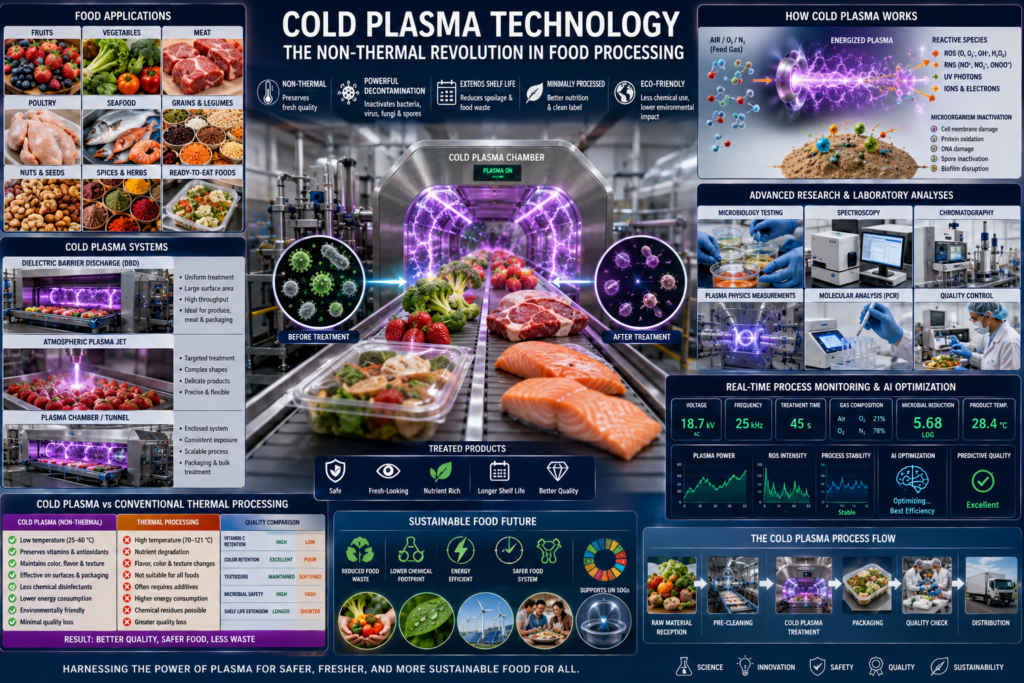
Several systems are used in food processing:
Dielectric Barrier Discharge (DBD)
One of the most common systems, DBD generates plasma between two electrodes separated by an insulating barrier.
Applications include:
- Fruit surfaces
- Vegetable decontamination
- Packaging sterilization
Plasma Jets
Localized plasma streams treat specific food surfaces or packaging components.
Atmospheric Pressure Plasma
These systems operate under normal atmospheric conditions, eliminating the need for expensive vacuum equipment.
How Cold Plasma Improves Food Safety
Reactive oxygen and nitrogen species interact with microorganisms by damaging:
- Cell membranes
- Cell walls
- DNA
- Proteins
- Enzymes
This prevents microbial growth and reproduction.
Cold plasma has demonstrated effectiveness against numerous foodborne pathogens, including:
- Listeria monocytogenes
- Salmonella enterica
- Escherichia coli O157:H7
- Campylobacter spp.
- Staphylococcus aureus
The effectiveness depends on treatment time, gas composition, food surface characteristics, and the target microorganism.
Applications in Food Processing
Fresh Fruits and Vegetables
Cold plasma can reduce surface contamination while maintaining freshness and minimizing changes in texture.
Meat and Poultry
Surface treatments may reduce microbial contamination on raw meat products without cooking the food.
Seafood
Cold plasma is being investigated for reducing spoilage microorganisms and improving refrigerated shelf life.
Grains and Seeds
Researchers are evaluating cold plasma for reducing fungal contamination and improving seed quality.
Food Packaging
Packaging materials can be sterilized before filling, reducing the risk of post-processing contamination.
Food Processing Equipment
Cold plasma offers an additional sanitation tool for difficult-to-clean equipment surfaces.
Advantages
Non-Thermal Preservation
Because processing occurs at low temperatures, many heat-sensitive nutrients and sensory properties are better preserved.
Reduced Chemical Usage
Cold plasma may reduce reliance on certain chemical disinfectants in food processing.
Improved Shelf Life
Lower microbial loads may contribute to longer refrigerated storage under appropriate conditions.
Environmental Benefits
Most cold plasma systems require only electricity and common gases such as air, oxygen, or nitrogen, producing relatively little chemical waste.
Limitations
Despite its promise, cold plasma faces several challenges.
Surface Treatment
Cold plasma primarily affects exposed surfaces and is less effective for microorganisms located deep within foods.
Process Standardization
Treatment conditions must be optimized for each food product to ensure safety while maintaining quality.
Equipment Costs
Industrial plasma systems require specialized equipment and process validation.
Regulatory Considerations
Commercial implementation requires compliance with national food safety regulations and demonstration that treated foods remain safe and of high quality.
Food Safety Considerations
Cold plasma should be integrated into comprehensive food safety management systems rather than used as a stand-alone solution.
Manufacturers typically combine plasma treatment with:
- Good Manufacturing Practices (GMP)
- Hazard Analysis and Critical Control Point (HACCP)
- Environmental monitoring
- Cold chain management
- Microbiological verification
Validation studies are essential to demonstrate consistent microbial reduction.
Current Research
Scientists continue investigating:
- Inactivation of antibiotic-resistant bacteria
- Biofilm removal
- Mycotoxin degradation
- Pesticide residue reduction
- Plasma-activated water
- Sustainable packaging sterilization
- Combination treatments with ultraviolet light and high-pressure processing
Artificial intelligence is also being explored to optimize plasma treatment parameters for different food products.
Future Outlook
Cold plasma is expected to play an increasingly important role in sustainable food production.
Future developments may include:
- Fully automated plasma processing lines
- Smart plasma systems with AI-based optimization
- Portable plasma sanitation devices
- Integration with robotic food processing systems
- Improved energy efficiency
- Greater use in fresh produce and minimally processed foods
As equipment becomes more affordable and regulatory approvals expand, cold plasma is likely to become a routine technology in modern food manufacturing.
Conclusion
Cold plasma technology represents one of the most exciting advances in non-thermal food preservation. By using energized gases instead of high temperatures or harsh chemicals, it offers an innovative approach to improving food safety while preserving the fresh qualities consumers value.
Although further research and commercialization are still needed, cold plasma has demonstrated significant potential for microbial control, shelf-life extension, packaging sterilization, and sustainable food processing. Together with complementary technologies such as High-Pressure Processing and Pulsed Electric Fields, it is helping shape the next generation of food preservation systems.
Key Takeaways
- Cold plasma is a non-thermal technology that uses ionized gases to improve food safety.
- Reactive oxygen and nitrogen species inactivate microorganisms on food surfaces and packaging.
- Applications include fresh produce, meat, seafood, grains, packaging, and equipment sanitation.
- Cold plasma helps preserve food quality while reducing microbial contamination.
- Continued research aims to expand commercial applications and improve process efficiency.
References
- Misra, N. N., Schlüter, O., & Cullen, P. J. (Eds.). (2016). Cold Plasma in Food and Agriculture: Fundamentals and Applications. Academic Press.
- Thirumdas, R., Sarangapani, C., & Annapure, U. S. (2015). Cold plasma: A novel non-thermal technology for food processing. Food Biophysics, 10, 1–11. https://doi.org/10.1007/s11483-014-9382-z
- Pankaj, S. K., Wan, Z., & Keener, K. M. (2018). Effects of cold plasma on food quality: A review. Foods, 7(1), 4. https://doi.org/10.3390/foods7010004
- Scholtz, V., Pazlarova, J., Souskova, H., Khun, J., & Julak, J. (2015). Nonthermal plasma—a tool for decontamination and disinfection. Biotechnology Advances, 33(6), 1108–1119. https://doi.org/10.1016/j.biotechadv.2015.01.002
- Food and Agriculture Organization (FAO). Food Safety and Quality. https://www.fao.org/food-safety
- World Health Organization (WHO). Food Safety. https://www.who.int/health-topics/food-safety