
Summary
Antimicrobial resistance (AMR) is widely recognized as one of the greatest threats to global health, food security, and sustainable development. It occurs when bacteria, fungi, viruses, or parasites evolve mechanisms that enable them to survive exposure to medicines designed to eliminate them. As a result, infections become more difficult to treat, increasing the risk of severe illness, prolonged hospitalization, and death.
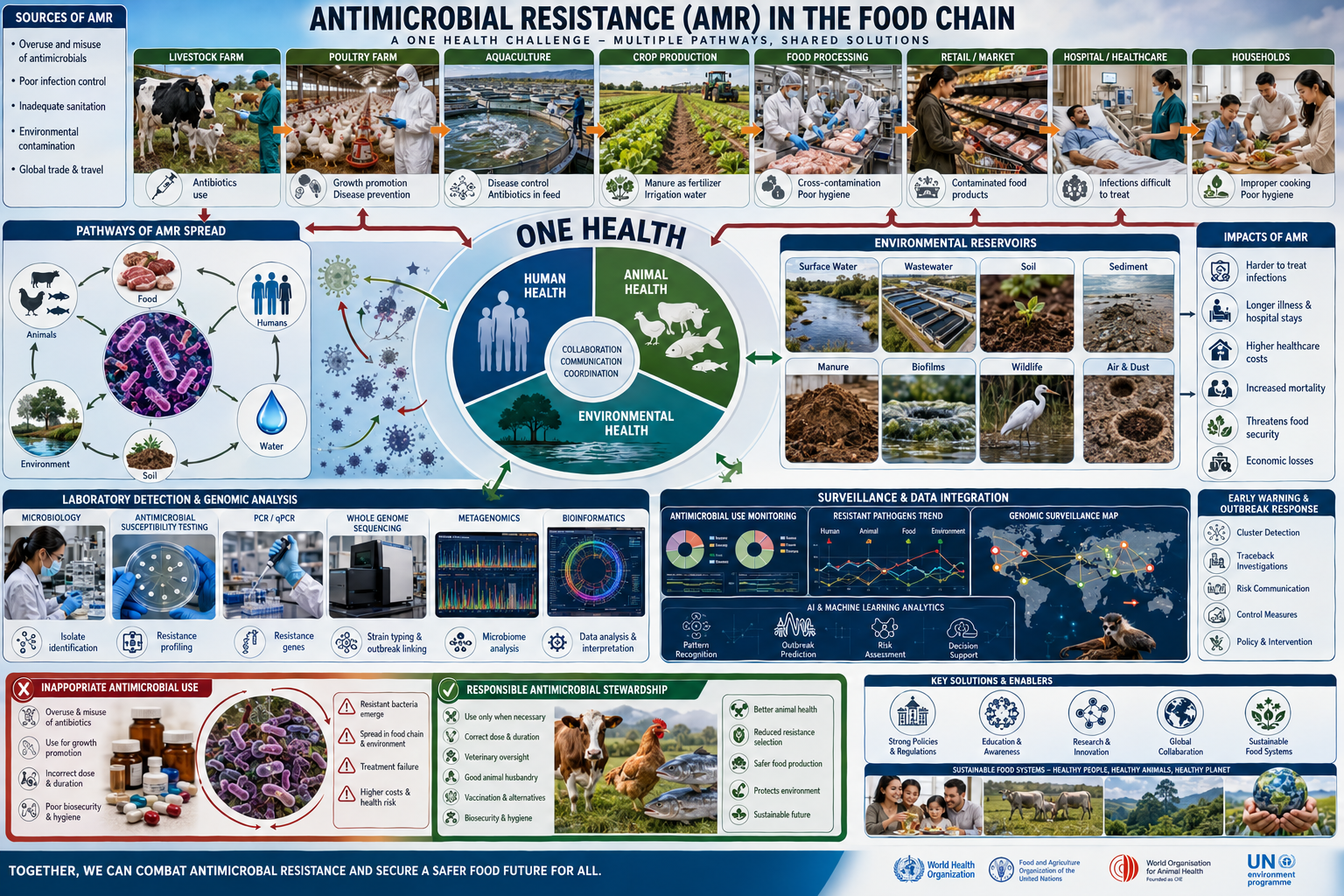
The food chain plays an important role in the emergence and spread of antimicrobial-resistant microorganisms. Resistant bacteria can move between animals, food products, the environment, and humans through complex pathways that include livestock production, aquaculture, fresh produce, food processing, water, and international trade.
Food scientists, veterinarians, medical professionals, microbiologists, and policymakers are working together under the One Health approach to reduce antimicrobial resistance through responsible antimicrobial use, improved hygiene, surveillance, food safety systems, and scientific innovation.
This article explains how antimicrobial resistance develops in the food chain, why it matters for food safety, current monitoring strategies, technological innovations, and practical measures that producers and consumers can take to reduce its spread.
Introduction
Since the discovery of antibiotics, antimicrobial medicines have transformed modern medicine by saving millions of lives. They are also used in veterinary medicine to treat bacterial infections in food-producing animals.
However, decades of inappropriate or excessive antimicrobial use in humans, animals, and agriculture have accelerated the evolution of resistant microorganisms.
Food production systems are interconnected with human and environmental health. Resistant bacteria can circulate between farms, food processing facilities, retail foods, wildlife, wastewater, and consumers, making antimicrobial resistance a complex global issue that cannot be addressed by any single sector alone.
What Is Antimicrobial Resistance?
Antimicrobial resistance occurs when microorganisms develop the ability to survive treatment with antimicrobial drugs.
These microorganisms include:
- Bacteria
- Fungi
- Viruses
- Parasites
In food safety, bacterial antimicrobial resistance receives the greatest attention because resistant foodborne pathogens can cause infections that are difficult to treat.
Common antimicrobial-resistant foodborne bacteria include:
- Salmonella enterica
- Campylobacter spp.
- Escherichia coli
- Listeria monocytogenes
- Enterococcus spp.
How Resistance Develops
Resistance develops naturally through evolution, but human activities accelerate the process.
Major mechanisms include:
Genetic Mutation
Random genetic changes may enable bacteria to survive antimicrobial treatment.
Horizontal Gene Transfer
Bacteria can exchange resistance genes through plasmids and other mobile genetic elements, allowing resistance to spread rapidly between different bacterial species.
Selection Pressure
When antimicrobial drugs are used frequently or incorrectly, susceptible bacteria are eliminated while resistant strains survive and multiply.
How Resistant Bacteria Enter the Food Chain
Livestock Production
Animals treated with antibiotics may carry resistant bacteria in their intestinal tract.
These bacteria can contaminate meat during slaughter if hygiene practices are inadequate.
Aquaculture
Antimicrobial use in fish farming may contribute to resistant microorganisms in aquatic environments if not carefully managed.
Fresh Produce
Fresh fruits and vegetables may become contaminated through:
- Irrigation water
- Organic fertilizers
- Soil
- Wildlife
- Food handlers
Food Processing Environments
Poor sanitation may allow resistant bacteria to establish persistent contamination in processing facilities.
International Trade
Global food trade enables resistant microorganisms to move rapidly across borders, reinforcing the need for international surveillance and cooperation.
Food Safety Implications
The presence of antimicrobial-resistant bacteria does not necessarily mean food is unsafe, but resistant infections may be more difficult to treat if transmission occurs.
Food safety systems aim to minimize contamination regardless of whether microorganisms are resistant or susceptible.
Key concerns include:
- More complicated clinical treatment
- Longer illness duration
- Increased healthcare costs
- Greater risk for vulnerable populations
- Reduced effectiveness of important antibiotics
The One Health Approach
Antimicrobial resistance cannot be addressed through human healthcare alone.
The One Health framework recognizes that the health of people, animals, plants, and the environment is interconnected.
Effective control requires collaboration among:
- Physicians
- Veterinarians
- Food scientists
- Farmers
- Environmental scientists
- Public health agencies
- Policymakers
Surveillance and Monitoring
Many countries have established integrated surveillance systems that monitor antimicrobial resistance in:
- Humans
- Food-producing animals
- Retail foods
- Food processing environments
- Surface water
- Wastewater
Modern laboratory technologies include:
- Whole Genome Sequencing (WGS)
- Polymerase Chain Reaction (PCR)
- Metagenomics
- Antimicrobial susceptibility testing
These tools help identify resistance genes, monitor emerging threats, and support outbreak investigations.
Strategies to Reduce AMR in Food Systems
Responsible Antimicrobial Use
Antimicrobials should be used only when necessary and under veterinary supervision.
Improved Farm Biosecurity
Better hygiene, vaccination, nutrition, and disease prevention reduce the need for antimicrobial treatments.
Food Processing Controls
Manufacturers implement:
- Good Manufacturing Practices (GMP)
- Hazard Analysis and Critical Control Point (HACCP)
- Environmental monitoring
- Cleaning and sanitation programs
- Temperature control
These measures reduce contamination regardless of antimicrobial resistance status.
Consumer Practices
Consumers contribute by:
- Cooking foods to safe temperatures
- Preventing cross-contamination
- Washing hands before food preparation
- Refrigerating perishable foods promptly
Emerging Technologies
Researchers are exploring innovative approaches to reduce antimicrobial resistance, including:
- Bacteriophage therapy
- Antimicrobial peptides
- Probiotics and competitive exclusion
- Cold plasma decontamination
- High-Pressure Processing (HPP)
- Ultraviolet-C treatment
- CRISPR-based antimicrobial technologies
Artificial intelligence is also being used to predict resistance patterns and improve surveillance systems.
Current Research
Recent research focuses on:
- Reducing antimicrobial use through precision livestock farming
- Identifying resistance genes using metagenomics
- Monitoring antimicrobial resistance in wastewater
- Developing rapid diagnostic technologies
- Understanding microbial ecology within food production systems
Researchers are also investigating alternatives to antibiotics that maintain animal health while reducing resistance selection.
Future Outlook
Addressing antimicrobial resistance will require continued global collaboration.
Future priorities include:
- Expanded genomic surveillance
- Better international data sharing
- Improved antimicrobial stewardship
- Development of alternative therapies
- Sustainable livestock production
- Enhanced consumer education
Success will depend on integrating scientific innovation with responsible food production and public health policies.
Conclusion
Antimicrobial resistance is a complex challenge that extends beyond hospitals and clinics into agriculture, food production, and the environment. While resistant bacteria may enter the food chain through multiple pathways, effective food safety systems, responsible antimicrobial use, and coordinated One Health strategies can substantially reduce risks.
Advances in genomics, microbiology, surveillance, and food processing technologies are providing powerful new tools to detect, monitor, and control antimicrobial resistance. By combining scientific research with practical interventions across the entire food system, society can help preserve the effectiveness of life-saving antimicrobial medicines while ensuring a safer and more sustainable food supply.
Key Takeaways
- Antimicrobial resistance develops when microorganisms evolve mechanisms to survive antimicrobial drugs.
- Resistant bacteria may spread through livestock, aquaculture, fresh produce, food processing environments, and international trade.
- Food safety systems reduce contamination regardless of whether microorganisms are resistant.
- Whole Genome Sequencing, metagenomics, and AI are improving antimicrobial resistance surveillance.
- The One Health approach integrates human, animal, environmental, and food system health to combat antimicrobial resistance.
References
- World Health Organization (WHO). Antimicrobial Resistance. https://www.who.int/health-topics/antimicrobial-resistance
- Food and Agriculture Organization (FAO). Action Plan on Antimicrobial Resistance. https://www.fao.org/antimicrobial-resistance
- World Organisation for Animal Health (WOAH). Antimicrobial Resistance. https://www.woah.org/en/what-we-do/global-initiatives/antimicrobial-resistance/
- Codex Alimentarius Commission. Code of Practice to Minimize and Contain Foodborne Antimicrobial Resistance.
- Prestinaci, F., Pezzotti, P., & Pantosti, A. (2015). Antimicrobial resistance: A global multifaceted phenomenon. Pathogens and Global Health, 109(7), 309–318. https://doi.org/10.1179/2047773215Y.0000000030
- Van Boeckel, T. P., et al. (2019). Reducing antimicrobial use in food animals. Science, 357(6358), 1350–1352. https://doi.org/10.1126/science.aao1495
- European Food Safety Authority (EFSA) & European Centre for Disease Prevention and Control (ECDC). The European Union Summary Report on Antimicrobial Resistance in Zoonotic and Indicator Bacteria.
- World Bank. Drug-Resistant Infections: A Threat to Our Economic Future.