
Summary
Consumers increasingly seek foods that are fresh, minimally processed, nutritious, and free from unnecessary preservatives. At the same time, food manufacturers must ensure products remain safe throughout increasingly complex global supply chains. Balancing these objectives has driven the development of innovative preservation technologies that improve food safety while maintaining quality.
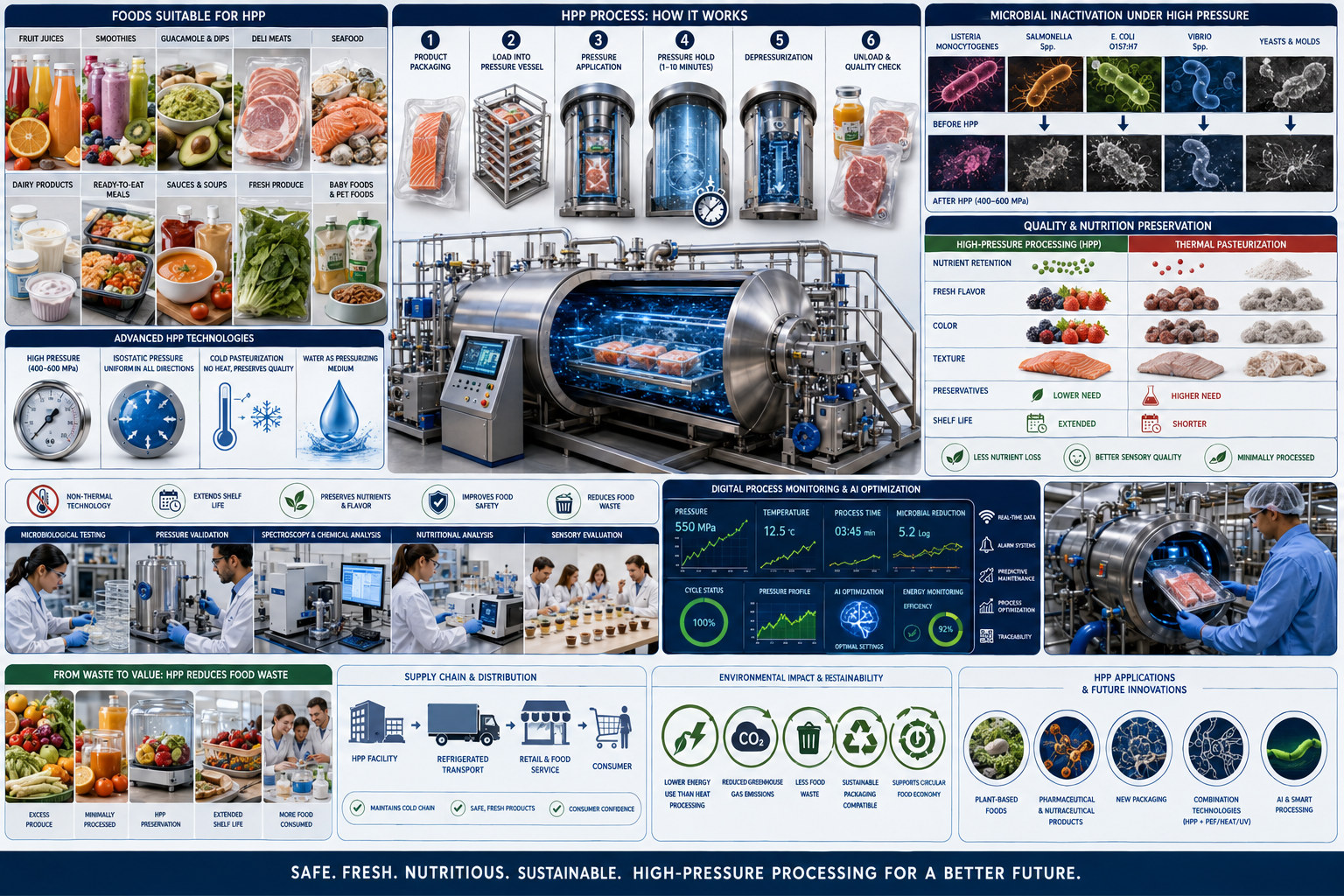
One of the most successful non-thermal preservation technologies is High-Pressure Processing (HPP), sometimes referred to as cold pasteurization. Instead of using heat to destroy microorganisms, HPP subjects packaged foods to extremely high hydrostatic pressure—typically between 400 and 600 megapascals (MPa). This process inactivates many harmful microorganisms while preserving flavor, texture, color, and heat-sensitive nutrients more effectively than many conventional thermal treatments.
Today, HPP is widely used for fruit juices, guacamole, deli meats, seafood, ready-to-eat meals, dips, sauces, dairy products, and pet foods. Continued advances in pressure technology are expanding its applications across the food industry.
This article explores how HPP works, its advantages and limitations, food safety implications, commercial applications, emerging research, and its future role in sustainable food systems.
Introduction
Traditional preservation methods such as pasteurization, sterilization, drying, and canning have dramatically improved food safety over the past century. However, thermal processing can sometimes alter flavor, texture, color, and nutritional quality.
To meet growing consumer demand for fresh-like foods, scientists have developed several non-thermal food preservation technologies, including:
- High-Pressure Processing (HPP)
- Pulsed Electric Field (PEF)
- Cold Plasma
- Ultraviolet (UV-C) Processing
- Ozone Treatment
Among these, HPP has become one of the most commercially successful because it effectively improves food safety while preserving many desirable quality attributes.
What Is High-Pressure Processing?
High-Pressure Processing is a food preservation technology that exposes sealed food products to extremely high water pressure.
Foods are placed inside a pressure vessel filled with water. Powerful pumps generate hydrostatic pressures that are transmitted uniformly throughout the packaged food.
Typical processing conditions include:
- Pressure: 400–600 MPa
- Processing time: 1–10 minutes
- Moderate temperatures, depending on the product
Because pressure is applied evenly in all directions (isostatically), foods retain their shape during processing.
Unlike heat treatments, HPP generally has minimal effects on small molecules such as vitamins, flavor compounds, and pigments.
How High-Pressure Processing Works
Step 1: Product Preparation
Foods are packaged in flexible, water-resistant packaging materials capable of withstanding high pressure.
Common products include:
- Fruit juices
- Smoothies
- Guacamole
- Salsa
- Ready-to-eat meats
- Seafood
- Dairy products
Step 2: Loading the Pressure Vessel
Packaged foods are loaded into a large stainless-steel pressure chamber filled with water.
Step 3: Pressure Application
Hydraulic pumps rapidly increase pressure throughout the vessel.
The pressure disrupts cellular structures and critical biological functions in many microorganisms.
Step 4: Pressure Hold
Foods remain under pressure for several minutes to achieve the desired microbial reduction.
Step 5: Depressurization
Pressure is released rapidly, and the products are removed, dried, and prepared for distribution.
How HPP Improves Food Safety
High pressure can inactivate many foodborne pathogens, including:
- Listeria monocytogenes
- Salmonella spp.
- Escherichia coli O157:H7
- Vibrio species
Pressure damages microbial cell membranes, proteins, and enzymes, preventing growth and survival.
However, bacterial spores are generally more pressure-resistant and may require combinations of pressure and mild heat for effective control.
Advantages of High-Pressure Processing
Preserves Fresh Flavor
Because HPP uses little or no heat, foods retain fresh sensory characteristics more effectively than many thermal processes.
Better Nutrient Retention
Heat-sensitive nutrients such as vitamin C and certain antioxidants are often better preserved.
Longer Shelf Life
Reducing spoilage microorganisms extends refrigerated shelf life while maintaining quality.
Fewer Preservatives
Improved microbial control allows manufacturers to reduce reliance on some chemical preservatives.
Processing After Packaging
Since foods are treated after packaging, opportunities for post-processing contamination are reduced.
Limitations
Despite its many benefits, HPP has limitations.
High Equipment Costs
Industrial HPP systems require substantial investment in specialized pressure vessels and pumps.
Packaging Requirements
Rigid containers such as glass are generally unsuitable because they may fracture under high pressure.
Flexible packaging materials are preferred.
Not Suitable for All Foods
Certain foods, including products containing large air pockets, may experience structural changes during pressure treatment.
Spore Resistance
Some bacterial spores survive HPP unless additional preservation hurdles are applied.
Applications in the Food Industry
HPP is increasingly used across multiple food sectors.
Fruit and Vegetable Products
- Fresh juices
- Smoothies
- Guacamole
- Hummus
- Salsa
Meat Products
- Cooked ham
- Turkey
- Roast beef
- Ready-to-eat sliced meats
Seafood
- Oysters
- Lobster
- Crab
- Shrimp
Pressure treatment can also facilitate shell removal in some shellfish.
Dairy
Selected dairy products benefit from extended shelf life while maintaining fresh flavor.
Ready-to-Eat Foods
Prepared meals, soups, dips, and refrigerated convenience foods increasingly utilize HPP.
Food Safety and Regulatory Considerations
Manufacturers using HPP implement comprehensive food safety systems, including:
- Good Manufacturing Practices (GMP)
- Hazard Analysis and Critical Control Point (HACCP)
- Process validation
- Microbiological verification
- Environmental monitoring
- Cold chain management
HPP is considered a processing technology—not a substitute for proper hygiene or refrigeration.
Environmental Sustainability
HPP may contribute to sustainability by:
- Reducing food waste through longer shelf life
- Lowering preservative use
- Preserving product quality
- Supporting minimally processed foods
The overall environmental footprint depends on equipment efficiency, electricity sources, packaging materials, and production scale.
Research Spotlight
Current research focuses on combining HPP with complementary preservation technologies, including:
- Mild heat (pressure-assisted thermal processing)
- Natural antimicrobial compounds
- Pulsed electric fields
- Ultraviolet treatment
- Protective cultures
Researchers are also studying HPP’s effects on proteins, enzymes, allergens, probiotics, and functional food ingredients.
Future Outlook
The future of HPP is expected to include:
- Larger industrial processing systems
- More energy-efficient pressure equipment
- AI-assisted process optimization
- Expanded applications in plant-based foods
- Improved recyclable pressure-resistant packaging
- Combination preservation technologies
As consumer demand for fresh, minimally processed foods grows, HPP is likely to become even more important in modern food manufacturing.
Conclusion
High-Pressure Processing has transformed modern food preservation by offering an effective non-thermal method for improving food safety while preserving freshness, flavor, texture, and nutritional quality. By applying extremely high hydrostatic pressure instead of heat, HPP enables manufacturers to produce minimally processed foods with extended shelf life and reduced reliance on preservatives.
Although equipment costs and product limitations remain challenges, continued advances in engineering, packaging, and food science are expanding the technology’s commercial potential. As global food systems increasingly prioritize quality, sustainability, and consumer health, High-Pressure Processing is expected to remain a cornerstone of next-generation food preservation.
Key Takeaways
- High-Pressure Processing uses extreme hydrostatic pressure rather than heat to preserve foods.
- HPP improves food safety by inactivating many harmful microorganisms.
- The technology helps maintain fresh taste, texture, color, and nutritional quality.
- HPP extends refrigerated shelf life while reducing reliance on some preservatives.
- Future innovations will improve efficiency, sustainability, and applications across a wider range of foods.
References
- Food and Agriculture Organization (FAO). Food Processing Technologies for Sustainable Food Systems.
- World Health Organization (WHO). Food Safety.
- International Commission on Microbiological Specifications for Foods (ICMSF). Microorganisms in Foods.
- Comprehensive Reviews in Food Science and Food Safety. High-Pressure Processing of Foods.
- Trends in Food Science & Technology. Advances in Non-Thermal Food Preservation Technologies.
- Innovative Food Science & Emerging Technologies. Applications of High Hydrostatic Pressure in Food Processing.
- Journal of Food Engineering. Industrial Applications of High-Pressure Processing.
- Annual Review of Food Science and Technology. Emerging Technologies for Food Preservation.