
Summary
Food packaging has evolved far beyond its traditional role of protecting food during storage and transportation. Today, advances in materials science, electronics, nanotechnology, and digital communication have given rise to smart packaging—innovative systems capable of monitoring food quality, detecting contamination, extending shelf life, and communicating real-time information to manufacturers, retailers, and consumers.
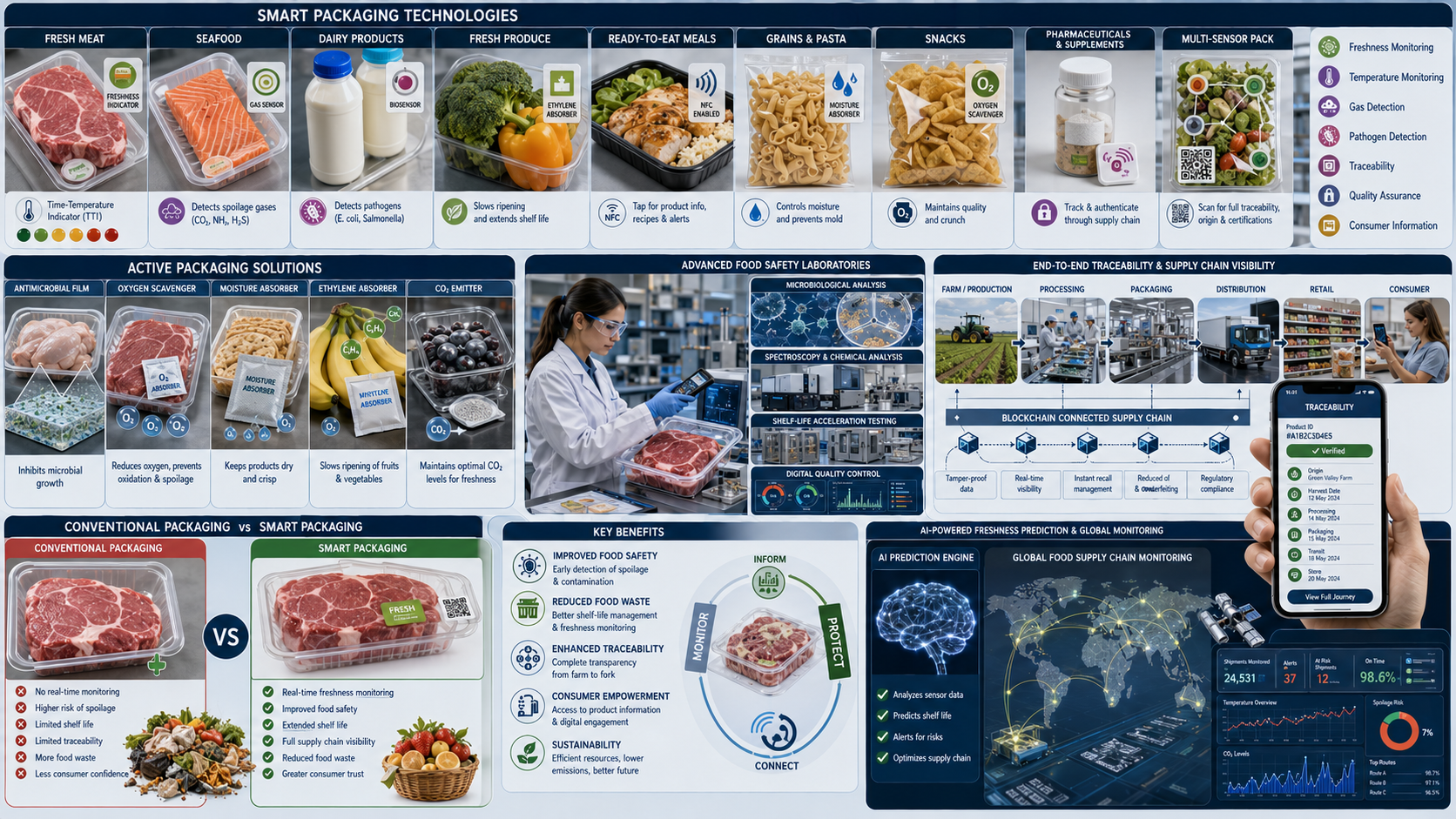
Unlike conventional packaging, smart packaging can actively interact with food or provide information about its condition throughout the supply chain. Technologies such as time-temperature indicators, freshness sensors, radio-frequency identification (RFID), near-field communication (NFC), biosensors, gas sensors, and QR-code-enabled digital traceability are transforming food safety management and reducing food waste.
As global food supply chains become increasingly complex, smart packaging offers powerful tools for improving transparency, enhancing consumer confidence, and supporting sustainable food systems.
Introduction
Modern consumers expect food to be safe, fresh, authentic, and traceable from farm to table. At the same time, food manufacturers face growing challenges related to spoilage, contamination, counterfeit products, and increasingly complex distribution networks.
Traditional packaging provides a physical barrier against contamination but cannot indicate whether food has been mishandled, exposed to unsafe temperatures, or begun to spoil.
Smart packaging addresses these limitations by integrating sensing, monitoring, and communication technologies directly into food packages, enabling continuous monitoring throughout the product’s lifecycle.
What Is Smart Food Packaging?
Smart food packaging refers to packaging systems that monitor, communicate, or actively improve food quality and safety.
It generally falls into two categories:
Intelligent Packaging
Intelligent packaging monitors food or environmental conditions without directly altering the food.
Examples include:
- Freshness indicators
- Time-temperature indicators
- RFID tags
- NFC-enabled labels
- QR-code traceability
- Biosensors
- Gas sensors
Active Packaging
Active packaging interacts with the packaged food to extend shelf life or maintain quality.
Examples include:
- Oxygen scavengers
- Moisture absorbers
- Ethylene absorbers
- Carbon dioxide emitters
- Antimicrobial packaging
- Antioxidant-releasing films
Many commercial packaging systems combine both intelligent and active technologies.
Key Smart Packaging Technologies
Time-Temperature Indicators (TTIs)
TTIs monitor cumulative temperature exposure during storage and transportation.
If refrigerated foods experience unsafe temperatures, the indicator changes color, alerting retailers and consumers to potential quality loss.
Common applications include:
- Dairy products
- Meat
- Seafood
- Vaccines
- Frozen foods
Freshness Indicators
Freshness indicators detect chemical changes associated with spoilage.
These indicators often respond to compounds such as:
- Ammonia
- Sulfur compounds
- Organic acids
- Carbon dioxide
Color changes provide a visual indication of product freshness.
Gas Sensors
Respiring foods produce gases during storage.
Gas sensors monitor concentrations of:
- Oxygen
- Carbon dioxide
- Ethylene
- Hydrogen sulfide
These measurements help estimate product freshness and shelf life.
Biosensors
Biosensors use biological recognition molecules to detect specific hazards.
Applications include detection of:
- Foodborne pathogens
- Allergens
- Mycotoxins
- Chemical contaminants
Future biosensors may provide rapid, real-time food safety monitoring directly within packages.
RFID Technology
Radio Frequency Identification (RFID) enables wireless tracking of food products throughout supply chains.
Benefits include:
- Inventory management
- Cold chain monitoring
- Product authentication
- Recall management
- Supply chain visibility
NFC and QR Codes
Consumers can scan packages using smartphones to access information including:
- Product origin
- Harvest date
- Nutritional information
- Sustainability certifications
- Storage recommendations
- Recipes
These technologies also support digital food traceability.
Benefits of Smart Packaging
Improved Food Safety
Continuous monitoring helps identify:
- Temperature abuse
- Microbial spoilage
- Packaging damage
- Supply chain failures
Early detection reduces food safety risks.
Reduced Food Waste
Many foods are discarded based solely on expiration dates rather than actual quality.
Freshness monitoring allows more accurate assessment of remaining shelf life, helping reduce unnecessary waste.
Better Traceability
Digital tracking improves transparency from farm to consumer.
Rapid traceability supports:
- Product recalls
- Counterfeit prevention
- Regulatory compliance
- Consumer confidence
Enhanced Consumer Engagement
Interactive packaging provides educational information and strengthens trust by giving consumers greater insight into product quality and origin.
Challenges
Despite its advantages, smart packaging faces several challenges.
Cost
Advanced sensors and electronic components increase packaging costs.
As technologies mature, production costs are expected to decline.
Recycling
Some smart packaging incorporates electronic components that complicate recycling.
Researchers are developing biodegradable sensors and environmentally friendly electronic materials.
Standardization
Industry-wide standards are needed to improve compatibility across food supply chains.
Data Security
Digital traceability systems require secure management of supply chain information to protect both businesses and consumers.
Emerging Innovations
Researchers are developing next-generation packaging technologies including:
- Printed electronic sensors
- Flexible biosensors
- Artificial intelligence-enabled freshness prediction
- Internet of Things (IoT)-connected packaging
- Blockchain-integrated traceability
- Self-powered sensor systems
- Edible sensors
- Biodegradable intelligent films
These innovations aim to make smart packaging more affordable and environmentally sustainable.
Applications Across Food Industries
Smart packaging is increasingly used for:
Fresh Meat
Temperature monitoring and spoilage detection.
Seafood
Cold chain verification and freshness monitoring.
Dairy Products
Shelf-life prediction and refrigeration monitoring.
Fruits and Vegetables
Ripeness indicators and ethylene monitoring.
Ready-to-Eat Meals
Safety verification and quality assurance.
Pharmaceuticals and Nutraceuticals
Temperature-sensitive product monitoring.
Research Spotlight
Recent advances in nanotechnology, biotechnology, and flexible electronics have accelerated the development of intelligent food packaging.
Scientists are exploring nanosensors capable of detecting microbial contamination at extremely low concentrations while integrating wireless communication systems that transmit real-time data throughout the supply chain.
These technologies could fundamentally change how food quality is monitored, reducing spoilage, improving food safety, and enabling predictive shelf-life management.
Future Outlook
The future of smart packaging is expected to include:
- AI-powered freshness prediction
- Digital product passports
- Blockchain-enabled transparency
- Self-healing packaging materials
- Compostable smart packaging
- Real-time pathogen detection
- Consumer smartphone integration
As production costs decline, smart packaging is likely to become increasingly common across both premium and everyday food products.
Conclusion
Smart food packaging represents one of the most significant innovations in modern food technology. By combining advanced sensors, digital communication, active preservation systems, and intelligent monitoring, these packaging solutions improve food safety, reduce waste, enhance traceability, and strengthen consumer confidence.
Although challenges related to cost, sustainability, and standardization remain, rapid advances in materials science and digital technologies continue to expand the capabilities of smart packaging. As global food systems become more interconnected, intelligent packaging will play an increasingly important role in ensuring safe, sustainable, and transparent food supply chains.
Key Takeaways
- Smart packaging combines sensing, monitoring, and communication technologies with food packaging.
- Intelligent packaging monitors food quality, while active packaging helps preserve it.
- Technologies include biosensors, RFID, NFC, QR codes, gas sensors, and time-temperature indicators.
- Smart packaging improves food safety, traceability, and shelf-life management while reducing food waste.
- Future developments will integrate AI, IoT, blockchain, and biodegradable electronic materials.
References
- Food and Agriculture Organization (FAO). Food Loss and Waste Reduction.
- World Health Organization (WHO). Food Safety.
- Comprehensive Reviews in Food Science and Food Safety. Smart Packaging Technologies for Food Applications.
- Trends in Food Science & Technology. Intelligent Packaging Systems for Food Quality Monitoring.
- Food Packaging and Shelf Life. Advances in Active and Intelligent Food Packaging.
- Journal of Food Engineering. Biosensors and Smart Packaging in Modern Food Systems.
- Nature Reviews Materials. Flexible Electronics for Smart Packaging.
- Annual Review of Food Science and Technology. Emerging Technologies in Food Packaging.