
Summary
Per- and polyfluoroalkyl substances (PFAS) are a large group of synthetic chemicals used in industrial processes and consumer products for their resistance to heat, water, oil, and stains. Because these compounds break down extremely slowly in the environment, they have earned the nickname “forever chemicals.”
Over the past decade, scientists have detected PFAS in drinking water, agricultural soils, seafood, dairy products, meat, eggs, and food packaging materials. Growing evidence suggests that long-term exposure to certain PFAS compounds may be associated with adverse health outcomes, prompting increased regulatory attention worldwide.
This article explores how PFAS enter food systems, examines potential health implications, reviews current scientific findings, and discusses strategies for reducing exposure.
Introduction
PFAS have been manufactured since the 1940s and are used in thousands of products. Their unique chemical structure makes them highly effective at repelling water, grease, and dirt.
Common applications include:
- Non-stick cookware
- Water-resistant textiles
- Firefighting foams
- Food packaging
- Industrial manufacturing processes
While these properties provide significant commercial benefits, they also contribute to environmental persistence. Once released, PFAS can remain in soil, water, wildlife, and human populations for many years.
As monitoring technologies improve, researchers are discovering PFAS contamination in an increasing number of food products and environmental sources.
What Are PFAS?
PFAS refers to a large family of fluorinated chemicals containing strong carbon-fluorine bonds.
These bonds make PFAS:
- Extremely stable
- Resistant to degradation
- Persistent in the environment
- Difficult to remove from water systems
Thousands of PFAS compounds exist, although only a subset has been extensively studied.
Among the most well-known are:
- PFOA (Perfluorooctanoic Acid)
- PFOS (Perfluorooctane Sulfonate)
- GenX chemicals
- PFHxS (Perfluorohexane Sulfonate)
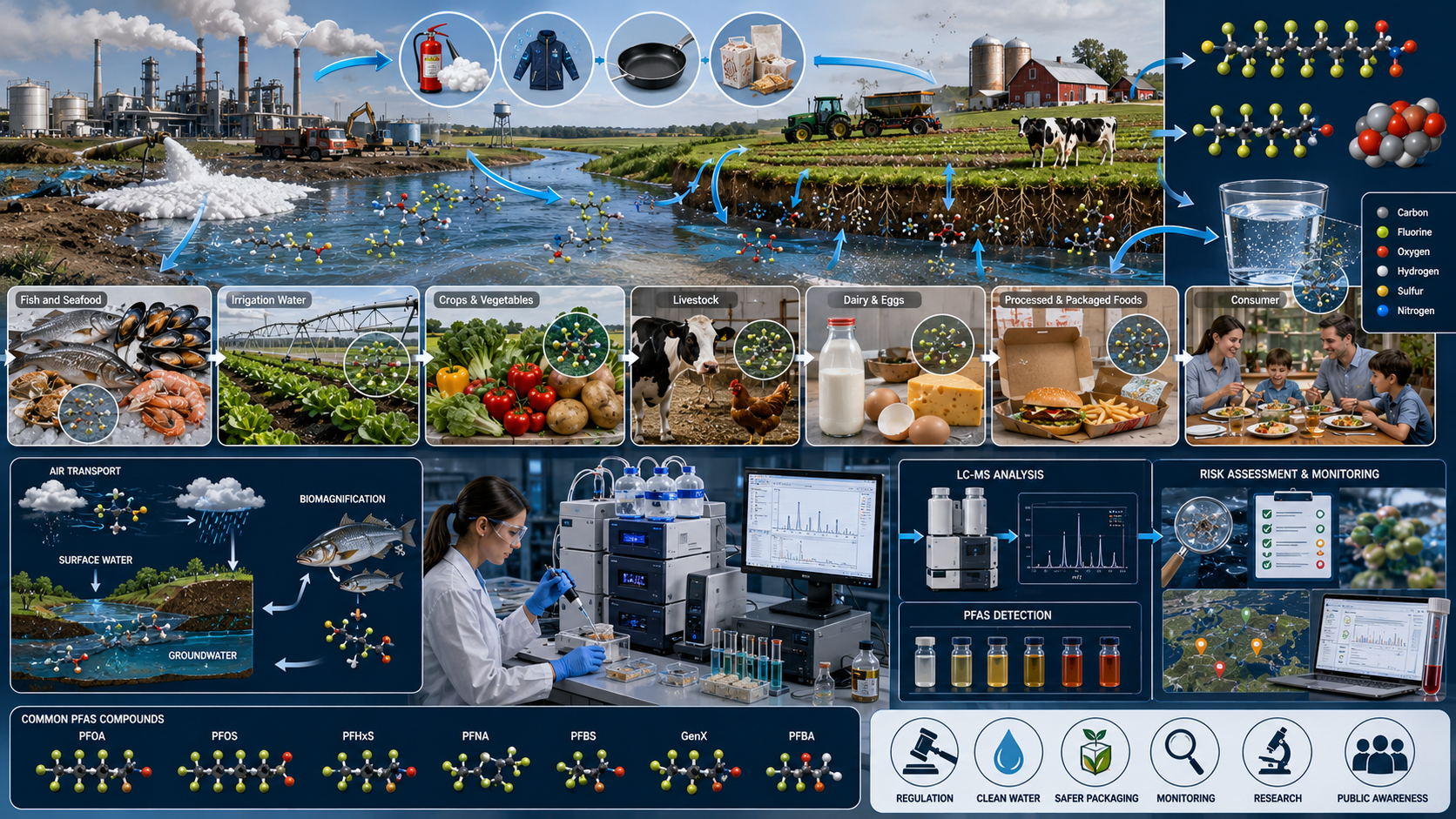
How PFAS Enter Food Systems
Food Packaging
Historically, PFAS have been used in grease-resistant food packaging such as:
- Fast-food wrappers
- Microwave popcorn bags
- Pizza boxes
- Bakery packaging
Although many manufacturers are transitioning away from certain PFAS compounds, legacy contamination remains a concern.
Contaminated Water
PFAS-contaminated groundwater and surface water may be used for:
- Irrigation
- Livestock production
- Food processing
This creates pathways for contamination of crops and animal products.
Agricultural Soils
PFAS may accumulate in soil through:
- Industrial emissions
- Biosolid applications
- Contaminated irrigation water
- Atmospheric deposition
Certain crops can absorb PFAS from soil and water.
Seafood and Aquatic Foods
Fish and shellfish can accumulate PFAS from contaminated aquatic environments.
Scientists have reported elevated concentrations in some seafood species harvested near industrial areas or contaminated waterways.
Foods Commonly Associated With PFAS Exposure
Research has identified PFAS in various food categories, including:
Seafood
Marine and freshwater species can accumulate PFAS through environmental exposure.
Meat and Poultry
Animals may be exposed through contaminated feed, water, or soil.
Eggs
PFAS can transfer from contaminated environments into egg production systems.
Dairy Products
Milk contamination may occur when dairy animals consume contaminated feed or water.
Produce
Some fruits and vegetables can absorb PFAS through root uptake.
Potential Health Concerns
Research on PFAS continues to evolve, but several health concerns have been investigated.
Immune System Effects
Studies suggest some PFAS compounds may affect immune system function and vaccine responses.
Cholesterol Changes
Elevated blood cholesterol levels have been associated with exposure to certain PFAS compounds.
Developmental Effects
Researchers continue to examine potential impacts on fetal and childhood development.
Endocrine Disruption
Some PFAS may interfere with hormonal systems.
Cancer Research
Certain PFAS compounds have been studied for possible associations with increased cancer risk, although evidence varies depending on the compound and exposure level.
What Does Current Science Say?
Scientists generally agree on several key points:
- PFAS exposure is widespread globally.
- Certain PFAS compounds accumulate in humans and wildlife.
- Some compounds have been linked to adverse health outcomes.
- More research is needed regarding newer replacement chemicals.
One challenge is that PFAS represents thousands of compounds with differing properties and toxicological profiles.
Detection and Monitoring Technologies
Liquid Chromatography-Mass Spectrometry (LC-MS)
LC-MS is considered the gold standard for PFAS detection.
It enables highly sensitive measurement of PFAS compounds in:
- Water
- Food
- Soil
- Biological samples
High-Resolution Mass Spectrometry
Advanced instruments can identify emerging PFAS compounds not routinely monitored.
Environmental Surveillance Programs
Many countries are expanding monitoring efforts to better understand contamination sources and exposure pathways.
Regulatory Developments
Governments worldwide are increasing oversight of PFAS contamination.
Key areas of focus include:
- Drinking water standards
- Food-contact materials
- Industrial emissions
- Environmental cleanup requirements
Several jurisdictions have introduced restrictions on PFAS use in food packaging and consumer products.
Reducing Consumer Exposure
While complete avoidance may be difficult, several strategies may help reduce exposure.
Support Safer Packaging Alternatives
Many food manufacturers are adopting PFAS-free packaging materials.
Improve Water Quality
Advanced filtration systems such as activated carbon and reverse osmosis can reduce PFAS concentrations in drinking water.
Strengthen Environmental Controls
Reducing industrial releases remains one of the most effective long-term solutions.
Expand Monitoring Programs
Routine testing can identify contamination hotspots and guide interventions.
Research Spotlight
PFAS and Food Safety
Recent scientific reviews emphasize the need for integrated approaches that combine:
- Environmental monitoring
- Food testing
- Toxicological research
- Regulatory action
Researchers increasingly view PFAS as both an environmental and food safety challenge requiring multidisciplinary solutions.
Future Directions
Emerging research is focusing on:
- Safer chemical alternatives
- Improved detection technologies
- Enhanced environmental remediation
- Better understanding of cumulative exposure
Scientists are also investigating methods to remove PFAS from contaminated water, soil, and food production systems.
Conclusion
PFAS contamination has become a significant global food safety and environmental health issue. These persistent chemicals can enter food systems through packaging, water, soil, and environmental pollution, creating multiple pathways for human exposure.
Although important scientific questions remain, growing evidence has prompted regulatory action and increased monitoring worldwide. Continued research, improved detection technologies, and proactive contamination prevention strategies will be critical for protecting public health and maintaining consumer confidence in food systems.
References and Further Reading
- World Health Organization (WHO). PFAS and Public Health.
- Food and Agriculture Organization (FAO). Environmental Contaminants in Food Systems.
- United States Environmental Protection Agency (EPA). PFAS Explained.
- European Food Safety Authority (EFSA). PFAS Risk Assessments.
- National Academies of Sciences. Guidance on PFAS Exposure.
- Environmental Science & Technology. PFAS in Food and Water Research.
- Journal of Exposure Science & Environmental Epidemiology. Human Exposure to PFAS.
- Nature Reviews Earth & Environment. Emerging Contaminants and Food Systems.