
Summary
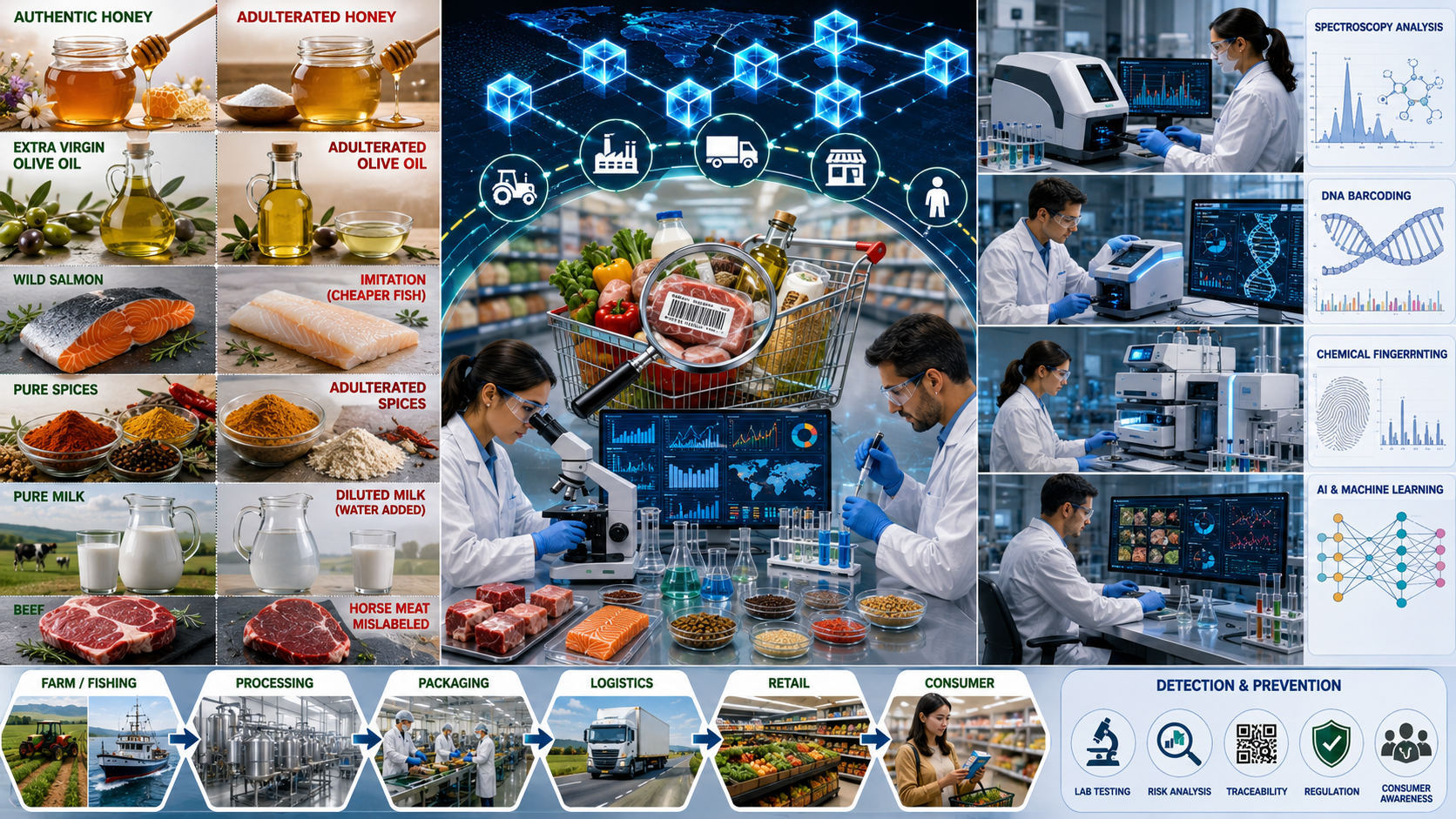
Consumers generally assume that foods purchased from supermarkets, markets, and online platforms are authentic and accurately labelled. However, a growing body of evidence suggests that food fraud has become one of the most significant emerging threats facing global food systems. Counterfeit honey, adulterated olive oil, diluted milk, mislabelled seafood, fake spices, fraudulent organic foods, and counterfeit alcoholic beverages have been reported across multiple continents.
Food fraud is not merely an economic crime. In many cases, it poses direct risks to human health. Some fraudulent products contain undeclared allergens, industrial chemicals, toxic dyes, pharmaceutical compounds, or contaminated ingredients capable of causing illness and death.
The increasing globalization of food supply chains has created opportunities for fraudulent activities that are difficult to detect using conventional inspection methods. At the same time, advances in analytical chemistry, DNA testing, spectroscopy, artificial intelligence, blockchain, and digital traceability are improving the ability of regulators and food companies to identify fraudulent products.
This article examines the growing problem of fake foods, explores major food fraud incidents, reviews emerging detection technologies, and discusses strategies for protecting consumers and strengthening food system integrity.
Introduction
Food authenticity has become an increasingly important issue in modern food systems. Global food supply chains often involve multiple countries, numerous intermediaries, and complex distribution networks. While these systems provide access to diverse foods throughout the year, they also create vulnerabilities that can be exploited by fraudulent actors.
Food fraud refers to the deliberate substitution, addition, tampering, or misrepresentation of food products for economic gain.
Unlike accidental contamination, food fraud is intentional. The primary motivation is usually financial profit.
The Food and Agriculture Organization (FAO) recognizes food fraud as a growing challenge that threatens consumer confidence, public health, and fair trade.
Recent investigations have revealed fraud involving:
- Honey
- Olive oil
- Fish and seafood
- Meat products
- Milk and dairy products
- Spices
- Coffee
- Tea
- Fruit juices
- Herbal products
As detection technologies improve, researchers continue to uncover fraudulent practices that previously went unnoticed.
Understanding Food Fraud
What Is Food Fraud?
Food fraud encompasses a variety of deceptive practices including:
Adulteration
Adding undeclared substances to increase profits.
Examples include:
- Water added to milk
- Sugar syrups added to honey
- Cheaper oils blended into olive oil
Substitution
Replacing valuable ingredients with lower-cost alternatives.
Examples include:
- Horse meat sold as beef
- Lower-value fish species sold as premium seafood
- Artificial flavors replacing natural ingredients
Mislabeling
Providing false information about:
- Origin
- Species
- Production methods
- Organic certification
- Geographic indications
Counterfeiting
Replicating branded food products without authorization.
Counterfeit foods often mimic packaging, labeling, and branding to deceive consumers.
Major Food Fraud Incidents
The Melamine Milk Scandal
One of the most serious food fraud incidents occurred in China in 2008.
Manufacturers added melamine, an industrial chemical, to diluted milk to artificially increase apparent protein levels during testing.
Consequences included:
- Over 300,000 affected infants
- More than 50,000 hospitalizations
- Several deaths
The incident demonstrated how economically motivated fraud can become a major public health disaster.
The European Horse Meat Scandal
In 2013, European authorities discovered that products labelled as beef contained horse meat.
The fraud affected multiple countries and highlighted weaknesses in food supply chain transparency.
Although horse meat itself was not necessarily unsafe, the scandal severely damaged consumer trust.
Counterfeit Alcohol
Counterfeit alcoholic beverages continue to cause poisonings worldwide.
Some fraudulent products contain:
- Methanol
- Industrial solvents
- Toxic contaminants
According to WHO reports, methanol poisoning outbreaks linked to counterfeit alcohol continue to occur in multiple regions.
Honey: One of the Most Fraudulent Foods
Honey is frequently cited as one of the world’s most adulterated foods.
Common fraudulent practices include:
- Addition of corn syrup
- Addition of rice syrup
- Misrepresentation of geographic origin
- False claims regarding floral sources
Recent investigations have identified extensive honey fraud networks operating across international markets.
The challenge arises because sophisticated sugar syrups can closely mimic the chemical composition of genuine honey.
Olive Oil Fraud
Extra virgin olive oil commands premium prices, making it attractive for fraud.
Common schemes include:
- Mixing cheaper vegetable oils with olive oil
- Misrepresenting quality grades
- False country-of-origin claims
Researchers estimate that olive oil remains among the most economically vulnerable food commodities worldwide.
Seafood Fraud
Seafood is particularly susceptible to fraud because species often become difficult to identify after processing.
Studies have documented:
- Species substitution
- False origin claims
- Mislabeling of wild-caught fish as farmed
- Misrepresentation of sustainability certifications
DNA testing programs have revealed significant levels of seafood mislabeling in numerous countries.
Public Health Implications
Food fraud is often perceived as an economic issue, but many cases have direct health consequences.
Potential risks include:
Allergen Exposure
Undeclared ingredients can expose consumers to allergens.
Examples include:
- Peanut proteins
- Milk proteins
- Soy ingredients
For sensitive individuals, exposure may trigger severe allergic reactions.
Toxic Chemicals
Fraudulent products may contain:
- Industrial dyes
- Pesticide residues
- Heavy metals
- Melamine
- Methanol
These substances may cause acute or chronic health effects.
Reduced Nutritional Value
Substitution and dilution may significantly reduce nutritional quality.
This is particularly concerning for:
- Infant foods
- Nutritional supplements
- Therapeutic foods
Emerging Technologies for Detecting Fake Foods
DNA Barcoding
DNA barcoding enables accurate species identification.
Applications include:
- Fish authentication
- Meat authentication
- Botanical ingredient verification
DNA techniques have become powerful tools against food fraud.
Stable Isotope Analysis
This approach examines natural isotopic signatures.
It can verify:
- Geographic origin
- Production systems
- Ingredient authenticity
Spectroscopy
Modern spectroscopic techniques provide rapid and non-destructive analysis.
Methods include:
- Near-infrared spectroscopy (NIR)
- Raman spectroscopy
- Fourier Transform Infrared Spectroscopy (FTIR)
These tools are increasingly used for routine authenticity testing.
Artificial Intelligence
AI systems can analyze large datasets and identify unusual patterns associated with fraud.
Applications include:
- Supply chain monitoring
- Risk prediction
- Authenticity assessment
Food Traceability and Blockchain
Digital traceability systems are becoming essential tools in the fight against food fraud.
Blockchain technologies can create immutable records documenting:
- Production
- Processing
- Transportation
- Distribution
Such systems improve transparency and reduce opportunities for fraudulent manipulation.
Research Spotlight
Food Fraud Vulnerability in Global Supply Chains
A growing body of research indicates that food fraud risk increases when:
- Supply chains become more complex
- Product values are high
- Verification systems are weak
- Market demand exceeds supply
Researchers emphasize the need for integrated surveillance systems combining analytical testing, digital traceability, and intelligence sharing.
Future Directions
Future food fraud prevention strategies may involve:
- Real-time authentication technologies
- Portable testing devices
- AI-powered surveillance systems
- Blockchain-enabled traceability
- International fraud databases
- Enhanced regulatory cooperation
Food scientists will play a critical role in developing robust methods for detecting and preventing fraud.
Conclusion
Food fraud represents one of the most significant emerging challenges facing modern food systems. Beyond economic losses, counterfeit and adulterated foods can threaten public health, undermine consumer confidence, and damage legitimate businesses.
Recent scandals involving milk, meat, honey, olive oil, seafood, and alcoholic beverages demonstrate the scale and complexity of the problem. Fortunately, advances in DNA testing, spectroscopy, artificial intelligence, and digital traceability are providing powerful new tools for detecting fraudulent products.
Protecting consumers will require collaboration among regulators, food industries, researchers, and consumers. As food systems continue to globalize, ensuring food authenticity will become increasingly important for public health, trade, and food security.
References and Further Reading
- Food and Agriculture Organization (FAO). Food Fraud and Food Integrity.
https://www.fao.org - World Health Organization (WHO). Food Safety.
https://www.who.int/health-topics/food-safety - European Commission Knowledge Centre for Food Fraud and Quality.
https://knowledge4policy.ec.europa.eu/food-fraud-quality_en - Spink, J., & Moyer, D.C. (2011). Defining the Public Health Threat of Food Fraud.
Journal of Food Science.
https://doi.org/10.1111/j.1750-3841.2011.02417.x - Moore, J.C., Spink, J., & Lipp, M. (2012). Development and Application of a Database of Food Ingredient Fraud.
Journal of Food Science.
https://doi.org/10.1111/j.1750-3841.2012.02657.x - Food Authenticity Network.
https://www.foodauthenticity.global - Europol. Food Fraud Operations Reports.
https://www.europol.europa.eu - OECD. Illicit Trade and Food Fraud.
https://www.oecd.org