
Summary
Modern consumers expect foods that are fresh, nutritious, minimally processed, and free from excessive preservatives. At the same time, food manufacturers face increasing pressure to improve food safety, reduce energy consumption, minimize food waste, and produce high-quality products efficiently. These demands have accelerated the development of innovative non-thermal food processing technologies.
Among the most promising is Pulsed Electric Field (PEF) technology, a process that uses short bursts of high-voltage electricity to alter cell membranes without relying on high temperatures. By disrupting microbial cells and modifying plant tissues, PEF can improve food safety, increase extraction yields, reduce processing times, and preserve the sensory and nutritional qualities of foods.
Although commercial applications are currently concentrated in liquid and semi-liquid foods, ongoing research is expanding PEF into fruit and vegetable processing, drying, extraction of bioactive compounds, winemaking, dairy processing, and sustainable food manufacturing.
This article explores the science behind Pulsed Electric Field technology, its industrial applications, advantages, limitations, food safety implications, and the innovations shaping its future.
Introduction
For decades, heat treatments such as pasteurization and sterilization have been the cornerstone of food preservation. These processes effectively destroy harmful microorganisms but may also alter flavor, color, texture, and heat-sensitive nutrients.
To overcome these limitations, researchers have developed several non-thermal food preservation technologies, including:
- High-Pressure Processing (HPP)
- Cold Plasma
- Pulsed Electric Fields (PEF)
- Ultraviolet (UV-C) Processing
- Ultrasound Processing
Among these technologies, PEF has attracted significant attention because it combines microbial control with minimal thermal damage while also improving extraction processes in plant-based foods.
What Is Pulsed Electric Field Technology?
Pulsed Electric Field technology is a non-thermal process in which food is exposed to very short pulses of high-voltage electricity, typically ranging from 10 to 80 kilovolts per centimeter (kV/cm).
The treatment usually lasts only a few microseconds to milliseconds.
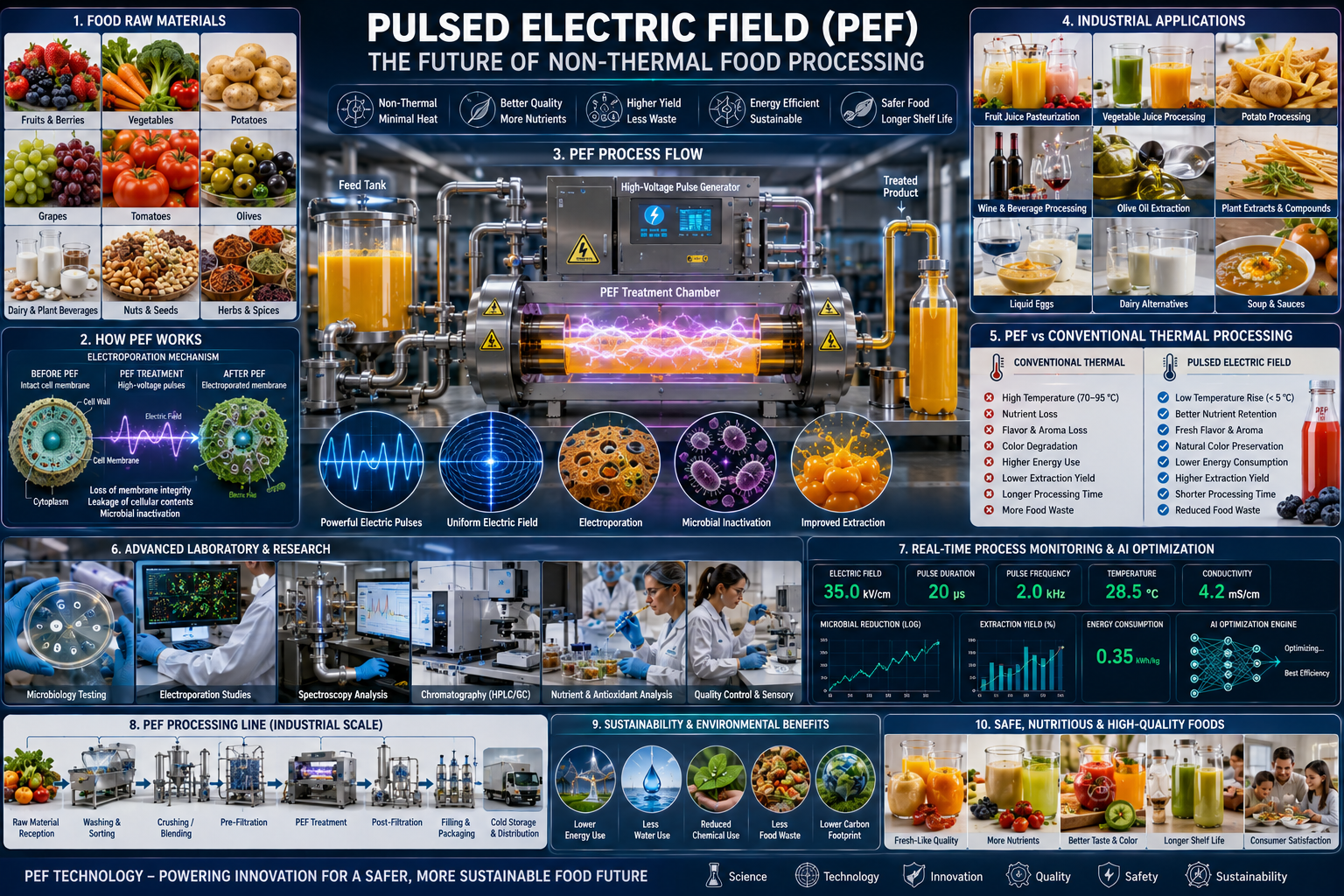
During processing, foods pass between two electrodes connected to a pulse generator. The electrical pulses create temporary or permanent pores in cell membranes through a phenomenon known as electroporation.
Depending on the treatment conditions, electroporation can:
- Inactivate microorganisms
- Increase membrane permeability
- Improve mass transfer
- Enhance extraction of intracellular compounds
- Facilitate drying and dehydration
Because the overall temperature rise is relatively small, PEF is classified as a non-thermal or minimally thermal technology.
How PEF Works
Step 1: Product Preparation
PEF is most effective for foods that can flow through treatment chambers, including:
- Fruit juices
- Vegetable juices
- Liquid eggs
- Milk alternatives
- Plant extracts
- Liquid nutritional products
Some solid foods undergo pre-treatment before processing.
Step 2: Flow Through the Treatment Chamber
The food moves continuously through a chamber equipped with electrodes.
The chamber is designed to ensure a uniform electric field across the product.
Step 3: High-Voltage Pulse Application
Short electrical pulses generate strong electric fields around microbial and plant cells.
These pulses cause electroporation by disrupting cell membranes.
Step 4: Microbial Inactivation and Tissue Modification
Microbial cells lose membrane integrity and are unable to maintain essential biological functions.
In plant tissues, membrane permeability increases, improving the release of juices, pigments, sugars, antioxidants, and other valuable compounds.
Food Safety Applications
PEF has demonstrated effectiveness against many vegetative microorganisms, including:
- Escherichia coli
- Listeria monocytogenes
- Salmonella enterica
- Saccharomyces cerevisiae
- Various spoilage bacteria and yeasts
The technology is particularly suitable for acidic beverages, where microbial inactivation is enhanced.
However, bacterial spores are more resistant and often require combination treatments such as mild heat or other preservation technologies.
Industrial Applications
Fruit Juice Processing
PEF helps preserve fresh flavor, aroma, vitamins, and natural color while reducing spoilage microorganisms.
Commercial applications include:
- Orange juice
- Apple juice
- Mixed fruit beverages
- Smoothies
Vegetable Processing
Treatment improves juice extraction and increases the recovery of valuable phytochemicals from vegetables such as tomatoes, carrots, and beetroot.
Potato Processing
PEF softens potato tissue, improving cutting efficiency during French fry and potato chip production while reducing mechanical damage and energy consumption.
Winemaking
PEF enhances the extraction of anthocyanins, tannins, and aroma compounds from grape skins, potentially improving wine quality and processing efficiency.
Oil Extraction
Researchers have demonstrated improved extraction yields from olives and oilseeds due to increased cell permeability.
Drying Processes
Pre-treatment with PEF accelerates moisture removal during drying, reducing processing time and energy use.
Advantages of Pulsed Electric Field Technology
Better Nutrient Retention
Because processing involves minimal heating, vitamins, antioxidants, and flavor compounds are generally better preserved than during conventional thermal treatments.
Improved Food Quality
Consumers often prefer products processed with PEF because they retain fresher sensory characteristics.
Increased Extraction Efficiency
Electroporation improves the recovery of juices, pigments, oils, sugars, and functional ingredients.
Energy Efficiency
Compared with some thermal processes, PEF can reduce overall energy requirements, particularly when integrated into continuous production systems.
Reduced Food Waste
Higher extraction yields allow manufacturers to recover more valuable material from agricultural raw materials.
Limitations
Despite its advantages, PEF is not suitable for every food application.
Limited Effectiveness in Dry Foods
Foods with very low electrical conductivity are difficult to process effectively.
Equipment Costs
Industrial PEF systems require sophisticated pulse generators and specialized treatment chambers.
Spore Resistance
Bacterial spores remain relatively resistant and often require additional preservation hurdles.
Product-Specific Optimization
Each food requires carefully validated treatment conditions to achieve the desired balance between safety and quality.
Food Safety and Regulatory Considerations
PEF should be incorporated into comprehensive food safety systems that include:
- Good Manufacturing Practices (GMP)
- Hazard Analysis and Critical Control Point (HACCP)
- Equipment sanitation
- Environmental monitoring
- Process validation
- Routine microbiological testing
Manufacturers must demonstrate that PEF-treated products consistently meet applicable food safety requirements.
Current Research
Researchers are investigating several exciting applications:
- Combination treatments with High-Pressure Processing and Cold Plasma
- Enhanced extraction of plant proteins
- Recovery of natural colorants
- Improved production of functional beverages
- Microbial control in dairy alternatives
- Sustainable processing of agricultural by-products
Artificial intelligence is increasingly being used to optimize pulse duration, field strength, and energy consumption for different food products.
Future Outlook
The future of Pulsed Electric Field technology is closely linked to sustainable food manufacturing.
Expected developments include:
- Larger industrial processing systems
- AI-driven process optimization
- Integration into smart food factories
- Increased use in plant-based protein production
- Improved extraction of bioactive compounds
- Hybrid preservation technologies combining PEF with other non-thermal methods
As equipment costs decrease and industrial experience grows, PEF is expected to become an increasingly important component of modern food processing.
Conclusion
Pulsed Electric Field technology is transforming the food industry by providing an efficient, non-thermal method for improving food safety, enhancing extraction processes, and preserving food quality. Through the controlled application of high-voltage electrical pulses, PEF offers manufacturers an innovative alternative to conventional heat treatments while supporting cleaner-label products and more sustainable production.
Although technical and economic challenges remain, advances in engineering, automation, and food science continue to expand the commercial potential of PEF. Together with High-Pressure Processing, Cold Plasma, and other emerging technologies, Pulsed Electric Field processing is helping define the future of safe, efficient, and environmentally responsible food manufacturing.
Key Takeaways
- Pulsed Electric Field technology uses short bursts of high-voltage electricity to modify cell membranes.
- Electroporation improves microbial control and enhances the extraction of valuable food components.
- PEF helps preserve flavor, nutrients, and fresh quality while reducing thermal damage.
- Commercial applications include juices, vegetables, potatoes, wine, and oil extraction.
- Continued innovation is expanding PEF into sustainable food manufacturing and next-generation processing systems.
References
- Barbosa-Cánovas, G. V., Zhang, Q. H., & Swanson, B. G. (1999). Pulsed Electric Fields in Food Processing: Fundamental Aspects and Applications. CRC Press.
- Toepfl, S., Heinz, V., & Knorr, D. (2007). High intensity pulsed electric fields applied for food preservation. Chemical Engineering and Processing, 46(6), 537–546. https://doi.org/10.1016/j.cep.2006.07.011
- Barba, F. J., Parniakov, O., Pereira, S. A., Wiktor, A., Grimi, N., Boussetta, N., Saraiva, J. A., Raso, J., Martin-Belloso, O., & Witrowa-Rajchert, D. (2015). Current applications and new opportunities for the use of pulsed electric fields in food science and industry. Food Research International, 77, 773–798. https://doi.org/10.1016/j.foodres.2015.09.015
- Food and Agriculture Organization (FAO). Food Safety and Quality. https://www.fao.org/food-safety
- World Health Organization (WHO). Food Safety. https://www.who.int/health-topics/food-safety
- Knorr, D., et al. (2011). Emerging technologies in food processing. Annual Review of Food Science and Technology, 2, 203–235. https://doi.org/10.1146/annurev.food.102308.124129