
Summary
Food packaging has evolved far beyond its traditional role of containing and protecting products during storage and transportation. Modern consumers expect packaging to extend shelf life, preserve nutritional quality, reduce food waste, provide real-time information about product freshness, and minimize environmental impacts. Meeting these expectations requires innovations that operate at an exceptionally small scale—where materials behave differently from their conventional forms.
Nanotechnology involves the design and application of materials with dimensions typically between 1 and 100 nanometers. At this scale, materials often exhibit unique mechanical, optical, electrical, and antimicrobial properties that can significantly improve packaging performance. These innovations are enabling the development of active packaging, which interacts with food to enhance preservation, and smart packaging, which monitors product quality throughout the supply chain.
Nanotechnology is increasingly being investigated for antimicrobial food packaging, oxygen and moisture barrier improvement, ethylene scavenging, freshness indicators, biosensors, and biodegradable packaging materials. However, alongside these promising applications, researchers continue to evaluate the safety of engineered nanomaterials, their migration into foods, environmental impacts, and appropriate regulatory oversight.
This article explores the science of nanotechnology in food packaging, the major nanomaterials used, industrial applications, benefits, regulatory considerations, emerging innovations, and the future of intelligent food packaging.
Introduction
Global food systems lose enormous quantities of food every year because of spoilage, microbial contamination, oxidation, moisture changes, and physical damage during transportation and storage. Packaging is one of the most effective interventions for reducing these losses.
Traditional packaging materials provide passive protection by acting as physical barriers. Modern food packaging, however, is becoming increasingly functional. Through advances in nanotechnology, packaging can now actively inhibit microbial growth, absorb undesirable gases, detect spoilage, monitor temperature history, and communicate product quality to manufacturers and consumers.
These developments align with global efforts to improve food security, reduce waste, and create more sustainable packaging systems.
What Is Nanotechnology?
Nanotechnology is the manipulation and application of materials at the nanoscale, generally between 1 and 100 nanometers (nm).
To appreciate this scale:
- A human hair is approximately 80,000–100,000 nanometers wide.
- Many bacteria measure around 1,000–5,000 nanometers.
- Individual nanoparticles are often invisible even under conventional light microscopes.
At the nanoscale, materials frequently display enhanced:
- Surface area
- Mechanical strength
- Chemical reactivity
- Electrical conductivity
- Optical properties
- Antimicrobial activity
These characteristics make nanomaterials attractive for food packaging applications.
Types of Nanotechnology in Food Packaging
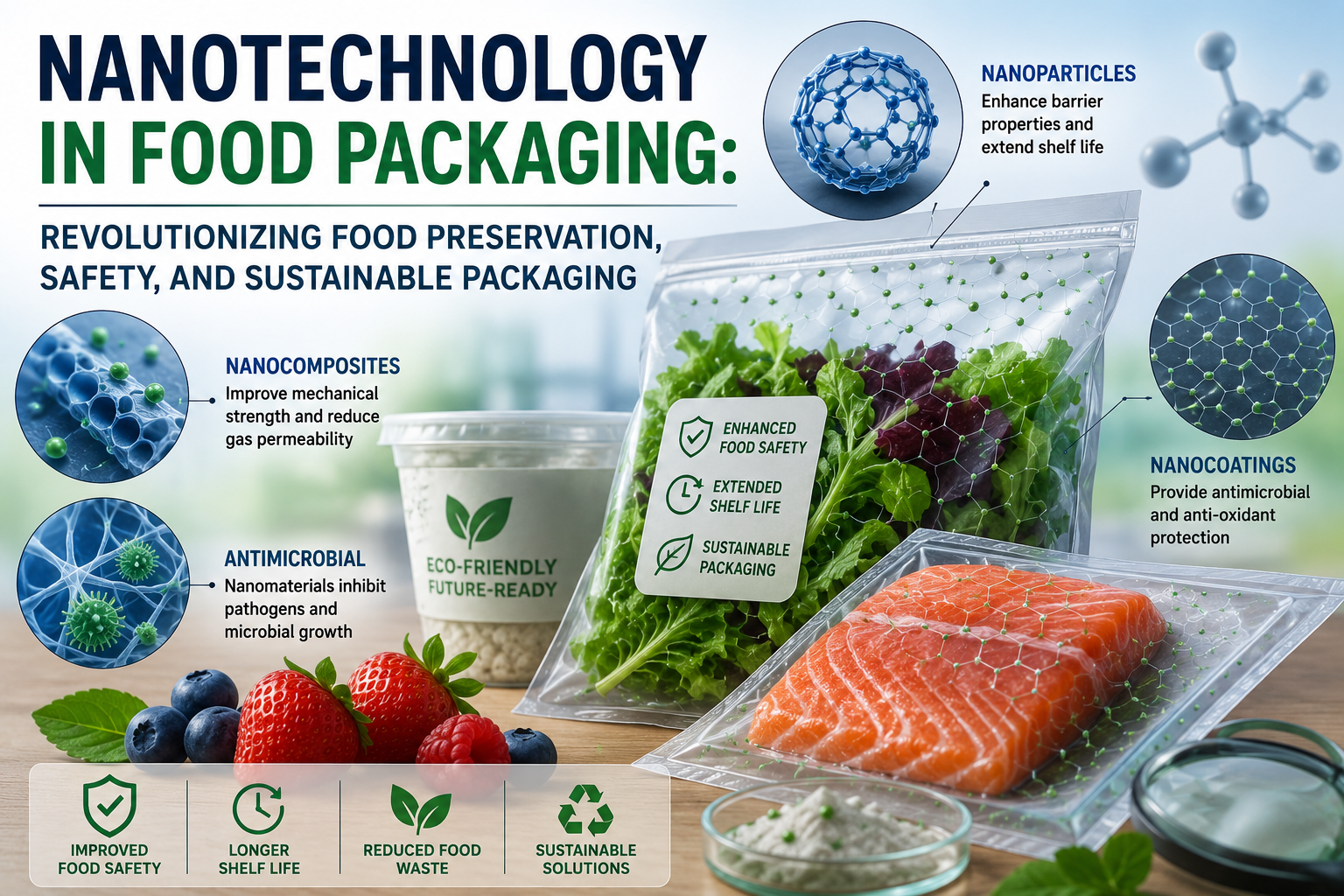
Nanocomposites
Nanocomposites incorporate nanoparticles into polymers to improve packaging performance.
Common improvements include:
- Increased mechanical strength
- Better oxygen barriers
- Reduced moisture permeability
- Improved thermal stability
- Enhanced durability
Nanocomposites are among the most commercially advanced nanotechnology applications in food packaging.
Active Packaging
Active packaging interacts with food or the package environment to preserve product quality.
Examples include:
- Oxygen scavengers
- Moisture absorbers
- Carbon dioxide regulators
- Ethylene scavengers
- Antimicrobial coatings
These systems help extend shelf life while maintaining food quality.
Smart Packaging
Smart packaging monitors product condition rather than directly preserving it.
Technologies include:
- Freshness indicators
- Time-temperature indicators
- Gas sensors
- Biosensors
- RFID-enabled monitoring
- QR code traceability
Combined with digital technologies, smart packaging supports real-time quality management throughout the supply chain.
Common Nanomaterials Used
Silver Nanoparticles
Silver nanoparticles possess broad-spectrum antimicrobial activity against many bacteria, yeasts, and molds.
Potential applications include:
- Meat packaging
- Dairy packaging
- Fresh produce
- Ready-to-eat foods
Because migration into foods remains an active research area, regulatory evaluations continue in many jurisdictions.
Zinc Oxide Nanoparticles
Zinc oxide nanoparticles provide antimicrobial and ultraviolet (UV) protection while improving polymer properties.
Titanium Dioxide Nanoparticles
Titanium dioxide has been studied for photocatalytic antimicrobial applications and UV protection, although its regulatory status varies by jurisdiction.
Nanoclay
Nanoclays improve barrier properties by reducing oxygen and moisture transmission through packaging films.
Applications include packaging for:
- Snacks
- Cereals
- Coffee
- Powdered foods
Cellulose Nanofibers
Derived from renewable plant materials, cellulose nanofibers improve mechanical strength while supporting biodegradable packaging development.
Applications Across Food Sectors
Fresh Fruits and Vegetables
Nanotechnology helps reduce:
- Moisture loss
- Ethylene accumulation
- Microbial spoilage
- Mechanical damage
This contributes to longer storage life and reduced post-harvest losses.
Meat and Poultry
Active antimicrobial packaging slows microbial growth and oxidation while helping preserve color and quality.
Dairy Products
Nanocomposite materials improve oxygen barriers, helping protect products susceptible to oxidation and flavor deterioration.
Seafood
Freshness indicators and antimicrobial packaging support cold-chain management and quality monitoring.
Bakery Products
Moisture regulation and mold inhibition contribute to improved shelf life without compromising product quality.
Food Safety Benefits
Nanotechnology supports food safety through several mechanisms.
Antimicrobial Protection
Certain nanomaterials inhibit bacterial growth on packaging surfaces.
Improved Barrier Performance
Reduced oxygen and moisture transfer slows spoilage reactions.
Spoilage Detection
Smart indicators provide visual or electronic signals when products deteriorate.
Temperature Monitoring
Time-temperature indicators help identify products exposed to improper storage conditions.
Enhanced Traceability
Integration with RFID, QR codes, blockchain, and IoT technologies improves supply chain transparency.
Sustainability
Nanotechnology also contributes to environmental sustainability.
Potential benefits include:
- Reduced food waste
- Lighter packaging materials
- Improved material efficiency
- Longer shelf life
- Development of biodegradable packaging
- Lower transportation emissions through reduced package weight
Researchers are increasingly investigating bio-based nanomaterials to replace petroleum-derived plastics.
Challenges and Safety Considerations
Despite significant promise, several challenges remain.
Nanoparticle Migration
Scientists continue studying whether nanoparticles migrate from packaging into foods under different storage and processing conditions.
Migration depends on factors such as:
- Food composition
- Temperature
- Packaging material
- Storage duration
- Nanoparticle characteristics
Human Health Assessment
Comprehensive toxicological evaluation remains essential before widespread commercialization of new nanomaterials.
Environmental Impact
Researchers continue investigating the environmental fate of engineered nanoparticles after disposal or recycling.
Consumer Acceptance
Public understanding of nanotechnology varies, highlighting the importance of transparent risk communication and evidence-based regulation.
Regulatory Landscape
Regulatory oversight differs among countries.
Authorities evaluating nanotechnology applications include:
- Food and Agriculture Organization (FAO)
- World Health Organization (WHO)
- European Food Safety Authority (EFSA)
- U.S. Food and Drug Administration (FDA)
- Codex Alimentarius Commission
Manufacturers are generally expected to demonstrate that packaging materials are safe under their intended conditions of use, including consideration of potential migration into food.
Emerging Technologies
Nanotechnology is increasingly integrated with other advanced technologies.
Artificial Intelligence
AI analyzes sensor data from smart packaging to predict shelf life and optimize inventory management.
Internet of Things (IoT)
Connected packaging systems provide real-time monitoring throughout transportation and storage.
Biosensors
Highly sensitive nanosensors can detect:
- Foodborne pathogens
- Chemical contaminants
- Spoilage metabolites
- Allergens
Biodegradable Nanocomposites
Researchers are combining nanotechnology with biodegradable polymers to improve environmental sustainability while maintaining packaging performance.
Current Research
Active areas of investigation include:
- Nano-enabled antimicrobial coatings
- Intelligent freshness indicators
- Self-healing packaging materials
- Plant-derived nanomaterials
- Nanocellulose-based biodegradable packaging
- Multi-functional active packaging
- AI-integrated smart packaging systems
- Migration assessment of engineered nanomaterials
These developments aim to improve both food safety and environmental performance.
Future Outlook
The next generation of food packaging is expected to become increasingly intelligent, connected, and sustainable.
Future innovations may include:
- Self-reporting packages that communicate freshness in real time
- Autonomous inventory systems using smart labels
- AI-driven shelf-life prediction
- Fully biodegradable nanocomposite packaging
- Packaging capable of detecting pathogens before spoilage becomes visible
- Integration with digital twins and blockchain for complete supply-chain traceability
As research continues, nanotechnology is expected to play an increasingly important role in reducing food waste, improving food safety, and supporting circular economy principles.
Conclusion
Nanotechnology is reshaping food packaging by enabling materials that do far more than simply protect products. Through enhanced barrier properties, antimicrobial activity, active preservation systems, and intelligent sensing technologies, nano-enabled packaging has the potential to significantly improve food quality, safety, and sustainability.
While continued research is necessary to fully understand long-term safety and environmental implications, responsible innovation, rigorous risk assessment, and transparent regulation will help ensure that nanotechnology contributes positively to future food systems. As these technologies mature, smart nanotechnology-enabled packaging is poised to become a cornerstone of modern food preservation and supply-chain management.
Key Takeaways
- Nanotechnology applies materials at the nanoscale to improve food packaging performance.
- Nanocomposites strengthen packaging and improve oxygen and moisture barriers.
- Active packaging extends shelf life through antimicrobial agents and gas scavengers.
- Smart packaging monitors freshness, temperature, and product quality using sensors and indicators.
- Ongoing research continues to evaluate nanoparticle migration, human safety, environmental impacts, and sustainable bio-based nanomaterials.
References
- Duncan, T. V. (2011). Applications of nanotechnology in food packaging and food safety: Barrier materials, antimicrobials and sensors. Journal of Colloid and Interface Science, 363(1), 1–24. https://doi.org/10.1016/j.jcis.2011.07.017
- Cushen, M., Kerry, J., Morris, M., Cruz-Romero, M., & Cummins, E. (2012). Nanotechnologies in the food industry—Recent developments, risks and regulation. Trends in Food Science & Technology, 24(1), 30–46.
- Rhim, J. W., Park, H. M., & Ha, C. S. (2013). Bio-nanocomposites for food packaging applications. Progress in Polymer Science, 38(10–11), 1629–1652.
- Food and Agriculture Organization (FAO). Food Safety and Quality. https://www.fao.org/food-safety
- World Health Organization (WHO). Food Safety. https://www.who.int/health-topics/food-safety
- European Food Safety Authority (EFSA). Guidance on risk assessment of nanomaterials in the food and feed chain.
- U.S. Food and Drug Administration (FDA). Guidance for Industry: Considering Whether an FDA-Regulated Product Involves the Application of Nanotechnology.