
Summary
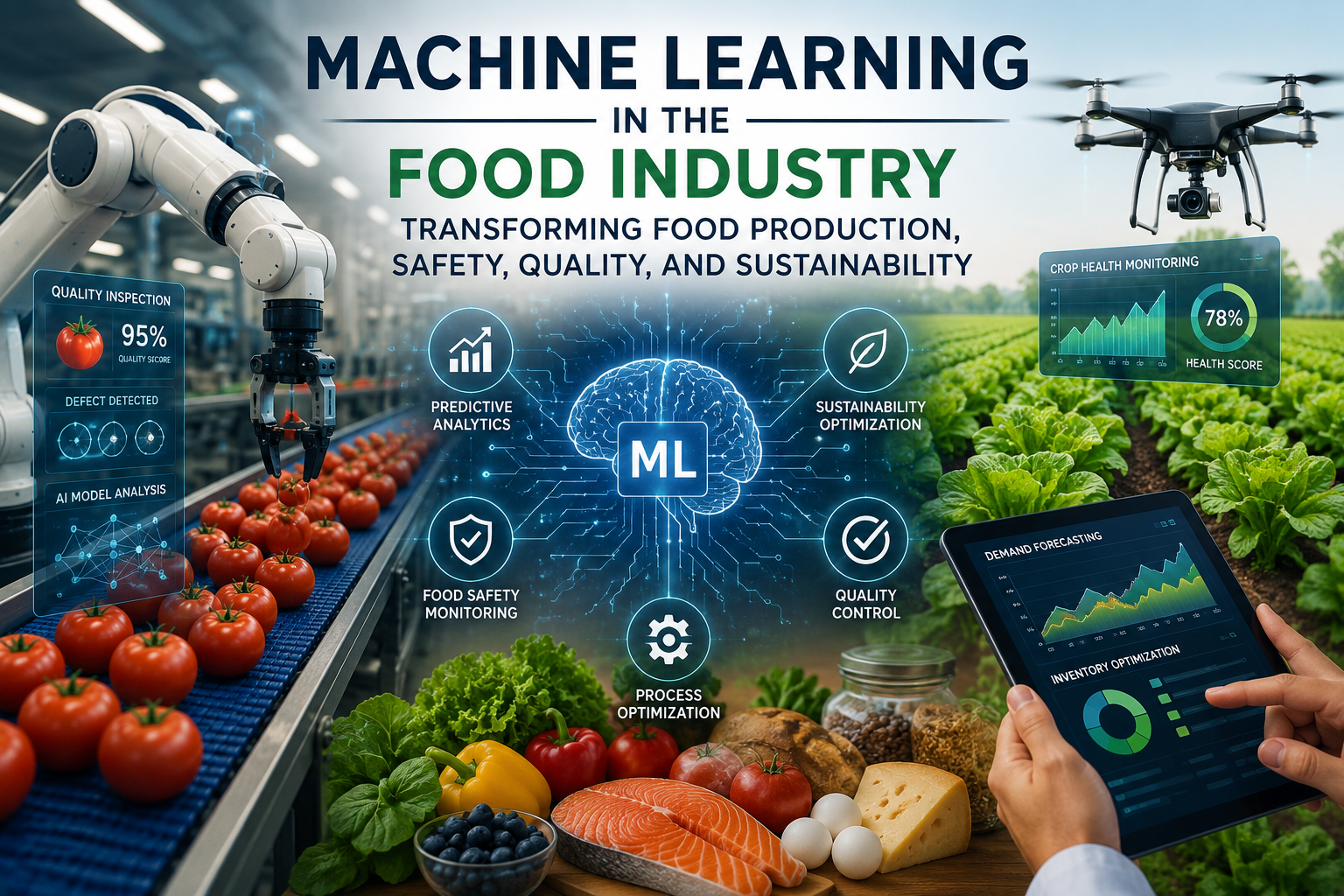
The global food industry is undergoing one of the most profound technological transformations since the Industrial Revolution. Increasing consumer expectations for safer foods, growing pressure to improve sustainability, increasingly complex supply chains, labor shortages, and the need for higher production efficiency have accelerated the adoption of digital technologies across the food system. Among these technologies, machine learning (ML) has emerged as one of the most influential drivers of innovation.
Machine learning enables computers to identify patterns within data, learn from experience, and make predictions or decisions with minimal explicit programming. Unlike traditional software that follows predefined rules, ML algorithms improve their performance as they process more data. When combined with advanced sensors, robotics, cloud computing, the Internet of Things (IoT), and digital twins, machine learning is creating intelligent food systems capable of continuously optimizing themselves.
Applications now span the entire food chain—from precision agriculture and livestock management to food processing, food safety, quality assurance, logistics, retail, and personalized nutrition. Machine learning models predict crop yields, identify plant diseases, optimize fermentation, detect food fraud, forecast shelf life, automate quality inspection, and strengthen food safety management systems.
This comprehensive guide explains the science behind machine learning, its major algorithms, applications across the food industry, industrial case studies, challenges, emerging technologies, and the future of intelligent food systems.
Introduction
The modern food industry generates enormous volumes of data every day. Farms collect satellite imagery, drones monitor crop health, factories record temperatures and pressures every second, laboratories sequence microbial genomes, warehouses track inventory in real time, and retailers analyze millions of purchasing decisions.
Historically, much of this data remained underutilized. Traditional statistical approaches often struggled to analyze highly complex, high-dimensional datasets containing nonlinear relationships and interactions. Machine learning overcomes these limitations by discovering hidden patterns and continuously improving predictions as additional data become available.
As part of the broader Industry 4.0 movement, machine learning is becoming central to intelligent food manufacturing. Food scientists, engineers, microbiologists, chemists, nutritionists, and data scientists increasingly collaborate to build predictive models that improve efficiency while strengthening food safety and sustainability.
Artificial Intelligence, Machine Learning, and Deep Learning
These terms are often used interchangeably, but they describe different concepts.
| Technology | Description | Food Industry Example |
|---|---|---|
| Artificial Intelligence (AI) | Broad field focused on creating intelligent systems | AI-powered production planning |
| Machine Learning (ML) | Subset of AI where algorithms learn from data | Shelf-life prediction |
| Deep Learning (DL) | Subset of ML using multi-layer neural networks | Automated defect detection from food images |
Think of AI as the umbrella discipline, machine learning as one branch of AI, and deep learning as a specialized branch of machine learning.
Fundamentals of Machine Learning
Supervised Learning
Supervised learning uses labeled datasets where the correct output is already known.
Common applications include:
- Food classification
- Quality grading
- Shelf-life prediction
- Disease diagnosis
- Yield prediction
Examples of supervised algorithms:
- Linear Regression
- Logistic Regression
- Random Forest
- Support Vector Machines (SVM)
- Gradient Boosting
- Artificial Neural Networks
Unsupervised Learning
These algorithms identify hidden patterns without predefined labels.
Applications include:
- Customer segmentation
- Food metabolomics
- Food authentication
- Fermentation profiling
- Contamination pattern analysis
Common algorithms include:
- K-Means Clustering
- Hierarchical Clustering
- Principal Component Analysis (PCA)
- t-SNE
- UMAP
Semi-Supervised Learning
Semi-supervised learning combines small amounts of labeled data with much larger unlabeled datasets.
This approach is increasingly valuable for food safety because obtaining labeled microbiological datasets is often expensive and time-consuming.
Reinforcement Learning
Reinforcement learning allows systems to improve through trial-and-error interactions.
Potential food industry applications include:
- Robotic harvesting
- Autonomous processing equipment
- Dynamic process optimization
- Smart warehouse logistics
Deep Learning
Deep learning employs multi-layer neural networks capable of learning highly complex patterns.
Applications include:
- Computer vision
- Speech recognition
- Robotics
- Food image analysis
- Automated inspection
Major Machine Learning Algorithms Used in Food Science
Linear Regression
Linear regression predicts continuous outcomes such as moisture content, protein concentration, or shelf life. It is simple, interpretable, and widely used for baseline predictive models.
Logistic Regression
Logistic regression predicts categorical outcomes, such as whether a food sample passes or fails microbiological specifications.
Decision Trees
Decision trees create simple rule-based models that are easy to interpret and useful for quality classification and hazard analysis.
Random Forest
Random Forest combines many decision trees to improve prediction accuracy while reducing overfitting.
Food applications include:
- Food fraud detection
- Quality grading
- Shelf-life prediction
- Crop disease diagnosis
Support Vector Machines (SVM)
SVMs perform exceptionally well for high-dimensional datasets such as spectroscopy, metabolomics, and food authentication.
Artificial Neural Networks (ANN)
ANNs imitate the structure of biological neurons and are widely used for:
- Fermentation optimization
- Drying process control
- Product quality prediction
- Moisture estimation
Convolutional Neural Networks (CNN)
CNNs specialize in image recognition.
Applications include:
- Fruit grading
- Vegetable sorting
- Meat marbling assessment
- Fish freshness evaluation
- Bakery inspection
- Foreign object detection
Recurrent Neural Networks (RNN) and LSTM
These algorithms analyze sequential data.
Applications include:
- Temperature monitoring
- Sensor data analysis
- Shelf-life forecasting
- Fermentation dynamics
Gradient Boosting and XGBoost
These algorithms achieve excellent predictive performance for complex industrial datasets.
Typical applications include:
- Food quality prediction
- Consumer behavior analysis
- Supply chain optimization
Explainable AI (XAI)
Food manufacturers increasingly require transparent AI systems capable of explaining why decisions were made.
Explainable AI improves:
- Regulatory acceptance
- Consumer confidence
- Model validation
- Scientific interpretation
Machine Learning Across the Food System
Precision Agriculture
Machine learning supports:
- Yield prediction
- Precision irrigation
- Fertilizer optimization
- Weed identification
- Pest forecasting
- Plant disease diagnosis
- Soil health assessment
- Weather forecasting integration
Satellite imagery, drones, multispectral cameras, and IoT sensors generate data that enable farmers to make informed decisions while reducing resource use.
Livestock and Aquaculture
ML applications include:
- Animal health monitoring
- Feeding optimization
- Disease detection
- Behavior analysis
- Milk yield prediction
- Fish growth monitoring
- Water quality management
Wearable sensors and computer vision systems enable continuous monitoring with minimal human intervention.
Food Manufacturing
Modern production facilities increasingly rely on ML for:
- Predictive maintenance
- Process optimization
- Energy management
- Automated process control
- Production scheduling
- Digital twin integration
- Equipment failure prediction
These applications reduce downtime and improve operational efficiency.
Food Safety
Machine learning enhances food safety by supporting:
Predictive Microbiology
ML predicts microbial growth under different environmental conditions, improving shelf-life estimation and process validation.
Environmental Monitoring
Algorithms identify contamination trends using environmental swab data.
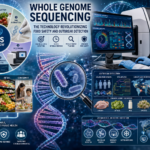
Whole Genome Sequencing
ML assists in analyzing large genomic datasets to improve outbreak investigations and source attribution.
HACCP Optimization
Predictive analytics identify critical control points with the highest risk of failure.
Recall Prevention
Historical production data help predict conditions associated with recalls before they occur.
Computer Vision
Computer vision is among the fastest-growing ML applications.
Examples include:
- Apple defect detection
- Tomato maturity assessment
- Coffee bean grading
- Grain quality inspection
- Poultry carcass evaluation
- Seafood freshness assessment
- Foreign material detection
- Packaging inspection
Modern systems inspect thousands of products per minute with high consistency.
Food Chemistry
Machine learning analyzes complex analytical datasets generated by:
- Near-infrared spectroscopy (NIR)
- Fourier-transform infrared spectroscopy (FTIR)
- Raman spectroscopy
- LC-MS
- GC-MS
- NMR spectroscopy
Applications include:
- Food authentication
- Adulteration detection
- Metabolomics
- Nutritional profiling
- Chemical contamination detection
Fermentation Technology
ML models optimize:
- Starter culture performance
- Fermentation time
- Product consistency
- Flavor development
- Probiotic viability
- Bioprocess control
These approaches improve both efficiency and product quality.
Personalized Nutrition
Machine learning integrates dietary records, wearable devices, health indicators, microbiome data, and metabolic profiles to support individualized dietary recommendations.
Future nutrition platforms may recommend foods tailored to an individual’s physiology, health goals, and lifestyle.
Supply Chain Optimization
Applications include:
- Demand forecasting
- Inventory management
- Cold-chain optimization
- Route optimization
- Warehouse automation
- Food waste reduction
- Blockchain-enhanced traceability
Sustainability
Machine learning contributes to sustainability by optimizing:
- Water use
- Energy consumption
- Carbon footprint
- Fertilizer application
- Packaging efficiency
- Waste valorization
- Circular economy initiatives
Integration with Emerging Technologies
Machine learning rarely operates in isolation. It is increasingly integrated with complementary technologies.
Digital Twins
Virtual manufacturing models continuously learn from production data to optimize processing conditions.
Internet of Things (IoT)
Smart sensors provide real-time operational data for ML models.
Robotics
Collaborative robots (cobots) use ML to improve harvesting, packaging, palletizing, and quality inspection.
Food Metabolomics
ML identifies metabolic signatures associated with authenticity, spoilage, nutrition, and quality.
CRISPR and Biotechnology
ML accelerates gene target identification and supports crop improvement research.
3D Food Printing
Algorithms optimize ingredient formulations, print parameters, and nutritional customization.
Industrial Case Studies
Machine learning has already moved beyond research laboratories into commercial food production.
Precision Crop Management
ML-powered satellite imagery and drone systems help farmers identify nutrient deficiencies, water stress, and early disease symptoms before visible damage occurs, enabling targeted interventions.
Beverage Manufacturing
Machine learning models monitor fermentation kinetics, optimize ingredient dosing, and improve production consistency while reducing energy consumption.
Dairy Processing
Advanced analytics predict equipment maintenance needs, optimize pasteurization, monitor product quality, and support shelf-life estimation.
Automated Food Inspection
Computer vision systems equipped with deep learning inspect fruits, vegetables, meat, bakery products, and packaged foods at high speed, reducing reliance on manual inspection.
Challenges
Despite rapid progress, several challenges remain.
Data Quality
Machine learning models are only as reliable as the data used to train them.
Bias
Biased datasets can reduce model accuracy when applied to new products or environments.
Model Interpretability
Complex deep learning models may be difficult to explain, limiting regulatory confidence.
Cybersecurity
Connected food factories require robust protection against cyber threats.
Workforce Development
The food industry increasingly requires professionals skilled in food science, engineering, computer science, statistics, and AI.
Regulatory Considerations
Many regulatory agencies continue developing guidance on validating AI-supported decision-making in food production.
Current Research Trends
Active areas of investigation include:
- Explainable AI for food safety
- Federated learning for secure industrial collaboration
- Autonomous food factories
- Multi-omics data integration
- Climate-resilient agriculture
- AI-driven formulation of functional foods
- Intelligent packaging with embedded sensors
- Real-time contamination prediction
- Robotics guided by machine learning
- Foundation models for food image analysis
These developments are expected to expand the role of ML throughout the food system.
Future Outlook (2030–2040)
Over the next decade, machine learning is likely to become embedded in nearly every stage of food production.
Future intelligent food systems may include:
- Autonomous food factories that continuously optimize themselves
- AI-guided product formulation based on consumer preferences
- Fully integrated digital twins linked to real-time production data
- Precision agriculture using autonomous drones and robots
- Continuous pathogen surveillance combining ML and genomic sequencing
- Personalized nutrition recommendations informed by metabolomics and the gut microbiome
- Carbon-neutral manufacturing supported by predictive energy optimization
Rather than replacing food scientists, these systems will increasingly augment human expertise, enabling faster decisions and more resilient food production.
Conclusion
Machine learning has become one of the defining technologies of modern food science. By transforming vast amounts of agricultural, manufacturing, laboratory, and consumer data into actionable knowledge, ML is improving food safety, enhancing quality, reducing waste, supporting sustainability, and enabling personalized nutrition.
Its greatest value lies not in replacing established scientific methods but in strengthening them. When combined with microbiology, analytical chemistry, engineering, biotechnology, digital twins, robotics, and human expertise, machine learning provides a powerful framework for addressing many of the food system’s most pressing challenges.
As computing power, sensor technologies, and data availability continue to advance, machine learning will play an increasingly central role in building intelligent, efficient, and sustainable food systems capable of meeting the nutritional needs of a growing global population.
Key Takeaways
- Machine learning is a branch of artificial intelligence that learns from data to improve predictions and decision-making.
- Applications span precision agriculture, food manufacturing, food safety, quality assurance, logistics, personalized nutrition, and sustainability.
- Common algorithms include Random Forest, Support Vector Machines, Artificial Neural Networks, Convolutional Neural Networks, LSTM networks, and XGBoost.
- Machine learning is increasingly integrated with digital twins, IoT, robotics, metabolomics, computer vision, and genomic technologies.
- Data quality, explainability, workforce development, and regulatory validation remain important challenges.
- Machine learning is expected to become a foundational technology in next-generation smart food systems.
Glossary
Artificial Intelligence (AI): The broader field of developing systems that perform tasks requiring human-like intelligence.
Machine Learning (ML): A subset of AI in which algorithms learn from data to make predictions or decisions.
Deep Learning: A branch of ML that uses multi-layer neural networks to solve complex problems such as image recognition.
Computer Vision: AI techniques that enable computers to interpret and analyze images or videos.
Digital Twin: A continuously updated virtual model of a physical process, production line, or manufacturing facility.
Internet of Things (IoT): A network of connected sensors and devices that collect and exchange real-time data.
Random Forest: An ensemble machine learning algorithm that combines many decision trees to improve predictive performance.
Support Vector Machine (SVM): A supervised learning algorithm widely used for classification and regression tasks.
Convolutional Neural Network (CNN): A deep learning architecture designed for analyzing images and visual patterns.
Long Short-Term Memory (LSTM): A recurrent neural network architecture specialized for analyzing sequential or time-series data.
Explainable AI (XAI): Methods that make AI decisions more transparent and interpretable to humans.
References
- Jordan, M. I., & Mitchell, T. M. (2015). Machine learning: Trends, perspectives, and prospects. Science, 349(6245), 255–260. https://doi.org/10.1126/science.aaa8415
- LeCun, Y., Bengio, Y., & Hinton, G. (2015). Deep learning. Nature, 521, 436–444. https://doi.org/10.1038/nature14539
- Goodfellow, I., Bengio, Y., & Courville, A. (2016). Deep Learning. MIT Press.
- Erickson, B., Widmar, D. A., & Erbaugh, J. (2019). Precision agriculture and artificial intelligence. Computers and Electronics in Agriculture.
- Kamilaris, A., & Prenafeta-Boldú, F. X. (2018). Deep learning in agriculture: A survey. Computers and Electronics in Agriculture, 147, 70–90. https://doi.org/10.1016/j.compag.2018.02.016
- Misra, N. N., Dixit, Y., Al-Mallahi, A., Bhullar, M. S., Upadhyay, R., & Martynenko, A. (2022). IoT, AI, and smart food processing. Trends in Food Science & Technology, 120, 1–18.
- Cubero-Leon, E., Peñalver, R., & Maquet, A. (2014). Review on metabolomics for food authentication. Food Research International, 60, 95–107.
- Tao, F., Zhang, H., Liu, A., & Nee, A. Y. C. (2019). Digital Twin in Industry. IEEE Transactions on Industrial Informatics, 15(4), 2405–2415.
- McMeekin, T. A., Olley, J., Ratkowsky, D. A., & Ross, T. (2002). Predictive microbiology: Towards the interface and beyond. International Journal of Food Microbiology, 73(2–3), 395–407.
- Food and Agriculture Organization (FAO). Food Safety and Quality. https://www.fao.org/food-safety
- World Health Organization (WHO). Food Safety. https://www.who.int/health-topics/food-safety
- Codex Alimentarius Commission. General Principles of Food Hygiene. https://www.fao.org/fao-who-codexalimentarius/