
Summary
Modern food systems are becoming increasingly data-driven. Traditional analytical methods remain indispensable, but they often examine one characteristic of a food at a time—such as nutrient composition, microbial counts, or chemical contaminants. Today’s challenges, including climate change, food fraud, antimicrobial resistance, emerging pathogens, and personalized nutrition, require a more integrated understanding of food systems.
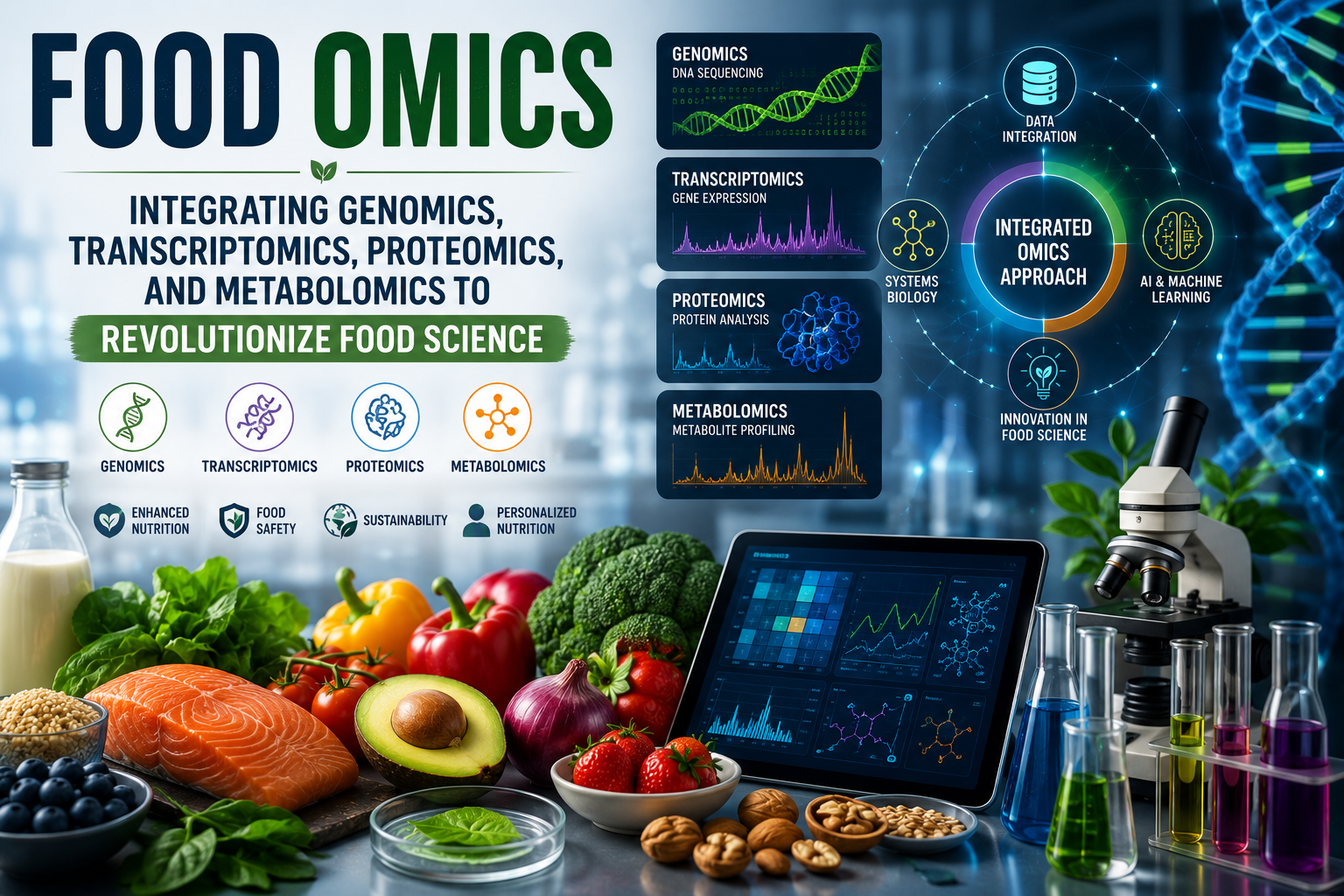
Food omics is a collective term describing a family of advanced molecular technologies that comprehensively analyze the genes, RNA molecules, proteins, metabolites, and microorganisms associated with foods. Together, these technologies provide an unprecedented understanding of food composition, quality, safety, traceability, nutrition, and biological function.
By integrating genomics, transcriptomics, proteomics, metabolomics, and microbiomics, scientists can investigate food systems from the molecular level to the consumer. Combined with artificial intelligence (AI), machine learning, bioinformatics, and high-performance computing, multi-omics is transforming agriculture, food manufacturing, food safety, and precision nutrition.
This article explores the principles of food omics, the major omics disciplines, analytical technologies, industrial applications, current research, challenges, and future opportunities for creating safer, healthier, and more sustainable food systems.
Introduction
Food is biologically complex. A single grain of wheat contains thousands of genes, proteins, enzymes, metabolites, microorganisms, and bioactive compounds that interact dynamically during growth, harvesting, processing, storage, and consumption.
Understanding these interactions has historically been difficult because traditional analytical methods focused on only a few molecules at a time. Advances in molecular biology, analytical chemistry, and computational science now allow researchers to study entire biological systems simultaneously.
These comprehensive approaches—collectively known as omics technologies—are reshaping food science by enabling scientists to identify molecular signatures associated with food quality, authenticity, spoilage, nutritional value, and safety.
What Is Food Omics?
Food omics refers to the comprehensive study of biological molecules within food systems using high-throughput analytical technologies.
Rather than studying individual components independently, omics examines complete biological datasets.
Major omics disciplines include:
- Genomics
- Transcriptomics
- Proteomics
- Metabolomics
- Microbiomics
- Epigenomics
- Lipidomics
- Glycomics
When combined, these approaches are known as multi-omics.
Genomics
Definition
Genomics studies the complete DNA sequence (genome) of organisms.
Applications in food science include:
- Crop improvement
- Livestock breeding
- Pathogen identification
- Food authenticity
- Whole Genome Sequencing (WGS)
- Biodiversity conservation
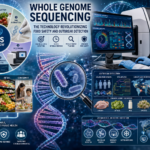
Whole genome sequencing has become a cornerstone of foodborne outbreak investigations, enabling high-resolution tracking of pathogens throughout the food chain.
Transcriptomics
Definition
Transcriptomics examines RNA molecules that are actively expressed by cells under specific conditions.
Applications include:
- Plant stress responses
- Food fermentation
- Crop disease resistance
- Food processing effects
- Environmental adaptation
Because gene expression changes rapidly in response to environmental conditions, transcriptomics provides insight into biological activity rather than genetic potential alone.
Proteomics
Definition
Proteomics investigates the complete collection of proteins produced within cells or foods.
Applications include:
- Allergen identification
- Enzyme characterization
- Food authentication
- Fermentation monitoring
- Protein functionality
- Meat quality assessment
Mass spectrometry has become one of the primary analytical tools supporting food proteomics.
Metabolomics
Definition
Metabolomics measures the small molecules (metabolites) produced during biological processes.
Applications include:
- Food quality evaluation
- Nutritional profiling
- Food authentication
- Shelf-life prediction
- Fermentation studies
- Biomarker discovery
Metabolites provide an integrated picture of biological activity and environmental influences.
Microbiomics
Definition
Microbiomics investigates microbial communities associated with foods, production environments, and the gastrointestinal tract.
Applications include:
- Fermented foods
- Food safety
- Shelf-life studies
- Probiotic development
- Environmental monitoring
- Gut microbiome research
Modern sequencing technologies have greatly expanded our understanding of microbial diversity in food systems.
Emerging Omics Disciplines
Additional specialized fields include:
Lipidomics
Analysis of fats and lipid metabolism.
Applications:
- Edible oils
- Dairy products
- Meat quality
- Nutritional research
Glycomics
Study of complex carbohydrates and glycans.
Applications:
- Functional foods
- Human milk oligosaccharides
- Food processing
- Microbial interactions
Epigenomics
Investigation of heritable changes in gene regulation that occur without altering DNA sequences.
Potential food applications include crop adaptation, nutritional programming, and stress tolerance.
Analytical Technologies
Food omics relies on advanced instrumentation.
DNA Sequencing
Applications include:
- Whole Genome Sequencing
- Metagenomics
- DNA barcoding
- Food authentication
Liquid Chromatography–Mass Spectrometry (LC-MS)
Used extensively for:
- Proteomics
- Metabolomics
- Lipidomics
Gas Chromatography–Mass Spectrometry (GC-MS)
Commonly used for:
- Aroma compounds
- Volatile metabolites
- Food authentication
Nuclear Magnetic Resonance (NMR)
Supports metabolite identification and structural characterization.
Bioinformatics
Specialized computational tools integrate and interpret massive omics datasets using statistical analysis, machine learning, and network biology.
Applications Across the Food System
Food Safety
Omics technologies support:
- Rapid pathogen detection
- Outbreak investigation
- Antimicrobial resistance surveillance
- Mycotoxin research
- Environmental monitoring
- Food fraud detection
Food Authentication
Multi-omics helps verify:
- Species identity
- Geographic origin
- Botanical origin
- Production systems
- Protected designation products
Precision Agriculture
Omics contributes to:
- Disease-resistant crops
- Stress-tolerant varieties
- Soil microbiome optimization
- Climate resilience
- Precision breeding
Food Processing
Scientists use omics to optimize:
- Fermentation
- Enzyme activity
- Flavor development
- Texture formation
- Shelf-life extension
Personalized Nutrition
By integrating food composition with human genomic and metabolic information, researchers aim to develop individualized dietary recommendations.
Multi-Omics Integration
No single omics discipline provides a complete understanding of food systems.
Multi-omics combines several datasets to answer complex biological questions.
For example, researchers may integrate:
- Genomics
- Transcriptomics
- Proteomics
- Metabolomics
- Microbiomics
This systems-level approach provides a more comprehensive understanding of food quality and biological function.
Artificial Intelligence and Omics
Modern omics generates enormous datasets requiring advanced computational analysis.
Artificial intelligence assists by:
- Detecting hidden molecular patterns
- Predicting food quality
- Identifying biomarkers
- Classifying food authenticity
- Supporting disease diagnostics
- Optimizing fermentation
- Accelerating breeding programs
Machine learning has become an essential partner in multi-omics research.
Industrial Applications
Food companies increasingly use omics for:
- Quality assurance
- Product innovation
- Starter culture development
- Ingredient authentication
- Functional food development
- Shelf-life optimization
- Contaminant surveillance
These applications improve efficiency while strengthening consumer confidence.
Challenges
Despite remarkable progress, several limitations remain.
High Costs
Advanced instrumentation and computational infrastructure require substantial investment.
Data Integration
Combining multiple omics datasets remains technically challenging.
Standardization
Analytical methods continue to evolve, requiring harmonized protocols across laboratories.
Data Interpretation
Large datasets require expertise in molecular biology, bioinformatics, statistics, and food science.
Regulatory Acceptance
International guidance for some emerging omics applications is still evolving.
Current Research
Scientists are actively investigating:
- AI-assisted multi-omics integration
- Climate-resilient crops
- Precision fermentation
- Functional foods
- Gut microbiome–nutrition interactions
- Food allergen biomarkers
- Sustainable protein production
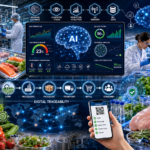
- Digital food traceability
- Omics-guided breeding
- Predictive food safety systems
Future Outlook
Food omics is expected to become increasingly integrated into digital food systems.
Future developments may include:
- Real-time molecular monitoring during food manufacturing
- Portable sequencing devices for food inspection
- AI-powered food quality prediction
- Digital twins incorporating multi-omics data
- Personalized diets informed by genomic and metabolomic profiles
- Autonomous laboratories performing continuous molecular surveillance
As analytical technologies become faster, more affordable, and increasingly automated, food omics will become a routine component of food production, regulation, and research.
Conclusion
Food omics represents a major scientific advancement in understanding the biological complexity of food systems. By integrating genomics, transcriptomics, proteomics, metabolomics, microbiomics, and computational biology, researchers can investigate food from the molecular level to the consumer.
These technologies are improving food safety, strengthening authenticity verification, advancing precision agriculture, enabling personalized nutrition, and accelerating sustainable food innovation. As artificial intelligence and multi-omics continue to converge, food scientists will gain unprecedented tools for solving some of the world’s greatest food security and public health challenges.
Key Takeaways
- Food omics integrates multiple molecular sciences to understand food systems comprehensively.
- Major omics disciplines include genomics, transcriptomics, proteomics, metabolomics, and microbiomics.
- Multi-omics provides systems-level understanding that surpasses individual analytical approaches.
- AI and bioinformatics are essential for analyzing complex omics datasets.
- Food omics is transforming food safety, authenticity, precision agriculture, nutrition, and biotechnology.
References
- Cevallos-Cevallos, J. M., Reyes-De-Corcuera, J. I., Etxeberria, E., Danyluk, M. D., & Rodrick, G. E. (2009). Metabolomic analysis in food science: A review. Trends in Food Science & Technology, 20(11–12), 557–566.
- Wishart, D. S. (2008). Metabolomics and food science. Trends in Food Science & Technology, 19(9), 482–493.
- López, M. G., et al. (2022). Multi-omics approaches in food science. Comprehensive Reviews in Food Science and Food Safety.
- Jordan, K., et al. (2020). Whole genome sequencing in food safety. Annual Review of Food Science and Technology.
- Food and Agriculture Organization (FAO). Food Safety and Quality. https://www.fao.org/food-safety
- World Health Organization (WHO). Food Safety. https://www.who.int/health-topics/food-safety
- European Food Safety Authority (EFSA). Scientific opinions on genomics and omics technologies in food and feed safety.
- Codex Alimentarius Commission. Food safety principles and risk analysis guidance.