
Summary
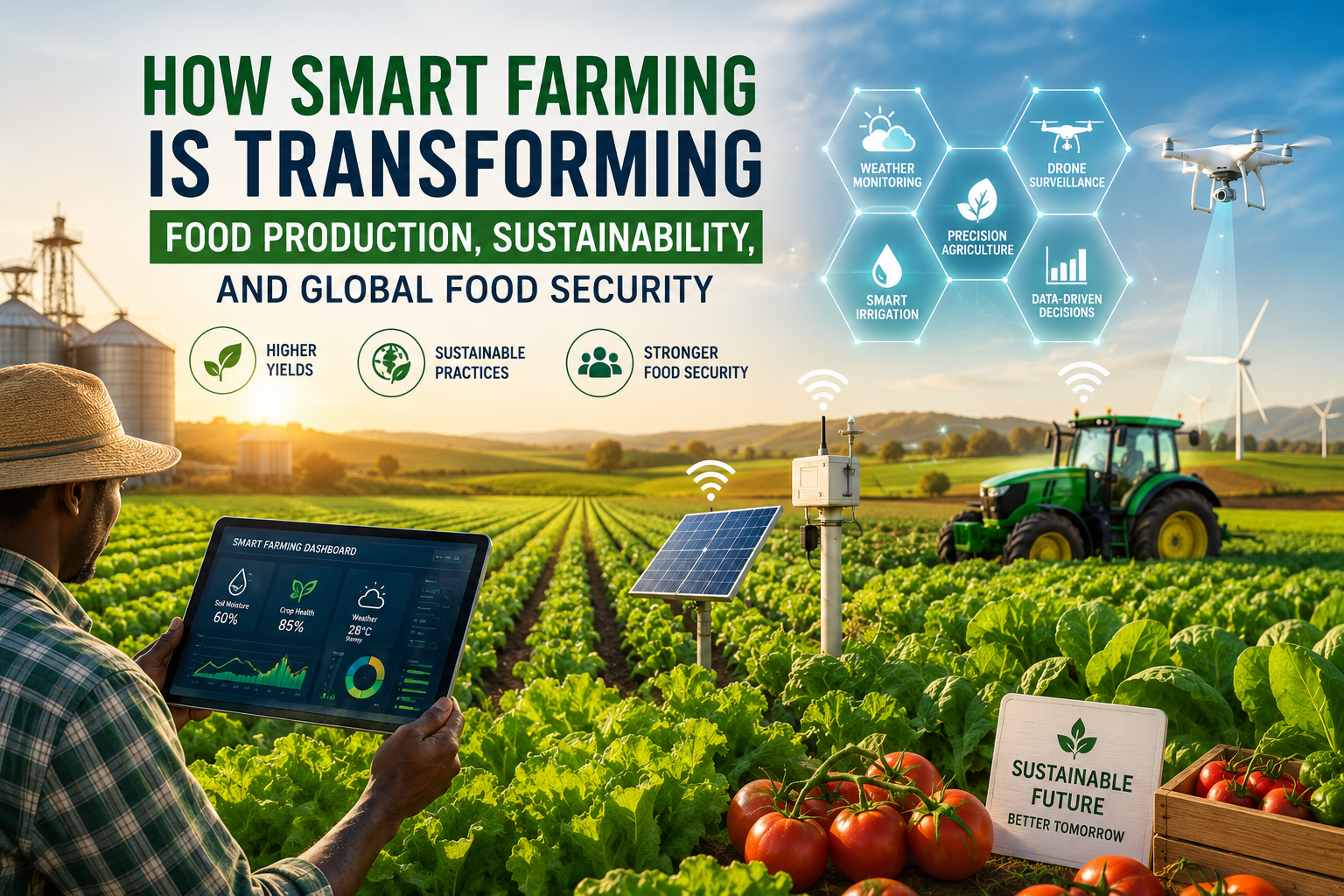
Agriculture is undergoing one of the most significant technological transformations in history. Population growth, climate change, land degradation, water scarcity, and increasing demand for safe, nutritious food are placing unprecedented pressure on food production systems. To meet these challenges, agriculture is becoming increasingly data-driven, interconnected, and intelligent through the adoption of precision agriculture.
Precision agriculture is a farm management approach that uses advanced technologies—including artificial intelligence (AI), machine learning, the Internet of Things (IoT), satellite imagery, drones, robotics, global positioning systems (GPS), geographic information systems (GIS), and advanced sensors—to monitor crop and livestock production with exceptional spatial and temporal precision. Instead of treating an entire farm uniformly, precision agriculture recognizes that variability exists within fields and seeks to manage each location according to its specific needs.
By applying the right input, at the right place, at the right time, and in the right quantity, precision agriculture improves productivity while reducing unnecessary use of fertilizers, pesticides, water, fuel, and labor. These technologies also support climate-smart agriculture by lowering greenhouse gas emissions, conserving natural resources, improving resilience to climate variability, and strengthening food security.
This article explores the scientific principles, technologies, applications, benefits, challenges, and future prospects of precision agriculture, highlighting its central role in building resilient and sustainable food systems.
Introduction
Agriculture has traditionally relied on farmer experience, visual observations, and generalized field management practices. While these approaches have supported food production for centuries, they often fail to account for significant variability in soil properties, moisture availability, crop health, pest pressure, and nutrient distribution within the same field.
Modern farms generate enormous amounts of information from weather stations, soil sensors, satellite imagery, drones, farm machinery, laboratory analyses, and historical production records. Precision agriculture transforms these diverse datasets into actionable insights, enabling farmers to make informed decisions based on evidence rather than assumptions.
Advances in digital technologies have accelerated this transformation. Artificial intelligence can analyze thousands of variables simultaneously, drones can inspect fields within minutes, autonomous tractors can apply fertilizers with centimeter-level accuracy, and smart irrigation systems can deliver water only where and when it is needed. Together, these innovations are reshaping agricultural production worldwide.
What Is Precision Agriculture?
Precision agriculture, also known as precision farming or site-specific crop management, is a management strategy that collects, processes, and analyzes data to optimize agricultural production while minimizing environmental impacts.
The fundamental principle is simple:
Apply the right input, in the right amount, at the right place, at the right time.
This approach contrasts with conventional farming, where fertilizers, pesticides, irrigation, and other inputs are often applied uniformly across entire fields despite substantial natural variability.
Core Technologies
Global Positioning System (GPS)
GPS provides accurate positioning for:
- Tractor guidance
- Variable-rate application
- Yield mapping
- Field boundary mapping
- Soil sampling
Modern systems achieve sub-meter and, with correction systems, even centimeter-level accuracy.
Geographic Information Systems (GIS)
GIS integrates multiple layers of spatial information, including:
- Soil type
- Elevation
- Crop history
- Drainage
- Pest occurrence
- Nutrient distribution
These maps help identify management zones within fields.
Remote Sensing
Remote sensing gathers information without direct contact using satellites, aircraft, and drones.
Common measurements include:
- Vegetation indices (e.g., NDVI)
- Plant vigor
- Water stress
- Canopy temperature
- Disease symptoms
Remote sensing enables rapid assessment of large agricultural areas.
Drones (Unmanned Aerial Vehicles)
Agricultural drones perform tasks such as:
- Crop scouting
- Disease detection
- Weed identification
- Plant counting
- Irrigation assessment
- Variable-rate spraying
High-resolution imagery allows early identification of problems before they become visible from the ground.
Internet of Things (IoT)
IoT networks connect sensors installed throughout farms to continuously monitor:
- Soil moisture
- Temperature
- Humidity
- Rainfall
- Leaf wetness
- Water quality
- Livestock activity
These data support real-time management decisions.
Artificial Intelligence and Machine Learning
Machine learning models analyze large agricultural datasets to predict:
- Crop yields
- Pest outbreaks
- Disease risk
- Nutrient deficiencies
- Irrigation requirements
- Harvest timing
AI also supports autonomous agricultural machinery and robotic harvesting systems.
Applications in Crop Production
Precision Nutrient Management
Variable-rate fertilizer application uses soil maps, crop sensors, and yield data to deliver nutrients only where needed.
Benefits include:
- Improved nutrient use efficiency
- Reduced fertilizer costs
- Lower environmental pollution
- Increased crop productivity
Precision Irrigation
Smart irrigation systems integrate weather forecasts, soil moisture sensors, and crop water demand models to optimize irrigation scheduling.
This improves water-use efficiency while reducing pumping costs and water losses.
Weed Management
Computer vision systems distinguish weeds from crops, allowing site-specific herbicide application or robotic weed removal.
Benefits include reduced herbicide use and slower development of herbicide resistance.
Disease Detection
AI-powered image analysis identifies early symptoms of fungal, bacterial, and viral diseases using drone or smartphone images.
Early detection improves control effectiveness while minimizing pesticide use.
Yield Prediction
Machine learning integrates weather, soil, crop, and historical yield data to forecast production before harvest.
These forecasts support farm planning, logistics, and market decisions.
Precision Livestock Farming
Precision agriculture extends beyond crop production.
Applications include:
- Wearable animal health sensors
- Automated feeding systems
- Milk yield monitoring
- Heat detection
- Disease surveillance
- Behavioral analysis
- Precision nutrition
Continuous monitoring improves animal welfare, productivity, and resource efficiency.
Food Safety Applications
Precision agriculture contributes to safer food production by:
- Monitoring irrigation water quality
- Reducing excessive pesticide applications
- Improving fertilizer management
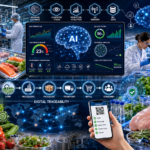
- Supporting traceability
- Detecting crop diseases earlier
- Monitoring environmental contamination
Digital records also strengthen farm-to-fork traceability.
Sustainability Benefits
Precision agriculture supports sustainable development by improving resource efficiency.
Water Conservation
Smart irrigation reduces unnecessary water use while maintaining crop productivity.
Reduced Chemical Inputs
Targeted pesticide and fertilizer application decreases environmental contamination.
Lower Greenhouse Gas Emissions
Efficient machinery operation and optimized nitrogen management reduce emissions associated with agricultural production.
Biodiversity Protection
Reducing unnecessary agrochemical applications helps protect beneficial insects, pollinators, and surrounding ecosystems.
Integration with Emerging Technologies
Precision agriculture increasingly integrates with:
Digital Twins
Virtual farm models simulate crop growth, irrigation, nutrient dynamics, and production scenarios.
Robotics
Autonomous tractors, robotic harvesters, and robotic weeders improve labor efficiency and precision.
Computer Vision
Image analysis supports crop monitoring, grading, harvesting, and quality assessment.
Blockchain
Digital traceability systems improve transparency across agricultural supply chains.
Climate Modeling
Weather prediction models help farmers anticipate droughts, floods, and disease-favorable conditions.
Challenges
Despite significant progress, precision agriculture faces several challenges.
High Initial Investment
Advanced equipment and digital infrastructure may be costly, particularly for smallholder farmers.
Data Management
Large datasets require secure storage, analysis, and interpretation.
Connectivity
Reliable internet access remains limited in many rural regions.
Skills Development
Successful implementation requires training in digital agriculture, data interpretation, and equipment management.
Interoperability
Equipment from different manufacturers may not always integrate seamlessly.
Current Research
Active research areas include:
- AI-guided autonomous farming
- Swarm robotics
- Satellite hyperspectral imaging
- Carbon-smart agriculture
- Soil microbiome monitoring
- Digital twins for crop systems
- Edge computing for on-farm analytics
- Climate-resilient decision support systems
Researchers are also integrating precision agriculture with genomics, metabolomics, and phenomics to accelerate crop improvement.
Future Outlook
Precision agriculture is expected to become increasingly autonomous over the next decade.
Future innovations may include:
- Fully autonomous tractors and harvesters
- AI-driven crop management platforms
- Real-time disease forecasting
- Intelligent irrigation networks
- Drone swarms for crop monitoring
- Carbon-credit verification through digital monitoring
- Farm-scale digital twins linked to satellite and sensor data
These developments will help agriculture produce more food using fewer resources while adapting to changing climatic conditions.
Conclusion
Precision agriculture represents a fundamental shift from generalized farming practices toward intelligent, data-driven management. By integrating artificial intelligence, remote sensing, robotics, IoT, and advanced analytics, farmers can optimize productivity while conserving water, reducing chemical inputs, protecting ecosystems, and strengthening food security.
As digital technologies continue to evolve, precision agriculture will become an increasingly important component of resilient and sustainable food systems. Its ability to combine scientific knowledge with real-time decision-making positions it as one of the most transformative innovations shaping the future of global agriculture.
Key Takeaways
- Precision agriculture uses digital technologies to optimize farming based on field-specific variability.
- GPS, GIS, drones, IoT sensors, AI, robotics, and satellite imagery are central technologies.
- Applications include precision irrigation, nutrient management, disease detection, yield prediction, and livestock monitoring.
- Precision agriculture improves productivity while reducing resource use and environmental impacts.
- Continued advances in AI, robotics, digital twins, and climate modeling will further accelerate the transition toward smart farming.
References
- Zhang, N., Wang, M., & Wang, N. (2002). Precision agriculture—A worldwide overview. Computers and Electronics in Agriculture, 36(2–3), 113–132. https://doi.org/10.1016/S0168-1699(02)00096-0
- Gebbers, R., & Adamchuk, V. I. (2010). Precision agriculture and food security. Science, 327(5967), 828–831. https://doi.org/10.1126/science.1183899
- Kamilaris, A., & Prenafeta-Boldú, F. X. (2018). Deep learning in agriculture: A survey. Computers and Electronics in Agriculture, 147, 70–90. https://doi.org/10.1016/j.compag.2018.02.016
- Food and Agriculture Organization (FAO). Digital Agriculture. https://www.fao.org
- World Bank. Precision Agriculture and Digital Farming. https://www.worldbank.org
- Wolfert, S., Ge, L., Verdouw, C., & Bogaardt, M. J. (2017). Big data in smart farming. Agricultural Systems, 153, 69–80. https://doi.org/10.1016/j.agsy.2017.01.023
- Liakos, K. G., Busato, P., Moshou, D., Pearson, S., & Bochtis, D. (2018). Machine learning in agriculture: A review. Sensors, 18(8), 2674. https://doi.org/10.3390/s18082674